Function
Growth factor that plays an essential role in the regulation of embryonic development, cell proliferation, cell migration, survival and chemotaxis. Potent mitogen for cells of mesenchymal origin. Required for normal proliferation and recruitment of pericytes and vascular smooth muscle cells in the central nervous system, skin, lung, heart and placenta.
Biological Context
Subcellular Location: Secreted
Tissue Specificity: Expressed at high levels in the heart, brain (sustantia nigra), placenta and fetal kidney. Expressed at moderate levels in the brain (hippocampus), skeletal muscle, kidney and lung
Disease Association: Basal ganglia calcification, idiopathic, 5 (IBGC5) : A form of basal ganglia calcification, an autosomal dominant condition characterized by symmetric calcification in the basal ganglia and other brain regions. Affected individuals can either be asymptomatic or show a wide spectrum of neuropsychiatric symptoms, including parkinsonism, dystonia, tremor, ataxia, dementia, psychosis, seizures, and chronic headache. Serum levels of calcium, phosphate, alkaline phosphatase and parathyroid hormone are normal. The neuropathological hallmark of the disease is vascular and pericapillary calcification, mainly of calcium phosphate, in the affected brain areas. [The disease is caused by variants affecting the gene represented in this entry] | [A chromosomal aberration involving PDGFB is found in dermatofibrosarcoma protuberans. Translocation t(17;22)(q22;q13) with PDGFB]
Product Specifications
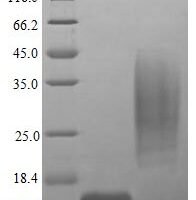
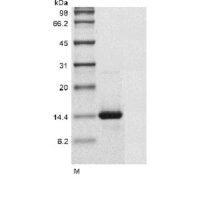
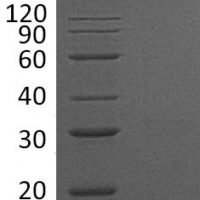
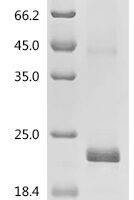
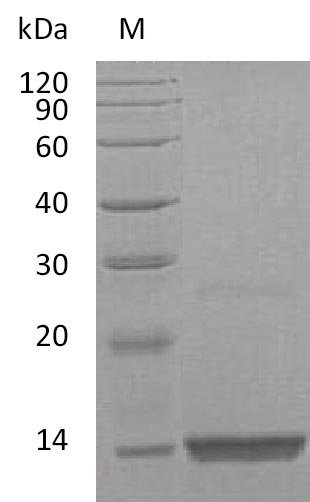
Recombinant Human Platelet-derived growth factor subunit B (PDGFB) (Active) is a recombinant protein from Homo sapiens (Human), expressed in E.coli, covering amino acids 82-190aa, with Tag-Free tag, molecular weight 12.42 kDa, purity Greater than 95% as determined by SDS-PAGE.. Suitable for ELISA and Western Blot applications. Explore more Growth Factor proteins →