
Recombinant Human Platelet factor 4 protein (PF4)

Recombinant Human Platelet factor 4 protein (PF4) — Chemokine released during platelet aggregation that plays a role in different biological processes including hematopoiesis, cell proliferation, differentiation, and activation. Purity >97%.

SKU: BCACP-000742 Category:
Product SKUBCACP-000742
Product DescriptionRecombinant Human Platelet factor 4 protein (PF4) protein is expressed from E.Coli with Tag-Free. It contains 32-101aa. [Accession | P02776].
Uniprot No.P02776
Gene NamesPF4
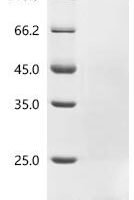
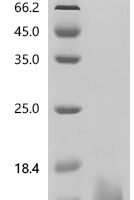
Purity>97% as determined by SDS-PAGE.
Expression SystemE.Coli
Expression Region32-101aa
SpeciesHomo sapiens (Human)
Tag InfoTag-Free
Molecular weight7.8 kDa
ActivityFully biologically active when compared to standard. The biological activity determined by a chemotaxis bioassay using human neutrophils is in a concentration range of 10-50 ng/ml.
BufferLyophilized from a 0.2 μm filtered 20 mM Tris-HCl, 0.5 M NaCl, 6% Trehalose, pH 8.0
StorageStore at -20°C/-80°C upon receipt, aliquoting is necessary for mutiple use. Avoid repeated freeze-thaw cycles.
Alternative NamesC-X-C motif chemokine 4; Chemokine (C X C motif) ligand 4; Chemokine (CXC motif) ligand 4; chemokine ligand 4; CXCL 4; CXCL4; Iroplact; MGC138298; Oncostatin A; Oncostatin-A; OncostatinA; PF 4; PF-4; PF4; Pf4a; Platelet factor 4; PLF4_HUMAN; SCYB 4; SCYB4; short form; Small inducible cytokine subfamily B; Small inducible cytokine subfamily member 4

Function

Chemokine released during platelet aggregation that plays a role in different biological processes including hematopoiesis, cell proliferation, differentiation, and activation. Acts via different functional receptors including CCR1, CXCR3A or CXCR3B. Upon interaction with CXCR3A receptor, induces activated T-lymphocytes migration mediated via downstream Ras/extracellular signal-regulated kinase (ERK) signaling.

Biological Context

Subcellular Location: Secreted

Product Specifications

Recombinant Human Platelet factor 4 protein (PF4) is a recombinant protein from Homo sapiens (Human), expressed in E.Coli, covering amino acids 32-101aa, with Tag-Free tag, molecular weight 7.8 kDa, purity >97% as determined by SDS-PAGE.. Suitable for ELISA and Western Blot applications.
Recommended applications depend on the target, product format, and product-specific validation data. Refer to the product datasheet or Certificate of Analysis (CoA), or contact BioCrest Sci for application guidance.

Biological Activity: Fully biologically active when compared to standard. The biological activity determined by a chemotaxis bioassay using human neutrophils is in a concentration range of 10-50 ng/ml.

Storage: Store at -20°C/-80°C upon receipt, aliquoting is necessary for mutiple use. Avoid repeated freeze-thaw cycles.

Shipping & Lead Time: Availability, shipping conditions, and estimated lead time are confirmed in the formal quotation or order confirmation based on the product format, destination, and order requirements.

Protein Biology

Function

Chemokine released during platelet aggregation that plays a role in different biological processes including hematopoiesis, cell proliferation, differentiation, and activation (PubMed:29930254, PubMed:9531587). Acts via different functional receptors including CCR1, CXCR3A or CXCR3B (PubMed:18174362, PubMed:29930254). Upon interaction with CXCR3A receptor, induces activated T-lymphocytes migration mediated via downstream Ras/extracellular signal-regulated kinase (ERK) signaling (PubMed:18174362, PubMed:24469069). Neutralizes the anticoagulant effect of heparin by binding more strongly to heparin than to the chondroitin-4-sulfate chains of the carrier molecule. Plays a role in the inhibition of hematopoiesis and in the maintenance of hematopoietic stem cell (HSC) quiescence (PubMed:9531587). Chemotactic for neutrophils and monocytes via CCR1 (PubMed:29930254). Inhibits endothelial cell proliferation. In cooperation with toll-like receptor 8/TLR8, induces chromatin remodeling and activates inflammatory gene expression via the TBK1-IRF5 axis (PubMed:35701499). In addition, induces myofibroblast differentiation and collagen synthesis in different precursor cells, including endothelial cells, by stimulating endothelial-to-mesenchymal transition (PubMed:34986347). Interacts with thrombomodulin/THBD to enhance the activation of protein C and thus potentiates its anticoagulant activity (PubMed:9395524)

Subcellular Location

Secreted

Subunit

Homotetramer (PubMed:7547867, PubMed:8031770). Interacts with TNFAIP6 (via Link domain) (PubMed:27044744). Interacts with CCR1 (PubMed:29930254). Interacts with CXCR3 (PubMed:18174362). Interacts with THBD; this interaction enhances generation of activated protein C (PubMed:9395524)

Gene: PF4  |  Organism: Homo sapiens  |  Synonyms: C-X-C motif chemokine 4; Iroplact; Oncostatin-A
Key Publications

Frequently Asked Questions

How do I order or inquire about this product?

Submit the Online Inquiry form with your required quantity and specifications, or email sales@biocrestsci.com. Available sizes, pricing, stock status, documentation, and estimated lead time are confirmed in the formal quotation.

What is the shipping and delivery time?

Availability, dispatch timing, shipping conditions, and delivery estimates depend on the product format, destination, and order requirements. These details are confirmed in the formal quotation or order confirmation.

How should this product be stored?

Follow the storage and handling instructions in the product-specific datasheet and Certificate of Analysis (CoA). Requirements may vary by product form and formulation; contact BioCrest Sci if product-specific guidance is needed.

What quality controls are performed on your products?

Quality-control data such as identity, purity, endotoxin level, or biological activity are provided only when specified on this product page, the datasheet, or Certificate of Analysis (CoA). Biological activity is not implied unless explicitly stated.

Shopping Cart
Scroll to Top