Recombinant Human Poly (A)-specific ribonuclease PARN (PARN)

Recombinant Human Poly (A)-specific ribonuclease PARN (PARN) — 3′-exoribonuclease that has a preference for poly(A) tails of mRNAs, thereby efficiently degrading poly(A) tails. Purity >90%.

SKU: BCRECP-001328 Category:

Product Specifications

Product SkuBCRECP-001328
Product DescriptionRecombinant Human Poly (A)-specific ribonuclease PARN (PARN) Protein is expressed from E.coli with N-terminal 6xHis-tagged. It contains 1-639aa. [Accession | O95453].
Uniprot No.O95453
Gene NamesPARN
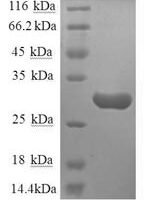
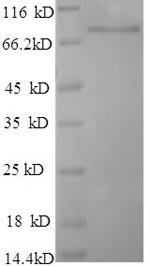
PurityGreater than 90% as determined by SDS-PAGE.
Expression SystemE.coli
Expression Region1-639aa
SpeciesHomo sapiens (Human)
Tag InfoN-terminal 6xHis-tagged
Molecular weight77.5kDa
ActivityPlease contact us to obtain bioactivity data.
BufferIf the delivery form is liquid, the default storage buffer is Tris/PBS-based buffer, 5%-50% glycerol. If the delivery form is lyophilized powder, the buffer before lyophilization is Tris/PBS-based buffer, 6% Trehalose.
StorageStore at -20°C/-80°C upon receipt, aliquoting is necessary for mutiple use. Avoid repeated freeze-thaw cycles.
Research AreasTranscription

Function

3'-exoribonuclease that has a preference for poly(A) tails of mRNAs, thereby efficiently degrading poly(A) tails. Exonucleolytic degradation of the poly(A) tail is often the first step in the decay of eukaryotic mRNAs and is also used to silence certain maternal mRNAs translationally during oocyte maturation and early embryonic development. Interacts with both the 3'-end poly(A) tail and the 5'-end cap structure during degradation, the interaction with the cap structure being required for an efficient degradation of poly(A) tails.

Biological Context

Subcellular Location: Nucleus; Cytoplasm; Nucleus, nucleolus
Tissue Specificity: Ubiquitous
Disease Association: Dyskeratosis congenita, autosomal recessive, 6 (DKCB6) : A form of dyskeratosis congenita, a rare multisystem disorder caused by defective telomere maintenance. It is characterized by progressive bone marrow failure, and the clinical triad of reticulated skin hyperpigmentation, nail dystrophy, and mucosal leukoplakia. Common but variable features include premature graying, aplastic anemia, low platelets, osteoporosis, pulmonary fibrosis, and liver fibrosis among others. Early mortality is often associated with bone marrow failure, infections, fatal pulmonary complications, or malignancy. [The disease is caused by variants affecting the gene represented in this entry] | Pulmonary fibrosis, and/or bone marrow failure syndrome, telomere-related, 4 (PFBMFT4) : An autosomal dominant disease associated with shortened telomeres. Pulmonary fibrosis is the most common manifestation. Other manifestations include aplastic anemia due to bone marrow failure, hepatic fibrosis, and increased cancer risk, particularly myelodysplastic syndrome and acute myeloid leukemia. Phenotype, age at onset, and severity are determined by telomere length. [The disease is caused by variants affecting the gene represented in this entry]

Product Specifications

Recombinant Human Poly (A)-specific ribonuclease PARN (PARN) is a recombinant protein from Homo sapiens (Human), expressed in E.coli, covering amino acids 1-639aa, with N-terminal 6xHis-tagged tag, molecular weight 77.5kDa, purity Greater than 90% as determined by SDS-PAGE.. Suitable for ELISA and Western Blot applications.
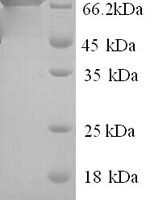
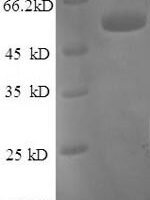
SDS-PAGE: Single band at expected molecular weight confirming purity.

ELISA: Suitable as coating antigen or detection standard.

Western Blot: Compatible with standard Western Blot protocols.

Protein Interaction: Validated for SPR (Surface Plasmon Resonance) and BLI (Bio-Layer Interferometry) studies.

Shipping: Shipped at ambient temperature. Lyophilized protein is stable during transit.

Storage: Store lyophilized protein at -20°C to -80°C. Reconstituted protein should be aliquoted and stored at -80°C. Avoid repeated freeze-thaw cycles.

Shelf Life: 12 months from date of receipt when stored as recommended.

Shipping Time: Orders placed before 2 PM EST ship same day. International orders typically deliver within 5-10 business days.

Protein Biology

Function

3'-exoribonuclease that has a preference for poly(A) tails of mRNAs, thereby efficiently degrading poly(A) tails. Exonucleolytic degradation of the poly(A) tail is often the first step in the decay of eukaryotic mRNAs and is also used to silence certain maternal mRNAs translationally during oocyte maturation and early embryonic development. Interacts with both the 3'-end poly(A) tail and the 5'-end cap structure during degradation, the interaction with the cap structure being required for an efficient degradation of poly(A) tails. Involved in nonsense-mediated mRNA decay, a critical process of selective degradation of mRNAs that contain premature stop codons. Also involved in degradation of inherently unstable mRNAs that contain AU-rich elements (AREs) in their 3'-UTR, possibly via its interaction with KHSRP. Probably mediates the removal of poly(A) tails of AREs mRNAs, which constitutes the first step of destabilization (PubMed:10882133, PubMed:11359775, PubMed:12748283, PubMed:15175153, PubMed:9736620). Also able to recognize and trim poly(A) tails of microRNAs such as MIR21 and H/ACA box snoRNAs (small nucleolar RNAs) leading to microRNAs degradation or snoRNA increased stability (PubMed:22442037, PubMed:25049417)

Subcellular Location

Nucleus; Cytoplasm; Nucleus, nucleolus

Disease Association

Dyskeratosis congenita, autosomal recessive, 6 (DKCB6) : A form of dyskeratosis congenita, a rare multisystem disorder caused by defective telomere maintenance. It is characterized by progressive bone marrow failure, and the clinical triad of reticulated skin hyperpigmentation, nail dystrophy, and mucosal leukoplakia. Common but variable features include premature graying, aplastic anemia, low platelets, osteoporosis, pulmonary fibrosis, and liver fibrosis among others. Early mortality is often associated with bone marrow failure, infections, fatal pulmonary complications, or malignancy. [The disease is caused by variants affecting the gene represented in this entry] | Pulmonary fibrosis, and/or bone marrow failure syndrome, telomere-related, 4 (PFBMFT4) : An autosomal dominant disease associated with shortened telomeres. Pulmonary fibrosis is the most common manifestation. Other manifestations include aplastic anemia due to bone marrow failure, hepatic fibrosis, and increased cancer risk, particularly myelodysplastic syndrome and acute myeloid leukemia. Phenotype, age at onset, and severity are determined by telomere length. [The disease is caused by variants affecting the gene represented in this entry]

Tissue Specificity

Ubiquitous

Subunit

Homodimer (PubMed:10801819, PubMed:16281054). Found in a mRNA decay complex with RENT1, RENT2 and RENT3B (PubMed:14527413). Interacts with KHSRP (PubMed:15175153). Interacts with CELF1/CUGBP1 (PubMed:16601207). Interacts with ZC3HAV1 in an RNA-independent manner (PubMed:21876179). Interacts with DHX36 (PubMed:14731398)

Gene: PARN  |  Organism: Homo sapiens  |  Synonyms: Deadenylating nuclease; Deadenylation nuclease; Polyadenylate-specific ribonuclease
Key Publications

Frequently Asked Questions

How do I order or inquire about this product?

Fill out the Online Inquiry form with your required quantity and specifications. You can also email sales@biocrestsci.com. Our team typically responds within 4 business hours with a quote and availability confirmation.

What is the shipping and delivery time?

Orders placed before 2 PM EST ship the same day. Domestic (US) delivery typically takes 2-3 business days. International orders deliver within 5-10 business days. All products are shipped at ambient temperature with appropriate packaging to ensure stability.

How should I store this recombinant protein?

Lyophilized proteins should be stored at -20°C to -80°C upon receipt. After reconstitution, aliquot and store at -80°C. Avoid repeated freeze-thaw cycles. Shelf life is 12 months from date of receipt when stored as recommended.

What quality controls are performed on your products?

Each product undergoes SDS-PAGE purity analysis (typically >85-95%), endotoxin testing, and bioactivity validation. Products are validated for ELISA, Western Blot, and SPR/BLI applications as specified on this product page. A Certificate of Analysis (CoA) is available upon request.

Shopping Cart
Scroll to Top