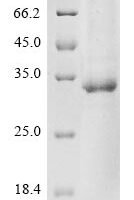
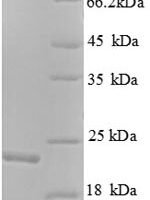
Recombinant Human Poly [ADP-ribose] polymerase 9 (PARP9), partial

Recombinant Human Poly [ADP-ribose] polymerase 9 (PARP9), partial — ADP-ribosyltransferase which, in association with E3 ligase DTX3L, plays a role in DNA damage repair and in immune responses including interferon-mediated antiviral defenses. Purity >90%.

SKU: BCRECP-001344 Category:

Product Specifications

Product SkuBCRECP-001344
Product DescriptionRecombinant Human Poly [ADP-ribose] polymerase 9 (PARP9) Protein is expressed from E.coli with N-terminal 6xHis-tagged. It contains 628-854aa. [Accession | Q8IXQ6].
Uniprot No.Q8IXQ6
Gene NamesPARP9
PurityGreater than 90% as determined by SDS-PAGE.
Expression SystemE.coli
Expression Region628-854aa
SpeciesHomo sapiens (Human)
Tag InfoN-terminal 6xHis-tagged
Molecular weight30.0kDa
ActivityPlease contact us to obtain bioactivity data.
BufferIf the delivery form is liquid, the default storage buffer is Tris/PBS-based buffer, 5%-50% glycerol. If the delivery form is lyophilized powder, the buffer before lyophilization is Tris/PBS-based buffer, 6% Trehalose.
StorageStore at -20°C/-80°C upon receipt, aliquoting is necessary for mutiple use. Avoid repeated freeze-thaw cycles.
Research AreasCancer

Function

ADP-ribosyltransferase which, in association with E3 ligase DTX3L, plays a role in DNA damage repair and in immune responses including interferon-mediated antiviral defenses. Within the complex, enhances DTX3L E3 ligase activity which is further enhanced by PARP9 binding to poly(ADP-ribose). In association with DTX3L and in presence of E1 and E2 enzymes, mediates NAD(+)-dependent mono-ADP-ribosylation of ubiquitin which prevents ubiquitin conjugation to substrates such as histones.

Biological Context

Subcellular Location: Cytoplasm, cytosol; Nucleus
Tissue Specificity: Expressed in lymphocyte-rich tissues, spleen, lymph nodes, peripheral blood lymphocytes and colonic mucosa. Expressed in macrophages. Also expressed in nonhematopoietic tissues such as heart and skeletal muscle. Isoform 2 is the predominant form. Most abundantly expressed in lymphomas with a brisk host inflammatory response. In diffuse large B-cell lymphomas tumors, expressed specifically by malignant B-cells
Disease Association: [Overexpressed at significantly higher levels in fatal high-risk diffuse large B-cell lymphomas (DLB-CL) compared to cured low-risk tumors. Overexpression in B-cell lymphoma transfectants may promote malignant B-cell migration. May therefore be involved in promoting B-cell migration and dissemination of high-risk DLB-CL tumors ]

Product Specifications

Recombinant Human Poly [ADP-ribose] polymerase 9 (PARP9), partial is a recombinant protein from Homo sapiens (Human), expressed in E.coli, covering amino acids 628-854aa, with N-terminal 6xHis-tagged tag, molecular weight 30.0kDa, purity Greater than 90% as determined by SDS-PAGE.. Suitable for ELISA and Western Blot applications.
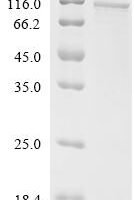
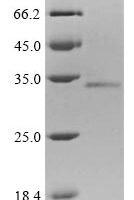
Recommended applications depend on the target, product format, and product-specific validation data. Refer to the product datasheet or Certificate of Analysis (CoA), or contact BioCrest Sci for application guidance.

Biological Activity: Please contact us to obtain bioactivity data.

Storage: Store at -20°C/-80°C upon receipt, aliquoting is necessary for mutiple use. Avoid repeated freeze-thaw cycles.

Shipping & Lead Time: Availability, shipping conditions, and estimated lead time are confirmed in the formal quotation or order confirmation based on the product format, destination, and order requirements.

Protein Biology

Function

ADP-ribosyltransferase which, in association with E3 ligase DTX3L, plays a role in DNA damage repair and in immune responses including interferon-mediated antiviral defenses (PubMed:16809771, PubMed:23230272, PubMed:26479788, PubMed:27796300). Within the complex, enhances DTX3L E3 ligase activity which is further enhanced by PARP9 binding to poly(ADP-ribose) (PubMed:28525742). In association with DTX3L and in presence of E1 and E2 enzymes, mediates NAD(+)-dependent mono-ADP-ribosylation of ubiquitin which prevents ubiquitin conjugation to substrates such as histones (PubMed:28525742). During DNA repair, PARP1 recruits PARP9/BAL1-DTX3L complex to DNA damage sites via PARP9 binding to ribosylated PARP1 (PubMed:23230272). Subsequent PARP1-dependent PARP9/BAL1-DTX3L-mediated ubiquitination promotes the rapid and specific recruitment of 53BP1/TP53BP1, UIMC1/RAP80, and BRCA1 to DNA damage sites (PubMed:23230272, PubMed:28525742). In response to DNA damage, PARP9-DTX3L complex is required for efficient non-homologous end joining (NHEJ); the complex function is negatively modulated by PARP9 activity (PubMed:28525742). Dispensable for B-cell receptor (BCR) assembly through V(D)J recombination and class switch recombination (CSR) (By similarity). In macrophages, positively regulates pro-inflammatory cytokines production in response to IFNG stimulation by suppressing PARP14-mediated STAT1 ADP-ribosylation and thus promoting STAT1 phosphorylation (PubMed:27796300). Also suppresses PARP14-mediated STAT6 ADP-ribosylation (PubMed:27796300)

Subcellular Location

Cytoplasm, cytosol; Nucleus

Disease Association

[Overexpressed at significantly higher levels in fatal high-risk diffuse large B-cell lymphomas (DLB-CL) compared to cured low-risk tumors. Overexpression in B-cell lymphoma transfectants may promote malignant B-cell migration. May therefore be involved in promoting B-cell migration and dissemination of high-risk DLB-CL tumors (PubMed:11110709)]

Tissue Specificity

Expressed in lymphocyte-rich tissues, spleen, lymph nodes, peripheral blood lymphocytes and colonic mucosa (PubMed:11110709, PubMed:16809771). Expressed in macrophages (PubMed:27796300). Also expressed in nonhematopoietic tissues such as heart and skeletal muscle (PubMed:11110709, PubMed:16809771). Isoform 2 is the predominant form (PubMed:11110709). Most abundantly expressed in lymphomas with a brisk host inflammatory response (PubMed:11110709, PubMed:16809771). In diffuse large B-cell lymphomas tumors, expressed specifically by malignant B-cells (PubMed:11110709, PubMed:16809771)

Subunit

Forms a stable complex with E3 ligase DTX3L; the interaction is required for PARP9 mediated ADP-ribosylation of ubiquitin (PubMed:12670957, PubMed:28525742). Interacts (via PARP catalytic domain) with DTX3L (via N-terminus) (PubMed:26479788). Forms a complex with STAT1 and DTX3L independently of IFNB1 or IFNG-mediated STAT1 'Tyr-701' phosphorylation (PubMed:26479788). Forms a complex with STAT1, DTX3L and histone H2B H2BC9/H2BJ; the interaction is likely to induce H2BC9/H2BJ ubiquitination (PubMed:26479788). Interacts (via N-terminus) with STAT1 (PubMed:26479788). Interacts with PARP14 in IFNG-stimulated macrophages; the interaction prevents PARP14-mediated STAT1 and STAT6 ADP-riboslylation (PubMed:27796300). Interacts with PARP1 (when poly-ADP-ribosylated) (PubMed:23230272)

Gene: PARP9  |  Organism: Homo sapiens  |  Synonyms: ADP-ribosyltransferase diphtheria toxin-like 9; B aggressive lymphoma protein; Poly [ADP-ribose] polymerase 9
Key Publications

Frequently Asked Questions

How do I order or inquire about this product?

Submit the Online Inquiry form with your required quantity and specifications, or email sales@biocrestsci.com. Available sizes, pricing, stock status, documentation, and estimated lead time are confirmed in the formal quotation.

What is the shipping and delivery time?

Availability, dispatch timing, shipping conditions, and delivery estimates depend on the product format, destination, and order requirements. These details are confirmed in the formal quotation or order confirmation.

How should this product be stored?

Follow the storage and handling instructions in the product-specific datasheet and Certificate of Analysis (CoA). Requirements may vary by product form and formulation; contact BioCrest Sci if product-specific guidance is needed.

What quality controls are performed on your products?

Quality-control data such as identity, purity, endotoxin level, or biological activity are provided only when specified on this product page, the datasheet, or Certificate of Analysis (CoA). Biological activity is not implied unless explicitly stated.

Shopping Cart
Scroll to Top