Recombinant Human Potassium voltage-gated channel subfamily A member 1 (KCNA1), partial

Recombinant Human Potassium voltage-gated channel subfamily A member 1 (KCNA1), partial — Voltage-gated potassium channel that mediates transmembrane potassium transport in excitable membranes, primarily in the brain and the central nervous system, but also in the kidney. Purity >90%.

SKU: BCRECP-000994 Category:

Product Specifications

Product SkuBCRECP-000994
Product DescriptionRecombinant Human Potassium voltage-gated channel subfamily A member 1 (KCNA1) Protein is expressed from E.coli with N-terminal 6xHis-tagged. It contains 1-154aa. [Accession | Q09470].
Uniprot No.Q09470
Gene NamesKCNA1
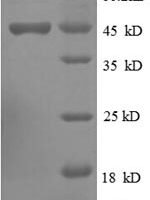
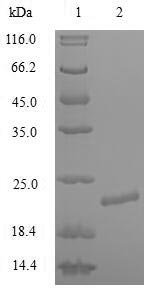
PurityGreater than 90% as determined by SDS-PAGE.
Expression SystemE.coli
Expression Region1-154aa
SpeciesHomo sapiens (Human)
Tag InfoN-terminal 6xHis-tagged
Molecular weight22.2kDa
ActivityPlease contact us to obtain bioactivity data.
BufferIf the delivery form is liquid, the default storage buffer is Tris/PBS-based buffer, 5%-50% glycerol. If the delivery form is lyophilized powder, the buffer before lyophilization is Tris/PBS-based buffer, 6% Trehalose.
StorageStore at -20°C/-80°C upon receipt, aliquoting is necessary for mutiple use. Avoid repeated freeze-thaw cycles.
Research AreasNeuroscience

Function

Voltage-gated potassium channel that mediates transmembrane potassium transport in excitable membranes, primarily in the brain and the central nervous system, but also in the kidney. Contributes to the regulation of the membrane potential and nerve signaling, and prevents neuronal hyperexcitability. Forms tetrameric potassium-selective channels through which potassium ions pass in accordance with their electrochemical gradient.

Biological Context

Subcellular Location: Cell membrane (Multi-pass membrane protein); Membrane; Cell projection, axon; Cytoplasmic vesicle; Perikaryon; Endoplasmic reticulum; Cell projection, dendrite; Cell junction; Synapse; Presynaptic cell membrane; Presynapse
Tissue Specificity: Detected adjacent to nodes of Ranvier in juxtaparanodal zones in spinal cord nerve fibers, but also in paranodal regions in some myelinated spinal cord axons (at protein level). Detected in the islet of Langerhans
Disease Association: Episodic ataxia 1 (EA1) : An autosomal dominant disorder characterized by brief episodes of ataxia and dysarthria. Neurological examination during and between the attacks demonstrates spontaneous, repetitive discharges in the distal musculature (myokymia) that arise from peripheral nerve. Nystagmus is absent. [The disease is caused by variants affecting the gene represented in this entry] | Myokymia isolated 1 (MK1) : A condition characterized by spontaneous involuntary contraction of muscle fiber groups that can be observed as vermiform movement of the overlying skin. Electromyography typically shows continuous motor unit activity with spontaneous oligo- and multiplet-discharges of high intraburst frequency (myokymic discharges). Isolated spontaneous muscle twitches occur in many persons and have no grave significance. [The disease is caused by variants affecting the gene represented in this entry]

Product Specifications

Recombinant Human Potassium voltage-gated channel subfamily A member 1 (KCNA1), partial is a recombinant protein from Homo sapiens (Human), expressed in E.coli, covering amino acids 1-154aa, with N-terminal 6xHis-tagged tag, molecular weight 22.2kDa, purity Greater than 90% as determined by SDS-PAGE.. Suitable for ELISA and Western Blot applications.
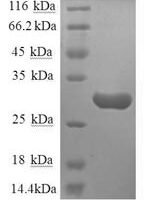
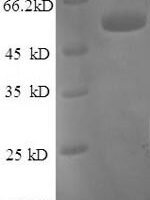
SDS-PAGE: Single band at expected molecular weight confirming purity.

ELISA: Suitable as coating antigen or detection standard.

Western Blot: Compatible with standard Western Blot protocols.

Protein Interaction: Validated for SPR (Surface Plasmon Resonance) and BLI (Bio-Layer Interferometry) studies.

Shipping: Shipped at ambient temperature. Lyophilized protein is stable during transit.

Storage: Store lyophilized protein at -20°C to -80°C. Reconstituted protein should be aliquoted and stored at -80°C. Avoid repeated freeze-thaw cycles.

Shelf Life: 12 months from date of receipt when stored as recommended.

Shipping Time: Orders placed before 2 PM EST ship same day. International orders typically deliver within 5-10 business days.

Protein Biology

Function

Voltage-gated potassium channel that mediates transmembrane potassium transport in excitable membranes, primarily in the brain and the central nervous system, but also in the kidney (PubMed:19903818, PubMed:8845167). Contributes to the regulation of the membrane potential and nerve signaling, and prevents neuronal hyperexcitability (PubMed:17156368). Forms tetrameric potassium-selective channels through which potassium ions pass in accordance with their electrochemical gradient. The channel alternates between opened and closed conformations in response to the voltage difference across the membrane (PubMed:19912772). Can form functional homotetrameric channels and heterotetrameric channels that contain variable proportions of KCNA1, KCNA2, KCNA4, KCNA5, KCNA6, KCNA7, and possibly other family members as well; channel properties depend on the type of alpha subunits that are part of the channel (PubMed:12077175, PubMed:17156368). Channel properties are modulated by cytoplasmic beta subunits that regulate the subcellular location of the alpha subunits and promote rapid inactivation of delayed rectifier potassium channels (PubMed:12077175, PubMed:17156368). In vivo, membranes probably contain a mixture of heteromeric potassium channel complexes, making it difficult to assign currents observed in intact tissues to any particular potassium channel family member. Homotetrameric KCNA1 forms a delayed-rectifier potassium channel that opens in response to membrane depolarization, followed by slow spontaneous channel closure (PubMed:19307729, PubMed:19903818, PubMed:19912772, PubMed:19968958). In contrast, a heterotetrameric channel formed by KCNA1 and KCNA4 shows rapid inactivation (PubMed:17156368). Regulates neuronal excitability in hippocampus, especially in mossy fibers and medial perforant path axons, preventing neuronal hyperexcitability. Response to toxins that are selective for KCNA1, respectively for KCNA2, suggests that heteromeric potassium channels composed of both KCNA1 and KCNA2 play a role in pacemaking and regulate the output of deep cerebellar nuclear neurons (By similarity). May function as down-stream effector for G protein-coupled receptors and inhibit GABAergic inputs to basolateral amygdala neurons (By similarity). May contribute to the regulation of neurotransmitter release, such as gamma-aminobutyric acid (GABA) release (By similarity). Plays a role in regulating the generation of action potentials and preventing hyperexcitability in myelinated axons of the vagus nerve, and thereby contributes to the regulation of heart contraction (By similarity). Required for normal neuromuscular responses (PubMed:11026449, PubMed:17136396). Regulates the frequency of neuronal action potential firing in response to mechanical stimuli, and plays a role in the perception of pain caused by mechanical stimuli, but does not play a role in the perception of pain due to heat stimuli (By similarity). Required for normal responses to auditory stimuli and precise location of sound sources, but not for sound perception (By similarity). The use of toxins that block specific channels suggest that it contributes to the regulation of the axonal release of the neurotransmitter dopamine (By similarity). Required for normal postnatal brain development and normal proliferation of neuronal precursor cells in the brain (By similarity). Plays a role in the reabsorption of Mg(2+) in the distal convoluted tubules in the kidney and in magnesium ion homeostasis, probably via its effect on the membrane potential (PubMed:19307729, PubMed:23903368)

Subcellular Location

Cell membrane (Multi-pass membrane protein); Membrane; Cell projection, axon; Cytoplasmic vesicle; Perikaryon; Endoplasmic reticulum; Cell projection, dendrite; Cell junction; Synapse; Presynaptic cell membrane; Presynapse

Disease Association

Episodic ataxia 1 (EA1) : An autosomal dominant disorder characterized by brief episodes of ataxia and dysarthria. Neurological examination during and between the attacks demonstrates spontaneous, repetitive discharges in the distal musculature (myokymia) that arise from peripheral nerve. Nystagmus is absent. [The disease is caused by variants affecting the gene represented in this entry] | Myokymia isolated 1 (MK1) : A condition characterized by spontaneous involuntary contraction of muscle fiber groups that can be observed as vermiform movement of the overlying skin. Electromyography typically shows continuous motor unit activity with spontaneous oligo- and multiplet-discharges of high intraburst frequency (myokymic discharges). Isolated spontaneous muscle twitches occur in many persons and have no grave significance. [The disease is caused by variants affecting the gene represented in this entry]

Tissue Specificity

Detected adjacent to nodes of Ranvier in juxtaparanodal zones in spinal cord nerve fibers, but also in paranodal regions in some myelinated spinal cord axons (at protein level) (PubMed:11086297). Detected in the islet of Langerhans (PubMed:21483673)

Subunit

Homotetramer and heterotetramer with other channel-forming alpha subunits, such as KCNA2, KCNA4, KCNA5, KCNA6 and KCNA7 (PubMed:12077175, PubMed:17156368). Channel activity is regulated by interaction with the beta subunits KCNAB1 and KCNAB2 (PubMed:12077175, PubMed:17156368). Identified in a complex with KCNA2 and KCNAB2 (PubMed:11086297). Interacts (via C-terminus) with the PDZ domains of DLG1, DLG2 and DLG4 (By similarity). Interacts with LGI1 within a complex containing LGI1, KCNA4 and KCNAB1 (By similarity). Interacts (via N-terminus) with STX1A; this promotes channel inactivation (By similarity). Interacts (via N-terminus) with the heterodimer formed by GNB1 and GNG2; this promotes channel inactivation (By similarity). Can interact simultaneously with STX1A and the heterodimer formed by GNB1 and GNG2 (By similarity). Interacts (via cytoplasmic N-terminal domain) with KCNRG; this inhibits channel activity (PubMed:19968958). Interacts with ANK3; this inhibits channel activity (PubMed:23903368). Interacts with ADAM11 (By similarity)

Gene: KCNA1  |  Organism: Homo sapiens  |  Synonyms: Voltage-gated K(+) channel HuKI; Voltage-gated potassium channel HBK1; Voltage-gated potassium channel subunit Kv1.1
Key Publications

Frequently Asked Questions

How do I order or inquire about this product?

Fill out the Online Inquiry form with your required quantity and specifications. You can also email sales@biocrestsci.com. Our team typically responds within 4 business hours with a quote and availability confirmation.

What is the shipping and delivery time?

Orders placed before 2 PM EST ship the same day. Domestic (US) delivery typically takes 2-3 business days. International orders deliver within 5-10 business days. All products are shipped at ambient temperature with appropriate packaging to ensure stability.

How should I store this recombinant protein?

Lyophilized proteins should be stored at -20°C to -80°C upon receipt. After reconstitution, aliquot and store at -80°C. Avoid repeated freeze-thaw cycles. Shelf life is 12 months from date of receipt when stored as recommended.

What quality controls are performed on your products?

Each product undergoes SDS-PAGE purity analysis (typically >85-95%), endotoxin testing, and bioactivity validation. Products are validated for ELISA, Western Blot, and SPR/BLI applications as specified on this product page. A Certificate of Analysis (CoA) is available upon request.

Shopping Cart
Scroll to Top