, ,

Recombinant Human Receptor-interacting serine/threonine-protein kinase 2 (RIPK2)

Recombinant Human Receptor-interacting serine/threonine-protein kinase 2 (RIPK2) — Serine/threonine/tyrosine-protein kinase that plays an essential role in modulation of innate and adaptive immune responses. Purity >90%.

SKU: BCRECP-001539 Categories: , ,

Product Specifications

Product SkuBCRECP-001539
Product DescriptionRecombinant Human Receptor-interacting serine/threonine-protein kinase 2 (RIPK2) Protein is expressed from E.coli with N-terminal 6xHis-tagged. It contains 1-540aa. [Accession | O43353].
Uniprot No.O43353
Gene NamesRIPK2
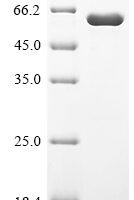
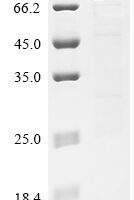
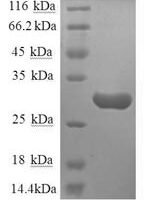
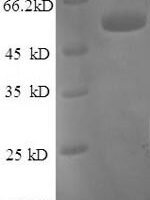
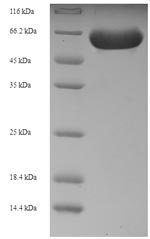
PurityGreater than 90% as determined by SDS-PAGE.
Expression SystemE.coli
Expression Region1-540aa
SpeciesHomo sapiens (Human)
Tag InfoN-terminal 6xHis-tagged
Molecular weight65.2kDa
ActivityPlease contact us to obtain bioactivity data.
BufferIf the delivery form is liquid, the default storage buffer is Tris/PBS-based buffer, 5%-50% glycerol. If the delivery form is lyophilized powder, the buffer before lyophilization is Tris/PBS-based buffer, 6% Trehalose.
StorageStore at -20°C/-80°C upon receipt, aliquoting is necessary for mutiple use. Avoid repeated freeze-thaw cycles.
Research AreasImmunology

Function

Serine/threonine/tyrosine-protein kinase that plays an essential role in modulation of innate and adaptive immune responses. Acts as a key effector of NOD1 and NOD2 signaling pathways: upon activation by bacterial peptidoglycans, NOD1 and NOD2 oligomerize and recruit RIPK2 via CARD-CARD domains, leading to the formation of RIPK2 filaments.

Product Specifications

Recombinant Human Receptor-interacting serine/threonine-protein kinase 2 (RIPK2) — Serine/threonine/tyrosine-protein kinase that plays an essential role in modulation of innate and adaptive immune responses. Purity >90%. Suitable for ELISA and Western Blot applications.

Recommended applications depend on the target, product format, and product-specific validation data. Refer to the product datasheet or Certificate of Analysis (CoA), or contact BioCrest Sci for application guidance.

Biological Activity: Please contact us to obtain bioactivity data.

Storage: Store at -20°C/-80°C upon receipt, aliquoting is necessary for mutiple use. Avoid repeated freeze-thaw cycles.

Shipping & Lead Time: Availability, shipping conditions, and estimated lead time are confirmed in the formal quotation or order confirmation based on the product format, destination, and order requirements.

Protein Biology

Function

Serine/threonine/tyrosine-protein kinase that plays an essential role in modulation of innate and adaptive immune responses (PubMed:14638696, PubMed:17054981, PubMed:21123652, PubMed:28656966, PubMed:9575181, PubMed:9642260). Acts as a key effector of NOD1 and NOD2 signaling pathways: upon activation by bacterial peptidoglycans, NOD1 and NOD2 oligomerize and recruit RIPK2 via CARD-CARD domains, leading to the formation of RIPK2 filaments (PubMed:17054981, PubMed:17562858, PubMed:21123652, PubMed:22607974, PubMed:28656966, PubMed:29452636, PubMed:30026309). Once recruited, RIPK2 autophosphorylates and undergoes 'Lys-63'-linked polyubiquitination by E3 ubiquitin ligases XIAP, BIRC2 and BIRC3, as well as 'Met-1'-linked (linear) polyubiquitination by the LUBAC complex, becoming a scaffolding protein for downstream effectors (PubMed:22607974, PubMed:28545134, PubMed:29452636, PubMed:30026309, PubMed:30279485, PubMed:30478312). 'Met-1'-linked polyubiquitin chains attached to RIPK2 recruit IKBKG/NEMO, which undergoes 'Lys-63'-linked polyubiquitination in a RIPK2-dependent process (PubMed:17562858, PubMed:22607974, PubMed:29452636, PubMed:30026309). 'Lys-63'-linked polyubiquitin chains attached to RIPK2 serve as docking sites for TAB2 and TAB3 and mediate the recruitment of MAP3K7/TAK1 to IKBKG/NEMO, inducing subsequent activation of IKBKB/IKKB (PubMed:18079694). In turn, NF-kappa-B is released from NF-kappa-B inhibitors and translocates into the nucleus where it activates the transcription of hundreds of genes involved in immune response, growth control, or protection against apoptosis (PubMed:18079694). The protein kinase activity is dispensable for the NOD1 and NOD2 signaling pathways (PubMed:29452636, PubMed:30026309). Contributes to the tyrosine phosphorylation of the guanine exchange factor ARHGEF2 through Src tyrosine kinase leading to NF-kappa-B activation by NOD2 (PubMed:21887730). Also involved in adaptive immunity: plays a role during engagement of the T-cell receptor (TCR) in promoting BCL10 phosphorylation and subsequent NF-kappa-B activation (PubMed:14638696). Plays a role in the inactivation of RHOA in response to NGFR signaling (PubMed:26646181)

Subcellular Location

Cytoplasm; Cell membrane (Peripheral membrane protein); Endoplasmic reticulum

Tissue Specificity

Detected in heart, brain, placenta, lung, peripheral blood leukocytes, spleen, kidney, testis, prostate, pancreas and lymph node

Subunit

Interacts (via CARD domain) with NOD2 (via CARD domain) (PubMed:15044951, PubMed:17355968, PubMed:19592251, PubMed:21887730, PubMed:27812135, PubMed:30279485, PubMed:30478312). Interacts (via CARD domain) with NOD1 (via CARD domain) (PubMed:17054981, PubMed:30478312). Homooligomer; following interaction with NOD1 or NOD2, homooligomerizes via its CARD domain and forms long filaments named RIPosomes (PubMed:30279485, PubMed:30478312). Found in a signaling complex consisting of at least ARHGEF2, NOD2 and RIPK2 (PubMed:21887730). Interacts with ARHGEF2; the interaction mediates tyrosine phosphorylation of RIPK2 by Src kinase CSK (PubMed:21887730). Interacts with MAP3K4; this interaction sequesters RIPK2 from the NOD2 signaling pathway (PubMed:18775659). Interacts with IKBKG/NEMO (PubMed:18079694). The polyubiquitinated protein interacts with MAP3K7/TAK1; interaction is indirect and is mediated by TAB2 and TAB3 that bind to polyubiquitin chains attached to RIPK2 (PubMed:18079694). Binds to CFLAR/CLARP and CASP1 via their CARD domains (PubMed:9575181). Binds to BIRC3/c-IAP1 and BIRC2/c-IAP2, TRAF1, TRAF2, TRAF5 and TRAF6 (PubMed:21931591). Interacts with NLRP10 (PubMed:22672233). Interacts with CARD9 (By similarity). Interacts with INAVA; the interaction takes place upon PRR stimulation (PubMed:28436939). Interacts (via CARD domain) with NGFR (via death domain) (PubMed:26646181). Interacts with IRGM; promoting RIPK2 degradation (PubMed:36221902)

Gene: RIPK2  |  Organism: Homo sapiens  |  Synonyms: CARD-containing interleukin-1 beta-converting enzyme-associated kinase; RIP-like-interacting CLARP kinase; Receptor-interacting protein 2; Tyrosine-protein kinase RIPK2
Key Publications

Frequently Asked Questions

How do I order or inquire about this product?

Submit the Online Inquiry form with your required quantity and specifications, or email sales@biocrestsci.com. Available sizes, pricing, stock status, documentation, and estimated lead time are confirmed in the formal quotation.

What is the shipping and delivery time?

Availability, dispatch timing, shipping conditions, and delivery estimates depend on the product format, destination, and order requirements. These details are confirmed in the formal quotation or order confirmation.

How should this product be stored?

Follow the storage and handling instructions in the product-specific datasheet and Certificate of Analysis (CoA). Requirements may vary by product form and formulation; contact BioCrest Sci if product-specific guidance is needed.

What quality controls are performed on your products?

Quality-control data such as identity, purity, endotoxin level, or biological activity are provided only when specified on this product page, the datasheet, or Certificate of Analysis (CoA). Biological activity is not implied unless explicitly stated.

Shopping Cart
Scroll to Top