Recombinant Human Renin receptor (ATP6AP2)

Recombinant Human Renin receptor (ATP6AP2) — Multifunctional protein which functions as a renin, prorenin cellular receptor and is involved in the assembly of the lysosomal proton-transporting V-type ATPase (V-ATPase) and the acidification of… Purity >90%.

SKU: BCRECP-000135 Category:

Product Specifications

Product SkuBCRECP-000135
Product DescriptionRecombinant Human Renin receptor (ATP6AP2) Protein is expressed from E.coli with N-terminal 6xHis-SUMO-tagged. It contains 17-350aa. [Accession | O75787].
Uniprot No.O75787
Gene NamesATP6AP2
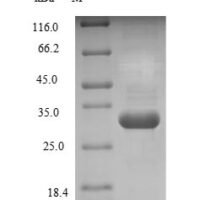
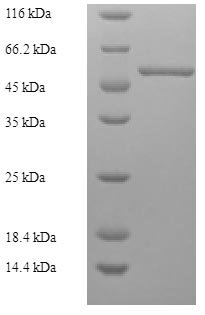
PurityGreater than 90% as determined by SDS-PAGE.
Expression SystemE.coli
Expression Region17-350aa
SpeciesHomo sapiens (Human)
Tag InfoN-terminal 6xHis-SUMO-tagged
Molecular weight53.5kDa
ActivityPlease contact us to obtain bioactivity data.
BufferIf the delivery form is liquid, the default storage buffer is Tris/PBS-based buffer, 5%-50% glycerol. If the delivery form is lyophilized powder, the buffer before lyophilization is Tris/PBS-based buffer, 6% Trehalose.
StorageStore at -20°C/-80°C upon receipt, aliquoting is necessary for mutiple use. Avoid repeated freeze-thaw cycles.
Research AreasSignal Transduction

Function

Multifunctional protein which functions as a renin, prorenin cellular receptor and is involved in the assembly of the lysosomal proton-transporting V-type ATPase (V-ATPase) and the acidification of the endo-lysosomal system. May mediate renin-dependent cellular responses by activating ERK1 and ERK2. By increasing the catalytic efficiency of renin in AGT/angiotensinogen conversion to angiotensin I, may also play a role in the renin-angiotensin system (RAS).

Biological Context

Subcellular Location: Endoplasmic reticulum membrane (Single-pass type I membrane protein); Lysosome membrane (Single-pass type I membrane protein); Cytoplasmic vesicle, autophagosome membrane (Single-pass type I membrane protein); Cell projection, dendritic spine membrane (Single-pass type I membrane protein); Cell projection, axon; Endosome membrane (Single-pass type I membrane protein); Cytoplasmic vesicle, clathrin-coated vesicle membrane (Single-pass type I membrane protein); Cytoplasmic vesicle, secretory vesicle, synaptic vesicle membrane (Single-pass type I membrane protein)
Tissue Specificity: Expressed in brain, heart, placenta, liver, kidney and pancreas. Barely detectable in lung and skeletal muscles. In the kidney cortex it is restricted to the mesangium of glomeruli. In the coronary and kidney artery it is expressed in the subendothelium, associated to smooth muscles where it colocalizes with REN. Expressed in vascular structures and by syncytiotrophoblast cells in the mature fetal placenta
Disease Association: Intellectual developmental disorder, X-linked, syndromic, Hedera type (MRXSH) : A disorder characterized by significantly below average general intellectual functioning associated with impairments in adaptive behavior and manifested during the developmental period. MRXSH patients manifest mild to moderate intellectual disability associated with epilepsy, delays in motor milestones and speech acquisition in infancy. [The disease is caused by variants affecting the gene represented in this entry] | Parkinsonism with spasticity, X-linked (XPDS) : A syndrome characterized by parkinsonian features, such as cogwheel rigidity, resting tremor and bradykinesia, and variably penetrant spasticity. [The disease is caused by variants affecting the gene represented in this entry] | Congenital disorder of glycosylation 2R (CDG2R) : A form of congenital disorder of glycosylation, a genetically heterogeneous group of multisystem disorders caused by a defect in glycoprotein biosynthesis and characterized by under-glycosylated serum glycoproteins. Congenital disorders of glycosylation result in a wide variety of clinical features, such as defects in the nervous system development, psychomotor retardation, dysmorphic features, hypotonia, coagulation disorders, and immunodeficiency. The broad spectrum of features reflects the critical role of N-glycoproteins during embryonic development, differentiation, and maintenance of cell functions. CDG2R is an X-linked recessive disorder characterized by infantile onset of liver failure, recurrent infections due to hypogammaglobulinemia, and cutis laxa. Some patients may also have mild intellectual impairment and dysmorphic features. [The disease is caused by variants affecting the gene represented in this entry] | [Defects in ATP6AP2 may be involved in a glycosylation disorder with autophagic defects characterized by serum protein hypoglycosylation, immunodeficiency, liver disease, psychomotor impairment, and cutis laxa]

Product Specifications

Recombinant Human Renin receptor (ATP6AP2) is a recombinant protein from Homo sapiens (Human), expressed in E.coli, covering amino acids 17-350aa, with N-terminal 6xHis-SUMO-tagged tag, molecular weight 53.5kDa, purity Greater than 90% as determined by SDS-PAGE.. Suitable for ELISA and Western Blot applications.
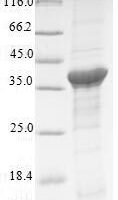
SDS-PAGE: Single band at expected molecular weight confirming purity.

ELISA: Suitable as coating antigen or detection standard.

Western Blot: Compatible with standard Western Blot protocols.

Protein Interaction: Validated for SPR (Surface Plasmon Resonance) and BLI (Bio-Layer Interferometry) studies.

Shipping: Shipped at ambient temperature. Lyophilized protein is stable during transit.

Storage: Store lyophilized protein at -20°C to -80°C. Reconstituted protein should be aliquoted and stored at -80°C. Avoid repeated freeze-thaw cycles.

Shelf Life: 12 months from date of receipt when stored as recommended.

Shipping Time: Orders placed before 2 PM EST ship same day. International orders typically deliver within 5-10 business days.

Protein Biology

Function

Multifunctional protein which functions as a renin, prorenin cellular receptor and is involved in the assembly of the lysosomal proton-transporting V-type ATPase (V-ATPase) and the acidification of the endo-lysosomal system (PubMed:12045255, PubMed:29127204, PubMed:30374053, PubMed:32276428). May mediate renin-dependent cellular responses by activating ERK1 and ERK2 (PubMed:12045255). By increasing the catalytic efficiency of renin in AGT/angiotensinogen conversion to angiotensin I, may also play a role in the renin-angiotensin system (RAS) (PubMed:12045255). Through its function in V-type ATPase (v-ATPase) assembly and acidification of the lysosome it regulates protein degradation and may control different signaling pathways important for proper brain development, synapse morphology and synaptic transmission (By similarity)

Subcellular Location

Endoplasmic reticulum membrane (Single-pass type I membrane protein); Lysosome membrane (Single-pass type I membrane protein); Cytoplasmic vesicle, autophagosome membrane (Single-pass type I membrane protein); Cell projection, dendritic spine membrane (Single-pass type I membrane protein); Cell projection, axon; Endosome membrane (Single-pass type I membrane protein); Cytoplasmic vesicle, clathrin-coated vesicle membrane (Single-pass type I membrane protein); Cytoplasmic vesicle, secretory vesicle, synaptic vesicle membrane (Single-pass type I membrane protein)

Disease Association

Intellectual developmental disorder, X-linked, syndromic, Hedera type (MRXSH) : A disorder characterized by significantly below average general intellectual functioning associated with impairments in adaptive behavior and manifested during the developmental period. MRXSH patients manifest mild to moderate intellectual disability associated with epilepsy, delays in motor milestones and speech acquisition in infancy. [The disease is caused by variants affecting the gene represented in this entry] | Parkinsonism with spasticity, X-linked (XPDS) : A syndrome characterized by parkinsonian features, such as cogwheel rigidity, resting tremor and bradykinesia, and variably penetrant spasticity. [The disease is caused by variants affecting the gene represented in this entry] | Congenital disorder of glycosylation 2R (CDG2R) : A form of congenital disorder of glycosylation, a genetically heterogeneous group of multisystem disorders caused by a defect in glycoprotein biosynthesis and characterized by under-glycosylated serum glycoproteins. Congenital disorders of glycosylation result in a wide variety of clinical features, such as defects in the nervous system development, psychomotor retardation, dysmorphic features, hypotonia, coagulation disorders, and immunodeficiency. The broad spectrum of features reflects the critical role of N-glycoproteins during embryonic development, differentiation, and maintenance of cell functions. CDG2R is an X-linked recessive disorder characterized by infantile onset of liver failure, recurrent infections due to hypogammaglobulinemia, and cutis laxa. Some patients may also have mild intellectual impairment and dysmorphic features. [The disease is caused by variants affecting the gene represented in this entry] | [Defects in ATP6AP2 may be involved in a glycosylation disorder with autophagic defects characterized by serum protein hypoglycosylation, immunodeficiency, liver disease, psychomotor impairment, and cutis laxa]

Tissue Specificity

Expressed in brain, heart, placenta, liver, kidney and pancreas. Barely detectable in lung and skeletal muscles. In the kidney cortex it is restricted to the mesangium of glomeruli. In the coronary and kidney artery it is expressed in the subendothelium, associated to smooth muscles where it colocalizes with REN. Expressed in vascular structures and by syncytiotrophoblast cells in the mature fetal placenta

Subunit

Interacts with renin (PubMed:12045255). Accessory component of the multisubunit proton-transporting vacuolar (V)-ATPase protein pump (PubMed:33065002). Interacts (via N-terminus) with ATP6AP1 (via N-terminus) (PubMed:29127204, PubMed:33065002). Interacts with ATP6V0D1; ATP6V0D1 is a V-ATPase complex subunit and the interaction promotes V-ATPase complex assembly (PubMed:30374053, PubMed:33065002). Interacts with TMEM9; TMEM9 is a V-ATPase assembly regulator and the interaction induces the interaction with ATP6V0D1 (PubMed:30374053). Interacts with VMA21 (via N-terminus); VMA21 is a V-ATPase accessory component (PubMed:29127204)

Gene: ATP6AP2  |  Organism: Homo sapiens  |  Synonyms: ATPase H(+)-transporting lysosomal accessory protein 2; ATPase H(+)-transporting lysosomal-interacting protein 2; ER-localized type I transmembrane adapter; Embryonic liver differentiation factor 10; N14F; Renin/prorenin receptor; Vacuolar ATP synthase membrane sector-associated protein M8-9
Key Publications

Frequently Asked Questions

How do I order or inquire about this product?

Fill out the Online Inquiry form with your required quantity and specifications. You can also email sales@biocrestsci.com. Our team typically responds within 4 business hours with a quote and availability confirmation.

What is the shipping and delivery time?

Orders placed before 2 PM EST ship the same day. Domestic (US) delivery typically takes 2-3 business days. International orders deliver within 5-10 business days. All products are shipped at ambient temperature with appropriate packaging to ensure stability.

How should I store this recombinant protein?

Lyophilized proteins should be stored at -20°C to -80°C upon receipt. After reconstitution, aliquot and store at -80°C. Avoid repeated freeze-thaw cycles. Shelf life is 12 months from date of receipt when stored as recommended.

What quality controls are performed on your products?

Each product undergoes SDS-PAGE purity analysis (typically >85-95%), endotoxin testing, and bioactivity validation. Products are validated for ELISA, Western Blot, and SPR/BLI applications as specified on this product page. A Certificate of Analysis (CoA) is available upon request.

Shopping Cart
Scroll to Top