Function
Critical isomerohydrolase in the retinoid cycle involved in regeneration of 11-cis-retinal, the chromophore of rod and cone opsins. Catalyzes the cleavage and isomerization of all-trans-retinyl fatty acid esters to 11-cis-retinol which is further oxidized by 11-cis retinol dehydrogenase to 11-cis-retinal for use as visual chromophore. Essential for the production of 11-cis retinal for both rod and cone photoreceptors.
Biological Context
Subcellular Location: Cytoplasm; Cell membrane (Lipid-anchor); Microsome membrane
Tissue Specificity: Retina (at protein level). Retinal pigment epithelium specific
Disease Association: Leber congenital amaurosis 2 (LCA2) : A severe dystrophy of the retina, typically becoming evident in the first years of life. Visual function is usually poor and often accompanied by nystagmus, sluggish or near-absent pupillary responses, photophobia, high hyperopia and keratoconus. [The disease is caused by variants affecting the gene represented in this entry] | Retinitis pigmentosa 20 (RP20) : A retinal dystrophy belonging to the group of pigmentary retinopathies. Retinitis pigmentosa is characterized by retinal pigment deposits visible on fundus examination and primary loss of rod photoreceptor cells followed by secondary loss of cone photoreceptors. Patients typically have night vision blindness and loss of midperipheral visual field. As their condition progresses, they lose their far peripheral visual field and eventually central vision as well. [The disease is caused by variants affecting the gene represented in this entry] | Retinitis pigmentosa 87 with choroidal involvement (RP87) : A form of retinitis pigmentosa, a retinal dystrophy belonging to the group of pigmentary retinopathies. Retinitis pigmentosa is characterized by retinal pigment deposits visible on fundus examination and primary loss of rod photoreceptor cells followed by secondary loss of cone photoreceptors. Patients typically have night vision blindness and loss of midperipheral visual field. RP87 is an autosomal dominant form characterized by a slowly progressive visual disturbance accompanied by extensive choroid/retinal atrophy that mimics certain aspects of choroideremia. Disease severity and age of onset are variable, and some carriers are unaffected. [The disease is caused by variants affecting the gene represented in this entry]
Product Specifications
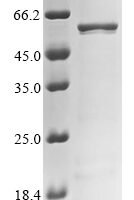
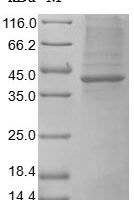
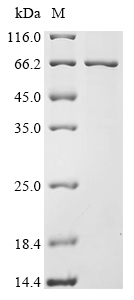
Recombinant Human Retinoid isomerohydrolase (RPE65) is a recombinant protein from Homo sapiens (Human), expressed in Baculovirus, covering amino acids 2-533aa, with N-terminal 10xHis-tagged and C-terminal Myc-tagged tag, molecular weight 64.7kDa, purity Greater than 85% as determined by SDS-PAGE.. Suitable for ELISA and Western Blot applications. Explore more Enzyme proteins →