, ,

Recombinant Human Ribose-phosphate pyrophosphokinase 1 (PRPS1)

Recombinant Human Ribose-phosphate pyrophosphokinase 1 (PRPS1) — recombinant protein from Homo sapiens (Human), expressed in E.coli. Purity >90%.

SKU: BCRECP-001449 Categories: , ,

Product Specifications

Product SkuBCRECP-001449
Product DescriptionRecombinant Human Ribose-phosphate pyrophosphokinase 1 (PRPS1) Protein is expressed from E.coli with N-terminal 6xHis-SUMO-tagged. It contains 2-318aa. [Accession | P60891].
Uniprot No.P60891
Gene NamesPRPS1
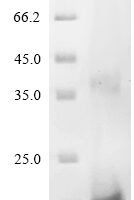
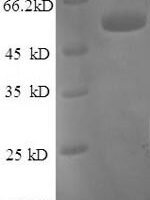
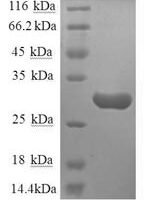
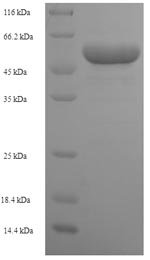
PurityGreater than 90% as determined by SDS-PAGE.
Expression SystemE.coli
Expression Region2-318aa
SpeciesHomo sapiens (Human)
Tag InfoN-terminal 6xHis-SUMO-tagged
Molecular weight50.7kDa
ActivityPlease contact us to obtain bioactivity data.
BufferIf the delivery form is liquid, the default storage buffer is Tris/PBS-based buffer, 5%-50% glycerol. If the delivery form is lyophilized powder, the buffer before lyophilization is Tris/PBS-based buffer, 6% Trehalose.
StorageStore at -20°C/-80°C upon receipt, aliquoting is necessary for mutiple use. Avoid repeated freeze-thaw cycles.
Research AreasCell Biology

Function

Catalyzes the synthesis of phosphoribosylpyrophosphate (PRPP) that is essential for nucleotide synthesis.

Biological Context

Disease Association: [Phosphoribosyl pyrophosphate synthetase I deficiency is a rare condition caused by mutations in PRPS1 that lead to variable disease phenotypes including optic atrophy, retinitis pigmentosa, ataxia, peripheral neuropathy and hearing loss] | Phosphoribosylpyrophosphate synthetase superactivity (PRPS1 superactivity) : Familial disorder characterized by excessive purine production, gout and uric acid urolithiasis. [The disease is caused by variants affecting the gene represented in this entry] | Charcot-Marie-Tooth disease, X-linked recessive, 5 (CMTX5) : A form of Charcot-Marie-Tooth disease, a disorder of the peripheral nervous system, characterized by progressive weakness and atrophy, initially of the peroneal muscles and later of the distal muscles of the arms. Charcot-Marie-Tooth disease is classified in two main groups on the basis of electrophysiologic properties and histopathology: primary peripheral demyelinating neuropathies characterized by severely reduced motor nerve conduction velocities (NCVs) (less than 38m/s) and segmental demyelination and remyelination, and primary peripheral axonal neuropathies characterized by normal or mildly reduced NCVs and chronic axonal degeneration and regeneration on nerve biopsy. [The disease is caused by variants affecting the gene represented in this entry] | ARTS syndrome (ARTS) : A disorder characterized by intellectual disability, early-onset hypotonia, ataxia, delayed motor development, hearing impairment, and optic atrophy. Susceptibility to infections, especially of the upper respiratory tract, can result in early death. [The disease is caused by variants affecting the gene represented in this entry] | Deafness, X-linked, 1 (DFNX1) : A form of deafness characterized by progressive, severe-to-profound sensorineural hearing loss in males. Females manifest mild to moderate hearing loss. [The disease is caused by variants affecting the gene represented in this entry] | [A mutation in PRPS1 has been found in a patient with a phenotype that bridges that of PRSPS1 superactivity and ARTS syndrome with uric acid overproduction without gout but with recurrent infections, sensorineural hearing loss and motor neuropathy. The intermediate phenotype may be because Leu-142 variant affects both allosteric sites that are involved in inhibition of PRPS1 and the ATP-binding site, which suggests that this substitution can result both in a gain-of-function and loss-of-function of PRPP synthetase]
Pathway: Metabolic intermediate biosynthesis; 5-phospho-alpha-D-ribose 1-diphosphate biosynthesis; 5-phospho-alpha-D-ribose 1-diphosphate from D-ribose 5-phosphate (route I): step 1/1

Product Specifications

Recombinant Human Ribose-phosphate pyrophosphokinase 1 (PRPS1) is a recombinant protein from Homo sapiens (Human), expressed in E.coli, covering amino acids 2-318aa, with N-terminal 6xHis-SUMO-tagged tag, molecular weight 50.7kDa, purity Greater than 90% as determined by SDS-PAGE.. Suitable for ELISA and Western Blot applications.

SDS-PAGE: Single band at expected molecular weight confirming purity.

ELISA: Suitable as coating antigen or detection standard.

Western Blot: Compatible with standard Western Blot protocols.

Protein Interaction: Validated for SPR (Surface Plasmon Resonance) and BLI (Bio-Layer Interferometry) studies.

Shipping: Shipped at ambient temperature. Lyophilized protein is stable during transit.

Storage: Store lyophilized protein at -20°C to -80°C. Reconstituted protein should be aliquoted and stored at -80°C. Avoid repeated freeze-thaw cycles.

Shelf Life: 12 months from date of receipt when stored as recommended.

Shipping Time: Orders placed before 2 PM EST ship same day. International orders typically deliver within 5-10 business days.

Protein Biology

Function

Catalyzes the synthesis of phosphoribosylpyrophosphate (PRPP) that is essential for nucleotide synthesis

Disease Association

[Phosphoribosyl pyrophosphate synthetase I deficiency is a rare condition caused by mutations in PRPS1 that lead to variable disease phenotypes including optic atrophy, retinitis pigmentosa, ataxia, peripheral neuropathy and hearing loss] | Phosphoribosylpyrophosphate synthetase superactivity (PRPS1 superactivity) : Familial disorder characterized by excessive purine production, gout and uric acid urolithiasis. [The disease is caused by variants affecting the gene represented in this entry] | Charcot-Marie-Tooth disease, X-linked recessive, 5 (CMTX5) : A form of Charcot-Marie-Tooth disease, a disorder of the peripheral nervous system, characterized by progressive weakness and atrophy, initially of the peroneal muscles and later of the distal muscles of the arms. Charcot-Marie-Tooth disease is classified in two main groups on the basis of electrophysiologic properties and histopathology: primary peripheral demyelinating neuropathies characterized by severely reduced motor nerve conduction velocities (NCVs) (less than 38m/s) and segmental demyelination and remyelination, and primary peripheral axonal neuropathies characterized by normal or mildly reduced NCVs and chronic axonal degeneration and regeneration on nerve biopsy. [The disease is caused by variants affecting the gene represented in this entry] | ARTS syndrome (ARTS) : A disorder characterized by intellectual disability, early-onset hypotonia, ataxia, delayed motor development, hearing impairment, and optic atrophy. Susceptibility to infections, especially of the upper respiratory tract, can result in early death. [The disease is caused by variants affecting the gene represented in this entry] | Deafness, X-linked, 1 (DFNX1) : A form of deafness characterized by progressive, severe-to-profound sensorineural hearing loss in males. Females manifest mild to moderate hearing loss. [The disease is caused by variants affecting the gene represented in this entry] | [A mutation in PRPS1 has been found in a patient with a phenotype that bridges that of PRSPS1 superactivity and ARTS syndrome with uric acid overproduction without gout but with recurrent infections, sensorineural hearing loss and motor neuropathy. The intermediate phenotype may be because Leu-142 variant affects both allosteric sites that are involved in inhibition of PRPS1 and the ATP-binding site, which suggests that this substitution can result both in a gain-of-function and loss-of-function of PRPP synthetase]

Subunit

Homodimer. The active form is probably a hexamer composed of 3 homodimers

Pathway

Metabolic intermediate biosynthesis; 5-phospho-alpha-D-ribose 1-diphosphate biosynthesis; 5-phospho-alpha-D-ribose 1-diphosphate from D-ribose 5-phosphate (route I): step 1/1

Gene: PRPS1  |  Organism: Homo sapiens  |  Synonyms: PPRibP; Phosphoribosyl pyrophosphate synthase I
Key Publications

Frequently Asked Questions

How do I order or inquire about this product?

Fill out the Online Inquiry form with your required quantity and specifications. You can also email sales@biocrestsci.com. Our team typically responds within 4 business hours with a quote and availability confirmation.

What is the shipping and delivery time?

Orders placed before 2 PM EST ship the same day. Domestic (US) delivery typically takes 2-3 business days. International orders deliver within 5-10 business days. All products are shipped at ambient temperature with appropriate packaging to ensure stability.

How should I store this recombinant protein?

Lyophilized proteins should be stored at -20°C to -80°C upon receipt. After reconstitution, aliquot and store at -80°C. Avoid repeated freeze-thaw cycles. Shelf life is 12 months from date of receipt when stored as recommended.

What quality controls are performed on your products?

Each product undergoes SDS-PAGE purity analysis (typically >85-95%), endotoxin testing, and bioactivity validation. Products are validated for ELISA, Western Blot, and SPR/BLI applications as specified on this product page. A Certificate of Analysis (CoA) is available upon request.

Shopping Cart
Scroll to Top