,

Recombinant Human Serine/threonine-protein phosphatase 2A catalytic subunit alpha isoform (PPP2CA)

Recombinant Human Serine/threonine-protein phosphatase 2A catalytic subunit alpha isoform (PPP2CA) — Catalytic subunit of protein phosphatase 2A (PP2A), a serine/threonine phosphatase involved in the regulation of a wide variety of enzymes, signal transduction pathways, and cellular events. Purit…

SKU: BCRECP-001430 Categories: ,

Product Specifications

Product SkuBCRECP-001430
Product DescriptionRecombinant Human Serine/threonine-protein phosphatase 2A catalytic subunit alpha isoform (PPP2CA) Protein is expressed from E.coli with N-terminal 10xHis-tagged and C-terminal Myc-tagged. It contains 1-309aa. [Accession | P67775].
Uniprot No.P67775
Gene NamesPPP2CA
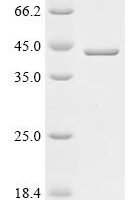
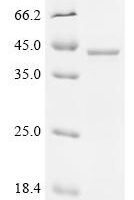
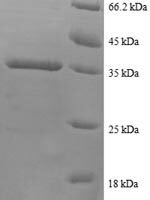
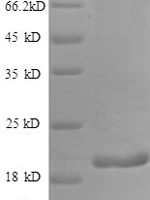
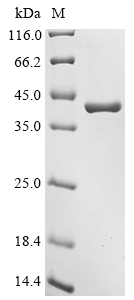
PurityGreater than 90% as determined by SDS-PAGE.
Expression SystemE.coli
Expression Region1-309aa
SpeciesHomo sapiens (Human)
Tag InfoN-terminal 10xHis-tagged and C-terminal Myc-tagged
Molecular weight43.0kDa
ActivityPlease contact us to obtain bioactivity data.
BufferIf the delivery form is liquid, the default storage buffer is Tris/PBS-based buffer, 5%-50% glycerol. If the delivery form is lyophilized powder, the buffer before lyophilization is Tris/PBS-based buffer, 6% Trehalose.
StorageStore at -20°C/-80°C upon receipt, aliquoting is necessary for mutiple use. Avoid repeated freeze-thaw cycles.
Research AreasCancer

Function

Catalytic subunit of protein phosphatase 2A (PP2A), a serine/threonine phosphatase involved in the regulation of a wide variety of enzymes, signal transduction pathways, and cellular events. PP2A is the major phosphatase for microtubule-associated proteins (MAPs). PP2A can modulate the activity of phosphorylase B kinase casein kinase 2, mitogen-stimulated S6 kinase, and MAP-2 kinase.

Biological Context

Subcellular Location: Cytoplasm; Nucleus; Chromosome; Chromosome, centromere; Cytoplasm, cytoskeleton, spindle pole
Disease Association: Houge-Janssens syndrome 3 (HJS3) : An autosomal dominant neurodevelopmental disorder characterized by global developmental delay with onset in infancy and additional variable features including hypotonia, epilepsy, brain abnormalities such as ventriculomegaly and a small corpus callosum, and autism spectrum disorder. [The disease is caused by variants affecting the gene represented in this entry]

Product Specifications

Recombinant Human Serine/threonine-protein phosphatase 2A catalytic subunit alpha isoform (PPP2CA) is a recombinant protein from Homo sapiens (Human), expressed in E.coli, covering amino acids 1-309aa, with N-terminal 10xHis-tagged and C-terminal Myc-tagged tag, molecular weight 43.0kDa, purity Greater than 90% as determined by SDS-PAGE.. Suitable for ELISA and Western Blot applications.

SDS-PAGE: Single band at expected molecular weight confirming purity.

ELISA: Suitable as coating antigen or detection standard.

Western Blot: Compatible with standard Western Blot protocols.

Protein Interaction: Validated for SPR (Surface Plasmon Resonance) and BLI (Bio-Layer Interferometry) studies.

Shipping: Shipped at ambient temperature. Lyophilized protein is stable during transit.

Storage: Store lyophilized protein at -20°C to -80°C. Reconstituted protein should be aliquoted and stored at -80°C. Avoid repeated freeze-thaw cycles.

Shelf Life: 12 months from date of receipt when stored as recommended.

Shipping Time: Orders placed before 2 PM EST ship same day. International orders typically deliver within 5-10 business days.

Protein Biology

Function

Catalytic subunit of protein phosphatase 2A (PP2A), a serine/threonine phosphatase involved in the regulation of a wide variety of enzymes, signal transduction pathways, and cellular events (PubMed:10801873, PubMed:12473674, PubMed:17245430, PubMed:22613722, PubMed:33243860, PubMed:34004147, PubMed:9920888). PP2A is the major phosphatase for microtubule-associated proteins (MAPs) (PubMed:22613722). PP2A can modulate the activity of phosphorylase B kinase casein kinase 2, mitogen-stimulated S6 kinase, and MAP-2 kinase (PubMed:22613722). Cooperates with SGO2 to protect centromeric cohesin from separase-mediated cleavage in oocytes specifically during meiosis I (By similarity). Can dephosphorylate various proteins, such as SV40 large T antigen, AXIN1, p53/TP53, PIM3, WEE1 (PubMed:10801873, PubMed:12473674, PubMed:17245430, PubMed:9920888). Activates RAF1 by dephosphorylating it at 'Ser-259' (PubMed:10801873). Mediates dephosphorylation of WEE1, preventing its ubiquitin-mediated proteolysis, increasing WEE1 protein levels, and promoting the G2/M checkpoint (PubMed:33108758). Mediates dephosphorylation of MYC; promoting its ubiquitin-mediated proteolysis: interaction with AMBRA1 enhances interaction between PPP2CA and MYC (PubMed:25438055). Mediates dephosphorylation of FOXO3; promoting its stabilization: interaction with AMBRA1 enhances interaction between PPP2CA and FOXO3 (PubMed:30513302). Catalyzes dephosphorylation of the pyrin domain of NLRP3, promoting assembly of the NLRP3 inflammasome (By similarity). Together with RACK1 adapter, mediates dephosphorylation of AKT1 at 'Ser-473', preventing AKT1 activation and AKT-mTOR signaling pathway (By similarity). Dephosphorylation of AKT1 is essential for regulatory T-cells (Treg) homeostasis and stability (By similarity). Catalyzes dephosphorylation of PIM3, promoting PIM3 ubiquitination and proteasomal degradation (PubMed:12473674). Part of the striatin-interacting phosphatase and kinase (STRIPAK) complexes (PubMed:33633399). STRIPAK complexes have critical roles in protein (de)phosphorylation and are regulators of multiple signaling pathways including Hippo, MAPK, nuclear receptor and cytoskeleton remodeling (PubMed:33633399). Different types of STRIPAK complexes are involved in a variety of biological processes such as cell growth, differentiation, apoptosis, metabolism and immune regulation (PubMed:33633399). Key mediator of a quality checkpoint during transcription elongation as part of the Integrator-PP2A (INTAC) complex (PubMed:33243860, PubMed:34004147, PubMed:37080207). The INTAC complex drives premature transcription termination of transcripts that are unfavorably configured for transcriptional elongation: within the INTAC complex, PPP2CA catalyzes dephosphorylation of the C-terminal domain (CTD) of Pol II subunit POLR2A/RPB1 and SUPT5H/SPT5, thereby preventing transcriptional elongation (PubMed:33243860, PubMed:34004147, PubMed:37080207)

Subcellular Location

Cytoplasm; Nucleus; Chromosome; Chromosome, centromere; Cytoplasm, cytoskeleton, spindle pole

Disease Association

Houge-Janssens syndrome 3 (HJS3) : An autosomal dominant neurodevelopmental disorder characterized by global developmental delay with onset in infancy and additional variable features including hypotonia, epilepsy, brain abnormalities such as ventriculomegaly and a small corpus callosum, and autism spectrum disorder. [The disease is caused by variants affecting the gene represented in this entry]

Subunit

PP2A consists of a common heterodimeric core enzyme composed of PPP2CA, a 36 kDa catalytic subunit (subunit C), and PPP2R1A, a 65 kDa constant regulatory subunit (PR65 or subunit A), that associates with a variety of regulatory subunits (PubMed:17055435, PubMed:18394995, PubMed:30595372, PubMed:38123684). Proteins that associate with the core dimer include three families of regulatory subunits B (the R2/B/PR55/B55, R3/B''/PR72/PR130/PR59 and R5/B'/B56 families), the 48 kDa variable regulatory subunit, viral proteins, and cell signaling molecules (PubMed:18394995, PubMed:30595372, PubMed:38123684). Interacts with the PP2A A subunit PPP2R1A (PubMed:37761890, PubMed:38123684). Interacts with the regulatory subunit PPP2R2A (PubMed:38123684). Interacts (via C-terminus) with PTPA (PubMed:25003389). Interacts with NXN; the interaction is direct (By similarity). Interacts with KCTD20 (By similarity). Interacts with BTBD10 (By similarity). Interacts with SGO1 and SGO2 (PubMed:16541025, PubMed:16580887, PubMed:17485487). Interacts with RAF1 (PubMed:10801873). Interaction with IGBP1 protects unassembled PPP2CA from degradative ubiquitination (PubMed:19818709, PubMed:20092282, PubMed:9647778). Interacts with GSK3B (via C2 domain) (PubMed:20080667). Interacts with MFHAS1; retains PPP2CA into the cytoplasm and excludes it from the nucleus (PubMed:28609714). Interacts with PABIR1/FAM122A (PubMed:27588481, PubMed:38123684). Interacts with ADCY8; interaction is phosphatase activity-dependent; antagonizes interaction between ADCY8 and calmodulin (PubMed:16258073). Interacts with CRTC3 (when phosphorylated at 'Ser-391') (PubMed:30611118). Interacts with SPRY2; the interaction is inhibited by TESK1 interaction with SPRY2, possibly by vesicular sequestration of SPRY2 (PubMed:17974561). Interacts with TRAF3IP3 (PubMed:30115741). Interacts with AMBRA1 (via PxP motifs); enhancing interaction between PPP2CA and MYC or FOXO3 (PubMed:25438055, PubMed:30513302). Forms a complex with AMBRA1 and BECN1; AMBRA1 and BECN1 components of the complex regulate MYC stability via different pathways (PubMed:25803737). Part of the core of STRIPAK complexes composed of PP2A catalytic and scaffolding subunits, the striatins (PP2A regulatory subunits), the striatin-associated proteins MOB4, STRIP1 and STRIP2, PDCD10 and members of the STE20 kinases, such as STK24 and STK26 (PubMed:33633399). Phosphatase component of the Integrator-PP2A (INTAC) complex, composed of the Integrator core complex and protein phosphatase 2A subunits PPP2CA and PPP2R1A (PubMed:33243860, PubMed:34004147, PubMed:37080207, PubMed:34762484, PubMed:36869814, PubMed:38570683)

Gene: PPP2CA  |  Organism: Homo sapiens  |  Synonyms: Replication protein C
Key Publications

Frequently Asked Questions

How do I order or inquire about this product?

Fill out the Online Inquiry form with your required quantity and specifications. You can also email sales@biocrestsci.com. Our team typically responds within 4 business hours with a quote and availability confirmation.

What is the shipping and delivery time?

Orders placed before 2 PM EST ship the same day. Domestic (US) delivery typically takes 2-3 business days. International orders deliver within 5-10 business days. All products are shipped at ambient temperature with appropriate packaging to ensure stability.

How should I store this recombinant protein?

Lyophilized proteins should be stored at -20°C to -80°C upon receipt. After reconstitution, aliquot and store at -80°C. Avoid repeated freeze-thaw cycles. Shelf life is 12 months from date of receipt when stored as recommended.

What quality controls are performed on your products?

Each product undergoes SDS-PAGE purity analysis (typically >85-95%), endotoxin testing, and bioactivity validation. Products are validated for ELISA, Western Blot, and SPR/BLI applications as specified on this product page. A Certificate of Analysis (CoA) is available upon request.

Shopping Cart
Scroll to Top