Function
May function as an intracellular leucine sensor that negatively regulates the TORC1 signaling pathway. May also regulate the insulin-receptor signaling pathway through activation of TORC2. This metabolic regulator may also play a role in protection against oxidative and genotoxic stresses.
Biological Context
Subcellular Location: Cytoplasm
Tissue Specificity: Widely expressed
Product Specifications
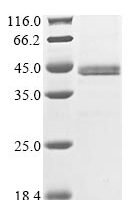
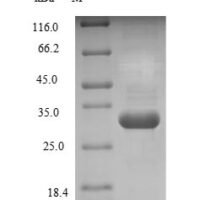
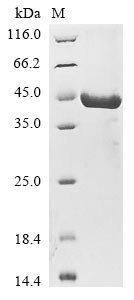
Recombinant Human Sestrin-3 (SESN3) is a recombinant protein from Homo sapiens (Human), expressed in E.coli, covering amino acids 1-321aa, with N-terminal 10xHis-tagged and C-terminal Myc-tagged tag, molecular weight 44.1kDa, purity Greater than 85% as determined by SDS-PAGE.. Suitable for ELISA and Western Blot applications.