Function
May have a pivotal role in cell differentiation of different cell types. Signaling could be triggered by the binding of a lectin-like ligand to the CD24 carbohydrates, and transduced by the release of second messengers derived from the GPI-anchor. Modulates B-cell activation responses.
Biological Context
Subcellular Location: Cell membrane (Lipid-anchor, GPI-anchor)
Tissue Specificity: B-cells. Expressed in a number of B-cell lines including P32/ISH and Namalwa. Expressed in erythroleukemia cell and small cell lung carcinoma cell lines. Also expressed on the surface of T-cells
Disease Association: Multiple sclerosis (MS) : A multifactorial, inflammatory, demyelinating disease of the central nervous system. Sclerotic lesions are characterized by perivascular infiltration of monocytes and lymphocytes and appear as indurated areas in pathologic specimens (sclerosis in plaques). The pathological mechanism is regarded as an autoimmune attack of the myelin sheath, mediated by both cellular and humoral immunity. Clinical manifestations include visual loss, extra-ocular movement disorders, paresthesias, loss of sensation, weakness, dysarthria, spasticity, ataxia and bladder dysfunction. Genetic and environmental factors influence susceptibility to the disease. [Disease susceptibility may be associated with variants affecting the gene represented in this entry]
Product Specifications
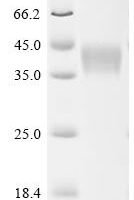
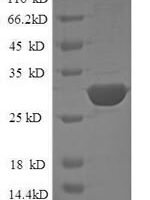
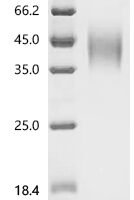
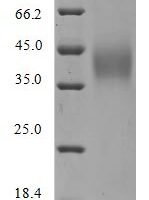
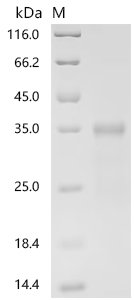
Recombinant Human Signal transducer CD24 (CD24), partial is a recombinant protein from Homo sapiens (Human), expressed in Yeast, covering amino acids 27-59aa, with C-terminal 6xHis-tagged tag, molecular weight 26.3kDa, purity Greater than 90% as determined by SDS-PAGE.. Suitable for ELISA and Western Blot applications. Explore more CD proteins →