Recombinant Human Succinate receptor 1 (SUCNR1) Protein

Recombinant Human Succinate receptor 1 (SUCNR1) Protein — G protein-coupled receptor for succinate able to mediate signaling through Gq/GNAQ or Gi/GNAI second messengers depending on the cell type and the processes regulated. Purity >85%.

SKU: BCRECP-00302TM Category:

Product Specifications

Uniprot No.Q9BXA5
Gene NamesSUCNR1
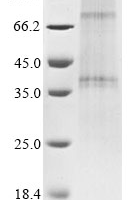
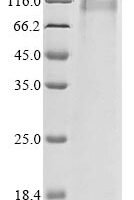
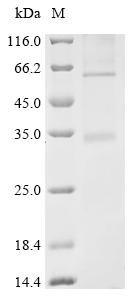
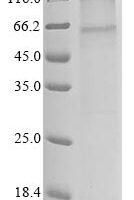
PurityGreater than 85% as determined by SDS-PAGE.
Expression Systemin vitro E.coli expression system
Expression Region1-334aa
SpeciesHomo sapiens (Human)
Tag InfoN-terminal 10xHis-tagged
Molecular weight40.2kDa
ActivityNot Test
BufferIf the delivery form is liquid, the default storage buffer is Tris/PBS-based buffer, 5%-50% glycerol.If the delivery form is lyophilized powder, the buffer before lyophilization is Tris/PBS-based buffer, 6% Trehalose.
StorageStore at -20°C/-80°C upon receipt, aliquoting is necessary for mutiple use. Avoid repeated freeze-thaw cycles.

Function

G protein-coupled receptor for succinate able to mediate signaling through Gq/GNAQ or Gi/GNAI second messengers depending on the cell type and the processes regulated. Succinate-SUCNR1 signaling serves as a link between metabolic stress, inflammation and energy homeostasis. In macrophages, plays a range of immune-regulatory roles.

Biological Context

Subcellular Location: Cell membrane (Multi-pass membrane protein)
Tissue Specificity: Expressed specifically in kidney. Highly expressed in immature dendritic cells, expression rapidly downregulates after maturation. Also expressed in macrophages

Product Specifications

Recombinant Human Succinate receptor 1 (SUCNR1) Protein is a recombinant protein from Homo sapiens (Human), expressed in in vitro E.coli expression system, covering amino acids 1-334aa, with N-terminal 10xHis-tagged tag, molecular weight 40.2kDa, purity Greater than 85% as determined by SDS-PAGE.. Suitable for ELISA and Western Blot applications.
Recommended applications depend on the target, product format, and product-specific validation data. Refer to the product datasheet or Certificate of Analysis (CoA), or contact BioCrest Sci for application guidance.

Biological Activity: Not Test

Storage: Store at -20°C/-80°C upon receipt, aliquoting is necessary for mutiple use. Avoid repeated freeze-thaw cycles.

Shipping & Lead Time: Availability, shipping conditions, and estimated lead time are confirmed in the formal quotation or order confirmation based on the product format, destination, and order requirements.

Protein Biology

Function

G protein-coupled receptor for succinate able to mediate signaling through Gq/GNAQ or Gi/GNAI second messengers depending on the cell type and the processes regulated (By similarity) (PubMed:15141213, PubMed:23770096, PubMed:34133934). Succinate-SUCNR1 signaling serves as a link between metabolic stress, inflammation and energy homeostasis (PubMed:18820681, PubMed:34133934). In macrophages, plays a range of immune-regulatory roles. During inflammation, succinate-SUCNR1 signaling may act as an anti-inflammatory mediator or boost inflammation depending on the inflammatory status of cells (By similarity). Hyperpolarizes M2 macrophages versus M1 phenotype through Gq signaling by regulating the transcription of genes involved in immune function (PubMed:34133934). In activated M1 macrophages, plays a pro-inflammatory role in response to LPS (By similarity). Expressed in dendritic cells, where it is involved in the sensing of immunological danger and enhances immunity. Mediates succinate triggered intracelleular calcium mobilization, induces migratory responses and acts in synergy with Toll-like receptor ligands for the production of proinflammatory cytokines as well as an enhancement of antigen-specific activation of helper T cells (PubMed:18820681). In the small intestine, mediates the activation of tuft cells by dietary succinate and triggers type 2 immunity (By similarity). In adipocytes, plays an important role in the control of energy metabolism. In response to succinate, controls leptin expression in an AMPK-JNK-CEBPA-dependent as well as circadian clock-regulated manner (By similarity). In muscle tissue, is expressed in non-muscle cells and coordinates muscle remodeling in response to the succinate produced during exercise training in a paracrine manner (By similarity). In retina, acts as a mediator of vessel growth during retinal development. In response to succinate, regulates the production of angiogenic factors, including VEGF, by retinal ganglion neurons (By similarity)

Subcellular Location

Cell membrane (Multi-pass membrane protein)

Tissue Specificity

Expressed specifically in kidney (PubMed:11273702). Highly expressed in immature dendritic cells, expression rapidly downregulates after maturation. Also expressed in macrophages (PubMed:18820681)

Gene: SUCNR1  |  Organism: Homo sapiens  |  Synonyms: G protein-coupled receptor 91; P2Y purinoceptor 1-like

Frequently Asked Questions

How do I order or inquire about this product?

Submit the Online Inquiry form with your required quantity and specifications, or email sales@biocrestsci.com. Available sizes, pricing, stock status, documentation, and estimated lead time are confirmed in the formal quotation.

What is the shipping and delivery time?

Availability, dispatch timing, shipping conditions, and delivery estimates depend on the product format, destination, and order requirements. These details are confirmed in the formal quotation or order confirmation.

How should this product be stored?

Follow the storage and handling instructions in the product-specific datasheet and Certificate of Analysis (CoA). Requirements may vary by product form and formulation; contact BioCrest Sci if product-specific guidance is needed.

What quality controls are performed on your products?

Quality-control data such as identity, purity, endotoxin level, or biological activity are provided only when specified on this product page, the datasheet, or Certificate of Analysis (CoA). Biological activity is not implied unless explicitly stated.

Shopping Cart
Scroll to Top