Recombinant Human Suppressor of cytokine signaling 1 (SOCS1)

Recombinant Human Suppressor of cytokine signaling 1 (SOCS1) — Essential negative regulator of type I and type II interferon (IFN) signaling, as well as that of other cytokines, including IL2, IL4, IL6 and leukemia inhibitory factor (LIF). Purity >90%.

SKU: BCRECP-001678 Category:

Product Specifications

Product SkuBCRECP-001678
Product DescriptionRecombinant Human Suppressor of cytokine signaling 1 (SOCS1) Protein is expressed from E.coli with N-terminal 6xHis-tagged. It contains 1-211aa. [Accession | O15524].
Uniprot No.O15524
Gene NamesSOCS1
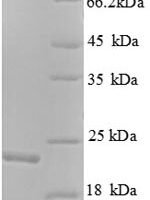
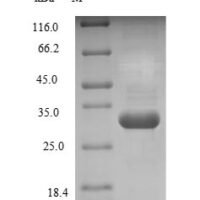
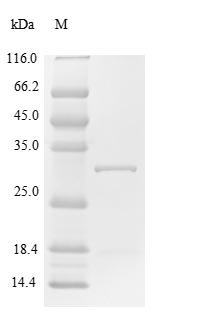
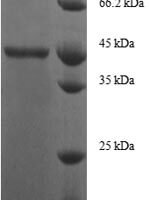
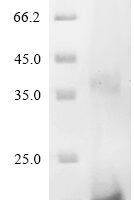
PurityGreater than 90% as determined by SDS-PAGE.
Expression SystemE.coli
Expression Region1-211aa
SpeciesHomo sapiens (Human)
Tag InfoN-terminal 6xHis-tagged
Molecular weight27.6kDa
ActivityPlease contact us to obtain bioactivity data.
BufferIf the delivery form is liquid, the default storage buffer is Tris/PBS-based buffer, 5%-50% glycerol. If the delivery form is lyophilized powder, the buffer before lyophilization is Tris/PBS-based buffer, 6% Trehalose.
StorageStore at -20°C/-80°C upon receipt, aliquoting is necessary for mutiple use. Avoid repeated freeze-thaw cycles.
Research AreasImmunology

Function

Essential negative regulator of type I and type II interferon (IFN) signaling, as well as that of other cytokines, including IL2, IL4, IL6 and leukemia inhibitory factor (LIF). Downregulates cytokine signaling by inhibiting the JAK/STAT signaling pathway. Acts by binding to JAK proteins and to IFNGR1 and inhibiting their kinase activity.

Biological Context

Subcellular Location: Nucleus; Cytoplasmic vesicle
Tissue Specificity: Expressed in all tissues with high expression in spleen, small intestine and peripheral blood leukocytes
Disease Association: Autoinflammatory syndrome, familial, with or without immunodeficiency (AISIMD) : An autosomal dominant, autoinflammatory disorder with incomplete penetrance characterized by autoimmune cytopenia, hemolytic anemia, thrombocytopenia, and lymphadenopathy. Additional variable features may include autoimmune thyroiditis, psoriasis or eczema, nephritis, hepatitis, and symptoms of systemic lupus erythematosus. Immunodeficiency is present in some patients. Disease onset is usually in the first decades of life, although later onset has been reported. [The disease is caused by variants affecting the gene represented in this entry]
Pathway: Protein modification; protein ubiquitination

Product Specifications

Recombinant Human Suppressor of cytokine signaling 1 (SOCS1) is a recombinant protein from Homo sapiens (Human), expressed in E.coli, covering amino acids 1-211aa, with N-terminal 6xHis-tagged tag, molecular weight 27.6kDa, purity Greater than 90% as determined by SDS-PAGE.. Suitable for ELISA and Western Blot applications.
Recommended applications depend on the target, product format, and product-specific validation data. Refer to the product datasheet or Certificate of Analysis (CoA), or contact BioCrest Sci for application guidance.

Biological Activity: Please contact us to obtain bioactivity data.

Storage: Store at -20°C/-80°C upon receipt, aliquoting is necessary for mutiple use. Avoid repeated freeze-thaw cycles.

Shipping & Lead Time: Availability, shipping conditions, and estimated lead time are confirmed in the formal quotation or order confirmation based on the product format, destination, and order requirements.

Protein Biology

Function

Essential negative regulator of type I and type II interferon (IFN) signaling, as well as that of other cytokines, including IL2, IL4, IL6 and leukemia inhibitory factor (LIF) (PubMed:32499645, PubMed:33087723). Downregulates cytokine signaling by inhibiting the JAK/STAT signaling pathway. Acts by binding to JAK proteins and to IFNGR1 and inhibiting their kinase activity. In vitro, suppresses Tec protein-tyrosine activity (PubMed:9341160). Regulates IFN-gamma (IFNG)-mediated sensory neuron survival (By similarity). Probable substrate recognition component of an ECS (Elongin BC-CUL2/5-SOCS-box protein) E3 ubiquitin ligase complex which mediates the ubiquitination and subsequent proteasomal degradation of target proteins (PubMed:11278610, PubMed:11313480)

Subcellular Location

Nucleus; Cytoplasmic vesicle

Disease Association

Autoinflammatory syndrome, familial, with or without immunodeficiency (AISIMD) : An autosomal dominant, autoinflammatory disorder with incomplete penetrance characterized by autoimmune cytopenia, hemolytic anemia, thrombocytopenia, and lymphadenopathy. Additional variable features may include autoimmune thyroiditis, psoriasis or eczema, nephritis, hepatitis, and symptoms of systemic lupus erythematosus. Immunodeficiency is present in some patients. Disease onset is usually in the first decades of life, although later onset has been reported. [The disease is caused by variants affecting the gene represented in this entry]

Tissue Specificity

Expressed in all tissues with high expression in spleen, small intestine and peripheral blood leukocytes

Subunit

Interacts with multiple activated signaling proteins of the tyrosine kinase signaling pathway including JAK family kinases, TEC, KIT, GRB2 and VAV. Binding to JAKs is mediated through the KIR and SH2 domains to a phosphorylated tyrosine residue within the JAK JH1 domain. Binds the SH3 domain of GRB2 via diproline determinants in the N-terminus, and the N-terminal regulatory domain of VAV (By similarity). Interacts with the Elongin BC complex (ELOB and ELOC). Component of an ECS CBC(SOCS1) E3 ubiquitin-protein ligase complex which contains Elongin BC, CUL5, RBX1 and SOCS1 (By similarity). Interacts (via SH2 domain and SOCS box) with TRIM8 (By similarity). Interacts with AXL, CUL2 and FGFR3. Interacts with INSR (By similarity). Interacts with TRIM8 (PubMed:12163497). Interacts with DCUN1D1 (PubMed:23401859). Interacts with IFNGR1 (By similarity)

Pathway

Protein modification; protein ubiquitination

Gene: SOCS1  |  Organism: Homo sapiens  |  Synonyms: JAK-binding protein; STAT-induced STAT inhibitor 1; Tec-interacting protein 3
Key Publications

Frequently Asked Questions

How do I order or inquire about this product?

Submit the Online Inquiry form with your required quantity and specifications, or email sales@biocrestsci.com. Available sizes, pricing, stock status, documentation, and estimated lead time are confirmed in the formal quotation.

What is the shipping and delivery time?

Availability, dispatch timing, shipping conditions, and delivery estimates depend on the product format, destination, and order requirements. These details are confirmed in the formal quotation or order confirmation.

How should this product be stored?

Follow the storage and handling instructions in the product-specific datasheet and Certificate of Analysis (CoA). Requirements may vary by product form and formulation; contact BioCrest Sci if product-specific guidance is needed.

What quality controls are performed on your products?

Quality-control data such as identity, purity, endotoxin level, or biological activity are provided only when specified on this product page, the datasheet, or Certificate of Analysis (CoA). Biological activity is not implied unless explicitly stated.

Shopping Cart
Scroll to Top