Recombinant Human T cell receptor beta constant 1 (TRBC1), partial (Active)

Recombinant Human T cell receptor beta constant 1 (TRBC1), partial (Active) — Constant region of T cell receptor (TR) beta chain. Purity >95%.

SKU: BCACP-000648 Category:
Product SKUBCACP-000648
Product DescriptionRecombinant Human T cell receptor beta constant 1 (TRBC1) protein is expressed from Yeast with C-terminal 10xHis-tagged. It contains 1-144aa. [Accession | P01850].
Uniprot No.P01850
Gene NamesTRBC1
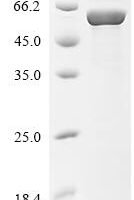
PurityGreater than 95% as determined by SDS-PAGE.
Expression SystemYeast
Expression Region1-144aa
SpeciesHomo sapiens (Human)
Tag InfoC-terminal 10xHis-tagged
Molecular weight18.3 kDa
ActivityMeasured by its binding ability in a functional ELISA.Immobilized Human CD80 at 2 μg/mL can bind anti-CD80 recombinant antibody.The EC50 is 2.361-2.785 ng/mL.;CD80 Recombinant Monoclonal Antibody captured on Protein A Chip can bind Human CD80 with an affinity constant of 3.28 nM as detected by MetaSPR Assay (WeSPRTM 200).
BufferLyophilized from a 0.2 μm filtered 20 mM Tris-HCl, 0.5 M NaCl, 6% Trehalose, pH 8.0
StorageStore at -20°C/-80°C upon receipt, aliquoting is necessary for mutiple use. Avoid repeated freeze-thaw cycles.
Alternative NamesT cell receptor beta constant 1

Function

Constant region of T cell receptor (TR) beta chain. Alpha-beta T cell receptors are antigen specific receptors which are essential to the immune response and are present on the cell surface of T lymphocytes. Recognize peptide-major histocompatibility (MH) (pMH) complexes that are displayed by antigen presenting cells (APC), a prerequisite for efficient T cell adaptive immunity against pathogens.

Biological Context

Subcellular Location: Cell membrane

Product Specifications

Recombinant Human T cell receptor beta constant 1 (TRBC1), partial (Active) is a recombinant protein from Homo sapiens (Human), expressed in Yeast, covering amino acids 1-144aa, with C-terminal 10xHis-tagged tag, molecular weight 18.3 kDa, purity Greater than 95% as determined by SDS-PAGE.. Suitable for ELISA and Western Blot applications.

Recommended applications depend on the target, product format, and product-specific validation data. Refer to the product datasheet or Certificate of Analysis (CoA), or contact BioCrest Sci for application guidance.

Biological Activity: Measured by its binding ability in a functional ELISA.Immobilized Human CD80 at 2 μg/mL can bind anti-CD80 recombinant antibody.The EC50 is 2.361-2.785 ng/mL.;CD80 Recombinant Monoclonal Antibody captured on Protein A Chip can bind Human CD80 with an affinity constant of 3.28 nM as detected by MetaSPR Assay (WeSPRTM 200).

Storage: Store at -20°C/-80°C upon receipt, aliquoting is necessary for mutiple use. Avoid repeated freeze-thaw cycles.

Shipping & Lead Time: Availability, shipping conditions, and estimated lead time are confirmed in the formal quotation or order confirmation based on the product format, destination, and order requirements.

Protein Biology

Function

Constant region of T cell receptor (TR) beta chain (PubMed:24600447). Alpha-beta T cell receptors are antigen specific receptors which are essential to the immune response and are present on the cell surface of T lymphocytes. Recognize peptide-major histocompatibility (MH) (pMH) complexes that are displayed by antigen presenting cells (APC), a prerequisite for efficient T cell adaptive immunity against pathogens (PubMed:25493333). Binding of alpha-beta TR to pMH complex initiates TR-CD3 clustering on the cell surface and intracellular activation of LCK that phosphorylates the ITAM motifs of CD3G, CD3D, CD3E and CD247 enabling the recruitment of ZAP70. In turn, ZAP70 phosphorylates LAT, which recruits numerous signaling molecules to form the LAT signalosome. The LAT signalosome propagates signal branching to three major signaling pathways, the calcium, the mitogen-activated protein kinase (MAPK) kinase and the nuclear factor NF-kappa-B (NF-kB) pathways, leading to the mobilization of transcription factors that are critical for gene expression and essential for T cell growth and differentiation (PubMed:23524462, PubMed:9382891). The T cell repertoire is generated in the thymus, by V-(D)-J rearrangement. This repertoire is then shaped by intrathymic selection events to generate a peripheral T cell pool of self-MH restricted, non-autoaggressive T cells. Post-thymic interaction of alpha-beta TR with the pMH complexes shapes TR structural and functional avidity (PubMed:15040585)

Subcellular Location

Cell membrane

Subunit

Alpha-beta TR is a heterodimer composed of an alpha and beta chain; disulfide-linked. The alpha-beta TR is associated with the transmembrane signaling CD3 coreceptor proteins to form the TR-CD3 (TcR or TCR). The assembly of alpha-beta TR heterodimers with CD3 occurs in the endoplasmic reticulum where a single alpha-beta TR heterodimer associates with one CD3D-CD3E heterodimer, one CD3G-CD3E heterodimer and one CD247 homodimer forming a stable octameric structure. CD3D-CD3E and CD3G-CD3E heterodimers preferentially associate with TR alpha and TR beta chains, respectively. The association of the CD247 homodimer is the last step of TcR assembly in the endoplasmic reticulum and is required for transport to the cell surface

Gene: TRBC1  |  Organism: Homo sapiens
Key Publications

Frequently Asked Questions

How do I order or inquire about this product?

Submit the Online Inquiry form with your required quantity and specifications, or email sales@biocrestsci.com. Available sizes, pricing, stock status, documentation, and estimated lead time are confirmed in the formal quotation.

What is the shipping and delivery time?

Availability, dispatch timing, shipping conditions, and delivery estimates depend on the product format, destination, and order requirements. These details are confirmed in the formal quotation or order confirmation.

How should this product be stored?

Follow the storage and handling instructions in the product-specific datasheet and Certificate of Analysis (CoA). Requirements may vary by product form and formulation; contact BioCrest Sci if product-specific guidance is needed.

What quality controls are performed on your products?

Quality-control data such as identity, purity, endotoxin level, or biological activity are provided only when specified on this product page, the datasheet, or Certificate of Analysis (CoA). Biological activity is not implied unless explicitly stated.

Shopping Cart
Scroll to Top