Recombinant Human TGFB1 (LAP) / TGF-beta 1 Protein

Recombinant Human TGFB1 (LAP) / TGF-beta 1 Protein — Multifunctional protein that regulates the growth and differentiation of various cell types and is involved in various processes, such as normal development, immune function, microglia function and… Purity >85%.

SKU: BCRETP-000039 Category:

Product Specifications

Product SkuBCRETP-000039
Product DescriptionRecombinant Human TGFB1 (LAP) / TGF-beta 1 Protein is expressed from HEK293 with His tag at the C-Terminus. It contains 1-278aa. [Accession | P01137].
Uniprot No.P01137
SynonymsCED;DPD1;LAP;TGF-beta 1;TGFB;TGFbeta
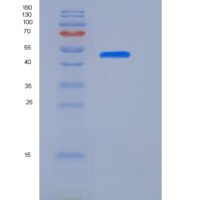
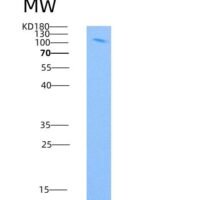
PurityGreater than 85% as determined by SDS-PAGE.
Expression SystemHEK293 Cells
Expression Region1-278aa
Tag InfoC-His
Molecular weight29.9 kDa
EndotoxinLess than 1.0 EU/μg as determined by LAL method.

Function

Multifunctional protein that regulates the growth and differentiation of various cell types and is involved in various processes, such as normal development, immune function, microglia function and responses to neurodegeneration. Activation into mature form follows different steps: following cleavage of the proprotein in the Golgi apparatus, Latency-associated peptide (LAP) and Transforming growth factor beta-1 (TGF-beta-1) chains remain non-covalently linked rendering TGF-beta-1 inactive during storage in extracellular matrix. At the same time, LAP chain interacts with 'milieu molecules', such as LTBP1, LRRC32/GARP and LRRC33/NRROS that control activation of TGF-beta-1 and maintain it in a latent state during storage in extracellular milieus.

Biological Context

Subcellular Location: Secreted
Tissue Specificity: Highly expressed in bone. Abundantly expressed in articular cartilage and chondrocytes and is increased in osteoarthritis (OA). Colocalizes with ASPN in chondrocytes within OA lesions of articular cartilage
Disease Association: Camurati-Engelmann disease 1 (CAEND1) : A form of Camurati-Engelmann disease, an autosomal dominant disorder characterized by hyperostosis and sclerosis of the diaphyses of long bones. Sclerotic changes at the skull base may also be present. The disease typically presents in childhood with pain, muscular weakness, and waddling gait. Systemic manifestations such as anemia, leukopenia, and hepatosplenomegaly may also occur. [The disease is caused by variants affecting the gene represented in this entry] | Inflammatory bowel disease, immunodeficiency, and encephalopathy (IBDIMDE) : An autosomal recessive disorder characterized by severe infantile inflammatory bowel disease manifesting as bloody diarrhea and failure to thrive, global developmental delay, epilepsy, brain atrophy and encephalopathy. Affected individuals suffer from recurrent infections associated with impaired T-cell response to stimulation and decreased T-cell subsets, including regulatory and helper T cells. [The disease is caused by variants affecting the gene represented in this entry]

Product Specifications

Recombinant Human TGFB1 (LAP) / TGF-beta 1 Protein is a recombinant protein, expressed in HEK293 Cells, covering amino acids 1-278aa, with C-His tag, molecular weight 29.9 kDa, purity Greater than 85% as determined by SDS-PAGE.. Suitable for ELISA and Western Blot applications.
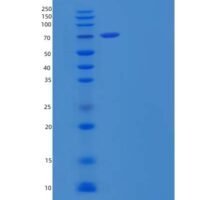
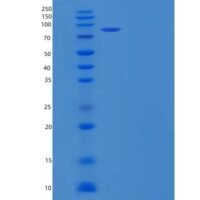
SDS-PAGE: Single band at expected molecular weight confirming purity.

ELISA: Suitable as coating antigen or detection standard.

Western Blot: Compatible with standard Western Blot protocols.

Protein Interaction: Validated for SPR (Surface Plasmon Resonance) and BLI (Bio-Layer Interferometry) studies.

Shipping: Shipped at ambient temperature. Lyophilized protein is stable during transit.

Storage: Store lyophilized protein at -20°C to -80°C. Reconstituted protein should be aliquoted and stored at -80°C. Avoid repeated freeze-thaw cycles.

Shelf Life: 12 months from date of receipt when stored as recommended.

Shipping Time: Orders placed before 2 PM EST ship same day. International orders typically deliver within 5-10 business days.

Protein Biology

Function

Multifunctional protein that regulates the growth and differentiation of various cell types and is involved in various processes, such as normal development, immune function, microglia function and responses to neurodegeneration (By similarity). Activation into mature form follows different steps: following cleavage of the proprotein in the Golgi apparatus, Latency-associated peptide (LAP) and Transforming growth factor beta-1 (TGF-beta-1) chains remain non-covalently linked rendering TGF-beta-1 inactive during storage in extracellular matrix (PubMed:29109152). At the same time, LAP chain interacts with 'milieu molecules', such as LTBP1, LRRC32/GARP and LRRC33/NRROS that control activation of TGF-beta-1 and maintain it in a latent state during storage in extracellular milieus (PubMed:19651619, PubMed:19750484, PubMed:2022183, PubMed:22278742, PubMed:8617200, PubMed:8939931). TGF-beta-1 is released from LAP by integrins (ITGAV:ITGB6 or ITGAV:ITGB8): integrin-binding to LAP stabilizes an alternative conformation of the LAP bowtie tail and results in distortion of the LAP chain and subsequent release of the active TGF-beta-1 (PubMed:22278742, PubMed:28117447). Once activated following release of LAP, TGF-beta-1 acts by binding to TGF-beta receptors (TGFBR1 and TGFBR2), which transduce signal (PubMed:20207738). While expressed by many cells types, TGF-beta-1 only has a very localized range of action within cell environment thanks to fine regulation of its activation by Latency-associated peptide chain (LAP) and 'milieu molecules' (By similarity). Plays an important role in bone remodeling: acts as a potent stimulator of osteoblastic bone formation, causing chemotaxis, proliferation and differentiation in committed osteoblasts (By similarity). Can promote either T-helper 17 cells (Th17) or regulatory T-cells (Treg) lineage differentiation in a concentration-dependent manner (By similarity). At high concentrations, leads to FOXP3-mediated suppression of RORC and down-regulation of IL-17 expression, favoring Treg cell development (By similarity). At low concentrations in concert with IL-6 and IL-21, leads to expression of the IL-17 and IL-23 receptors, favoring differentiation to Th17 cells (By similarity). Stimulates sustained production of collagen through the activation of CREB3L1 by regulated intramembrane proteolysis (RIP) (PubMed:25310401). Mediates SMAD2/3 activation by inducing its phosphorylation and subsequent translocation to the nucleus (PubMed:25893292, PubMed:29483653, PubMed:30696809). Positively regulates odontoblastic differentiation in dental papilla cells, via promotion of IPO7-mediated translocation of phosphorylated SMAD2 to the nucleus and subsequent transcription of target genes (By similarity). Can induce epithelial-to-mesenchymal transition (EMT) and cell migration in various cell types (PubMed:25893292, PubMed:30696809)

Subcellular Location

Secreted

Disease Association

Camurati-Engelmann disease 1 (CAEND1) : A form of Camurati-Engelmann disease, an autosomal dominant disorder characterized by hyperostosis and sclerosis of the diaphyses of long bones. Sclerotic changes at the skull base may also be present. The disease typically presents in childhood with pain, muscular weakness, and waddling gait. Systemic manifestations such as anemia, leukopenia, and hepatosplenomegaly may also occur. [The disease is caused by variants affecting the gene represented in this entry] | Inflammatory bowel disease, immunodeficiency, and encephalopathy (IBDIMDE) : An autosomal recessive disorder characterized by severe infantile inflammatory bowel disease manifesting as bloody diarrhea and failure to thrive, global developmental delay, epilepsy, brain atrophy and encephalopathy. Affected individuals suffer from recurrent infections associated with impaired T-cell response to stimulation and decreased T-cell subsets, including regulatory and helper T cells. [The disease is caused by variants affecting the gene represented in this entry]

Tissue Specificity

Highly expressed in bone (PubMed:11746498, PubMed:17827158). Abundantly expressed in articular cartilage and chondrocytes and is increased in osteoarthritis (OA) (PubMed:11746498, PubMed:17827158). Colocalizes with ASPN in chondrocytes within OA lesions of articular cartilage (PubMed:17827158)

Subunit

Homodimer; disulfide-linked (PubMed:20207738, PubMed:25209176, PubMed:28117447, PubMed:29109152). Interacts with TGF-beta receptors (TGFBR1 and TGFBR2), leading to signal transduction (PubMed:20207738)

Gene: TGFB1  |  Organism: Homo sapiens
Key Publications

Frequently Asked Questions

How do I order or inquire about this product?

Fill out the Online Inquiry form with your required quantity and specifications. You can also email sales@biocrestsci.com. Our team typically responds within 4 business hours with a quote and availability confirmation.

What is the shipping and delivery time?

Orders placed before 2 PM EST ship the same day. Domestic (US) delivery typically takes 2-3 business days. International orders deliver within 5-10 business days. All products are shipped at ambient temperature with appropriate packaging to ensure stability.

How should I store this recombinant protein?

Lyophilized proteins should be stored at -20°C to -80°C upon receipt. After reconstitution, aliquot and store at -80°C. Avoid repeated freeze-thaw cycles. Shelf life is 12 months from date of receipt when stored as recommended.

What quality controls are performed on your products?

Each product undergoes SDS-PAGE purity analysis (typically >85-95%), endotoxin testing, and bioactivity validation. Products are validated for ELISA, Western Blot, and SPR/BLI applications as specified on this product page. A Certificate of Analysis (CoA) is available upon request.

Shopping Cart
Scroll to Top