Recombinant Human Transcriptional repressor CTCF (CTCF), partial Protein

Recombinant Human Transcriptional repressor CTCF (CTCF), partial Protein — Chromatin binding factor that binds to DNA sequence specific sites and regulates the 3D structure of chromatin. Purity >90%.

SKU: BCRECP-00698TM Category:

Product Specifications

Uniprot No.P49711
Gene NamesCTCF
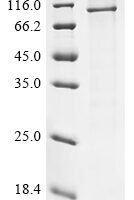
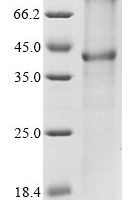
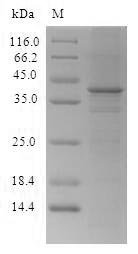
PurityGreater than 90% as determined by SDS-PAGE.
Expression Systemin vitro E.coli expression system
Expression Region266-727aa
SpeciesHomo sapiens (Human)
Tag InfoN-terminal 6xHis-tagged
Molecular weight57.4kDa
BufferIf the delivery form is liquid, the default storage buffer is Tris/PBS-based buffer, 5%-50% glycerol.If the delivery form is lyophilized powder, the buffer before lyophilization is Tris/PBS-based buffer, 6% Trehalose.
StorageStore at -20°C/-80°C upon receipt, aliquoting is necessary for mutiple use. Avoid repeated freeze-thaw cycles.

Function

Chromatin binding factor that binds to DNA sequence specific sites and regulates the 3D structure of chromatin. Binds together strands of DNA, thus forming chromatin loops, and anchors DNA to cellular structures, such as the nuclear lamina. Defines the boundaries between active and heterochromatic DNA via binding to chromatin insulators, thereby preventing interaction between promoter and nearby enhancers and silencers.

Biological Context

Subcellular Location: Nucleus, nucleoplasm; Chromosome; Chromosome, centromere
Tissue Specificity: Ubiquitous. Absent in primary spermatocytes
Disease Association: Intellectual developmental disorder, autosomal dominant 21 (MRD21) : A disorder characterized by significantly below average general intellectual functioning associated with impairments in adaptive behavior and manifested during the developmental period. Additional MRD21 features include short stature, microcephaly, and developmental delay. [The disease is caused by variants affecting the gene represented in this entry]

Product Specifications

Recombinant Human Transcriptional repressor CTCF (CTCF), partial Protein is a recombinant protein from Homo sapiens (Human), expressed in in vitro E.coli expression system, covering amino acids 266-727aa, with N-terminal 6xHis-tagged tag, molecular weight 57.4kDa, purity Greater than 90% as determined by SDS-PAGE.. Suitable for ELISA and Western Blot applications.
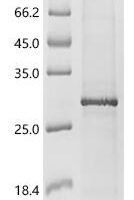
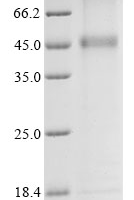
SDS-PAGE: Single band at expected molecular weight confirming purity.

ELISA: Suitable as coating antigen or detection standard.

Western Blot: Compatible with standard Western Blot protocols.

Protein Interaction: Validated for SPR (Surface Plasmon Resonance) and BLI (Bio-Layer Interferometry) studies.

Shipping: Shipped at ambient temperature. Lyophilized protein is stable during transit.

Storage: Store lyophilized protein at -20°C to -80°C. Reconstituted protein should be aliquoted and stored at -80°C. Avoid repeated freeze-thaw cycles.

Shelf Life: 12 months from date of receipt when stored as recommended.

Shipping Time: Orders placed before 2 PM EST ship same day. International orders typically deliver within 5-10 business days.

Protein Biology

Function

Chromatin binding factor that binds to DNA sequence specific sites and regulates the 3D structure of chromatin (PubMed:16949368, PubMed:18347100, PubMed:18654629, PubMed:19322193). Binds together strands of DNA, thus forming chromatin loops, and anchors DNA to cellular structures, such as the nuclear lamina (PubMed:18347100, PubMed:18654629, PubMed:19322193). Defines the boundaries between active and heterochromatic DNA via binding to chromatin insulators, thereby preventing interaction between promoter and nearby enhancers and silencers (PubMed:18347100, PubMed:18654629, PubMed:19322193). Participates in the allele-specific gene expression at the imprinted IGF2/H19 gene locus (PubMed:16107875, PubMed:16815976, PubMed:17827499). On the maternal allele, binding within the H19 imprinting control region (ICR) mediates maternally inherited higher-order chromatin conformation to restrict enhancer access to IGF2 (By similarity). Mediates interchromosomal association between IGF2/H19 and WSB1/NF1 and may direct distant DNA segments to a common transcription factory (By similarity). Regulates asynchronous replication of IGF2/H19 (By similarity). Plays a critical role in gene silencing over considerable distances in the genome (By similarity). Preferentially interacts with unmethylated DNA, preventing spreading of CpG methylation and maintaining methylation-free zones (PubMed:18413740). Inversely, binding to target sites is prevented by CpG methylation (PubMed:18413740). Plays an important role in chromatin remodeling (PubMed:18413740). Can dimerize when it is bound to different DNA sequences, mediating long-range chromatin looping (PubMed:12191639). Causes local loss of histone acetylation and gain of histone methylation in the beta-globin locus, without affecting transcription (PubMed:12191639). When bound to chromatin, it provides an anchor point for nucleosomes positioning (PubMed:12191639). Seems to be essential for homologous X-chromosome pairing (By similarity). May participate with Tsix in establishing a regulatable epigenetic switch for X chromosome inactivation (PubMed:11743158). May play a role in preventing the propagation of stable methylation at the escape genes from X-inactivation (PubMed:11743158). Involved in sister chromatid cohesion (PubMed:12191639). Associates with both centromeres and chromosomal arms during metaphase and required for cohesin localization to CTCF sites (PubMed:18550811). Plays a role in the recruitment of CENPE to the pericentromeric/centromeric regions of the chromosome during mitosis (PubMed:26321640). Acts as a transcriptional repressor binding to promoters of vertebrate MYC gene and BAG1 gene (PubMed:18413740, PubMed:8649389, PubMed:9591631). Also binds to the PLK and PIM1 promoters (PubMed:12191639). Acts as a transcriptional activator of APP (PubMed:9407128). Regulates APOA1/C3/A4/A5 gene cluster and controls MHC class II gene expression (PubMed:18347100, PubMed:19322193). Plays an essential role in oocyte and preimplantation embryo development by activating or repressing transcription (By similarity). Seems to act as tumor suppressor (PubMed:12191639)

Subcellular Location

Nucleus, nucleoplasm; Chromosome; Chromosome, centromere

Disease Association

Intellectual developmental disorder, autosomal dominant 21 (MRD21) : A disorder characterized by significantly below average general intellectual functioning associated with impairments in adaptive behavior and manifested during the developmental period. Additional MRD21 features include short stature, microcephaly, and developmental delay. [The disease is caused by variants affecting the gene represented in this entry]

Tissue Specificity

Ubiquitous. Absent in primary spermatocytes

Subunit

Interacts with CHD8 (PubMed:16949368). Interacts with LLPH (By similarity). Interacts with CENPE (PubMed:26321640). Interacts with BRD2; promoting BRD2 recruitment to chromatin (By similarity)

Gene: CTCF  |  Organism: Homo sapiens  |  Synonyms: 11-zinc finger protein; CCCTC-binding factor; CTCFL paralog
Key Publications

Frequently Asked Questions

How do I order or inquire about this product?

Fill out the Online Inquiry form with your required quantity and specifications. You can also email sales@biocrestsci.com. Our team typically responds within 4 business hours with a quote and availability confirmation.

What is the shipping and delivery time?

Orders placed before 2 PM EST ship the same day. Domestic (US) delivery typically takes 2-3 business days. International orders deliver within 5-10 business days. All products are shipped at ambient temperature with appropriate packaging to ensure stability.

How should I store this recombinant protein?

Lyophilized proteins should be stored at -20°C to -80°C upon receipt. After reconstitution, aliquot and store at -80°C. Avoid repeated freeze-thaw cycles. Shelf life is 12 months from date of receipt when stored as recommended.

What quality controls are performed on your products?

Each product undergoes SDS-PAGE purity analysis (typically >85-95%), endotoxin testing, and bioactivity validation. Products are validated for ELISA, Western Blot, and SPR/BLI applications as specified on this product page. A Certificate of Analysis (CoA) is available upon request.

Shopping Cart
Scroll to Top