,

Recombinant Human Tumor necrosis factor-inducible gene 6 protein (TNFAIP6)

Recombinant Human Tumor necrosis factor-inducible gene 6 protein (TNFAIP6) — Major regulator of extracellular matrix organization during tissue remodeling. Purity >90%.

SKU: BCRECP-001790 Categories: ,

Product Specifications

Product SkuBCRECP-001790
Product DescriptionRecombinant Human Tumor necrosis factor-inducible gene 6 protein (TNFAIP6) Protein is expressed from E.coli with N-terminal 6xHis-tagged. It contains 18-277aa. [Accession | P98066].
Uniprot No.P98066
Gene NamesTNFAIP6
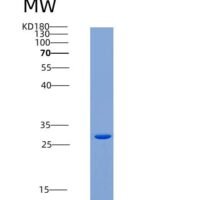
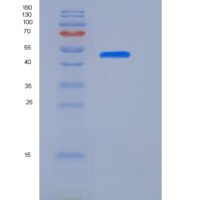
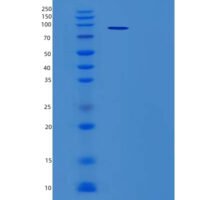
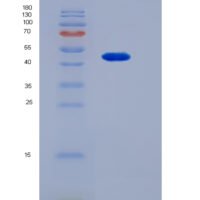
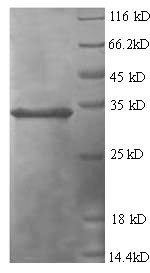
PurityGreater than 90% as determined by SDS-PAGE.
Expression SystemE.coli
Expression Region18-277aa
SpeciesHomo sapiens (Human)
Tag InfoN-terminal 6xHis-tagged
Molecular weight33.1kDa
ActivityPlease contact us to obtain bioactivity data.
BufferIf the delivery form is liquid, the default storage buffer is Tris/PBS-based buffer, 5%-50% glycerol. If the delivery form is lyophilized powder, the buffer before lyophilization is Tris/PBS-based buffer, 6% Trehalose.
StorageStore at -20°C/-80°C upon receipt, aliquoting is necessary for mutiple use. Avoid repeated freeze-thaw cycles.
Research AreasCell Adhesion

Function

Major regulator of extracellular matrix organization during tissue remodeling. Catalyzes the transfer of a heavy chain (HC) from inter-alpha-inhibitor (I-alpha-I) complex to hyaluronan. Cleaves the ester bond between the C-terminus of the HC and GalNAc residue of the chondroitin sulfate chain in I-alpha-I complex followed by transesterification of the HC to hyaluronan.

Biological Context

Subcellular Location: Secreted
Tissue Specificity: Expressed in airway epithelium and submucosal gland (at protein level). Colocalizes with bikunin at the ciliary border. Present in bronchoalveolar lavage fluid (at protein level). Expressed in mesenchymal stem cells. Found in the synovial fluid of patients with rheumatoid arthritis

Product Specifications

Recombinant Human Tumor necrosis factor-inducible gene 6 protein (TNFAIP6) is a recombinant protein from Homo sapiens (Human), expressed in E.coli, covering amino acids 18-277aa, with N-terminal 6xHis-tagged tag, molecular weight 33.1kDa, purity Greater than 90% as determined by SDS-PAGE.. Suitable for ELISA and Western Blot applications.

SDS-PAGE: Single band at expected molecular weight confirming purity.

ELISA: Suitable as coating antigen or detection standard.

Western Blot: Compatible with standard Western Blot protocols.

Protein Interaction: Validated for SPR (Surface Plasmon Resonance) and BLI (Bio-Layer Interferometry) studies.

Shipping: Shipped at ambient temperature. Lyophilized protein is stable during transit.

Storage: Store lyophilized protein at -20°C to -80°C. Reconstituted protein should be aliquoted and stored at -80°C. Avoid repeated freeze-thaw cycles.

Shelf Life: 12 months from date of receipt when stored as recommended.

Shipping Time: Orders placed before 2 PM EST ship same day. International orders typically deliver within 5-10 business days.

Protein Biology

Function

Major regulator of extracellular matrix organization during tissue remodeling (PubMed:15917224, PubMed:18042364, PubMed:26823460). Catalyzes the transfer of a heavy chain (HC) from inter-alpha-inhibitor (I-alpha-I) complex to hyaluronan. Cleaves the ester bond between the C-terminus of the HC and GalNAc residue of the chondroitin sulfate chain in I-alpha-I complex followed by transesterification of the HC to hyaluronan. In the process, potentiates the antiprotease function of I-alpha-I complex through release of free bikunin (PubMed:15917224, PubMed:16873769, PubMed:20463016). Acts as a catalyst in the formation of hyaluronan-HC oligomers and hyaluronan-rich matrix surrounding the cumulus cell-oocyte complex, a necessary step for oocyte fertilization (PubMed:26468290). Assembles hyaluronan in pericellular matrices that serve as platforms for receptor clustering and signaling. Enables binding of hyaluronan deposited on the surface of macrophages to LYVE1 on lymphatic endothelium and facilitates macrophage extravasation. Alters hyaluronan binding to functionally latent CD44 on vascular endothelium, switching CD44 into an active state that supports leukocyte rolling (PubMed:15060082, PubMed:26823460). Modulates the interaction of chemokines with extracellular matrix components and proteoglycans on endothelial cell surface, likely preventing chemokine gradient formation (PubMed:27044744). In a negative feedback mechanism, may limit excessive neutrophil recruitment at inflammatory sites by antagonizing the association of CXCL8 with glycosaminoglycans on vascular endothelium (PubMed:24501198). Has a role in osteogenesis and bone remodeling. Inhibits BMP2-dependent differentiation of mesenchymal stem cell to osteoblasts (PubMed:16771708, PubMed:18586671). Protects against bone erosion during inflammation by inhibiting TNFSF11/RANKL-dependent osteoclast activation (PubMed:18586671)

Subcellular Location

Secreted

Tissue Specificity

Expressed in airway epithelium and submucosal gland (at protein level). Colocalizes with bikunin at the ciliary border. Present in bronchoalveolar lavage fluid (at protein level) (PubMed:16873769). Expressed in mesenchymal stem cells (PubMed:16771708). Found in the synovial fluid of patients with rheumatoid arthritis

Subunit

Interacts (via Link domain) with inter-alpha-inhibitor (I-alpha-I) component bikunin (PubMed:15917224). Interacts with ITIH2/HC2; this interaction is required for transesterification of the HC to hyaluronan (PubMed:20463016). Interacts (via Link and CUB domains) with ITIH1 (PubMed:26468290). Chondroitin sulfate may be required for the stability of the complex (PubMed:7516184). Interacts (via Link domain) with various C-X-C and C-C chemokines including PF4, CXCL8, CXCL11, CXCL12, CCL2, CCL7, CCL19, CCL21, and CCL27; this interaction interferes with chemokine binding to glycosaminoglycans (PubMed:24501198, PubMed:27044744). Interacts (primarily via Link domain) with BMP2; this interaction is inhibited by hyaluronan (PubMed:16771708). Interacts (via both Link and CUB domains) with TNFSF11 (PubMed:18586671). Interacts (via CUB domain) with FN1 (via type III repeats 9-14); this interaction enhances fibronectin fibril assembly. TNFAIP6 may act as a bridging molecule between FN1 and THBS1 (PubMed:18042364)

Gene: TNFAIP6  |  Organism: Homo sapiens  |  Synonyms: Hyaluronate-binding protein; TNF-stimulated gene 6 protein; Tumor necrosis factor alpha-induced protein 6
Key Publications

Frequently Asked Questions

How do I order or inquire about this product?

Fill out the Online Inquiry form with your required quantity and specifications. You can also email sales@biocrestsci.com. Our team typically responds within 4 business hours with a quote and availability confirmation.

What is the shipping and delivery time?

Orders placed before 2 PM EST ship the same day. Domestic (US) delivery typically takes 2-3 business days. International orders deliver within 5-10 business days. All products are shipped at ambient temperature with appropriate packaging to ensure stability.

How should I store this recombinant protein?

Lyophilized proteins should be stored at -20°C to -80°C upon receipt. After reconstitution, aliquot and store at -80°C. Avoid repeated freeze-thaw cycles. Shelf life is 12 months from date of receipt when stored as recommended.

What quality controls are performed on your products?

Each product undergoes SDS-PAGE purity analysis (typically >85-95%), endotoxin testing, and bioactivity validation. Products are validated for ELISA, Western Blot, and SPR/BLI applications as specified on this product page. A Certificate of Analysis (CoA) is available upon request.

Shopping Cart
Scroll to Top