,

Recombinant Human Tumor necrosis factor ligand superfamily member 13B (TNFSF13B), partial (Active)

Recombinant Human Tumor necrosis factor ligand superfamily member 13B (TNFSF13B), partial (Active) — Acts as a transcription factor for its own parent gene, in association with NF-kappa-B p50 subunit, at least in autoimmune and proliferative B-cell diseases. Purity >90%.

SKU: BCACP-000066 Categories: ,
Product SKUBCACP-000066
Product DescriptionRecombinant Human Tumor necrosis factor ligand superfamily member 13B (TNFSF13B) protein is expressed from Mammalian cell with N-terminal hFc-tagged. It contains 134-285aa. [Accession | Q9Y275].
Uniprot No.Q9Y275
Gene NamesTNFSF13B
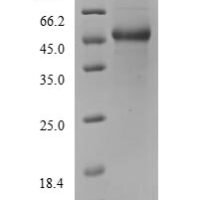
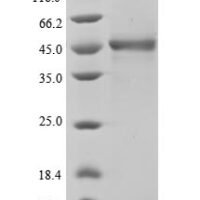
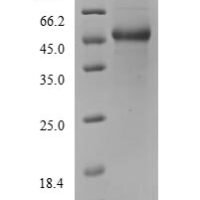
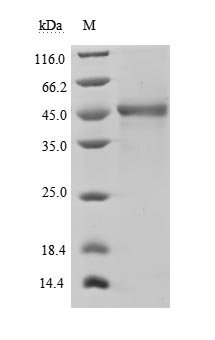
PurityGreater than 90% as determined by SDS-PAGE.Greater than 90% as determined by SEC-HPLC.
Expression SystemMammalian cell
Expression Region134-285aa
SpeciesHomo sapiens (Human)
Tag InfoN-terminal hFc-tagged
Molecular weight46.6 kDa
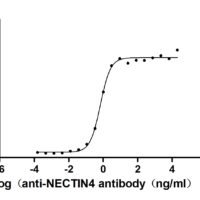
ActivityMeasured by its binding ability in a functional ELISA. Immobilized GH1 at 1 μg/ml can bind human GHR, the EC50 of human GHR protein is 24.96-33.39 ng/ml.;Human GH1 protein his/myc tag captured on COOH chip can bind Human GHR protein Fc tag with an affinity constant of 6.1 nM as detected by LSPR Assay.
BufferLyophilized from a 0.2 μm filtered 20 mM Tris-HCl, 0.5 M NaCl, 6% Trehalose, pH 8.0
StorageStore at -20°C/-80°C upon receipt, aliquoting is necessary for mutiple use. Avoid repeated freeze-thaw cycles.
Alternative NamesB lymphocyte stimulator (BLyS) (B-cell-activating factor) (BAFF) (Dendritic cell-derived TNF-like molecule) (TNF- and APOL-related leukocyte expressed ligand 1) (TALL-1)

Function

Acts as a transcription factor for its own parent gene, in association with NF-kappa-B p50 subunit, at least in autoimmune and proliferative B-cell diseases. The presence of Delta4BAFF is essential for soluble BAFF release by IFNG/IFN-gamma-stimulated monocytes and for B-cell survival. It can directly or indirectly regulate the differential expression of a large number of genes involved in the innate immune response and the regulation of apoptosis.

Biological Context

Subcellular Location: Secreted
Tissue Specificity: Abundantly expressed in peripheral blood Leukocytes and is specifically expressed in monocytes and macrophages. Also found in the spleen, lymph node, bone marrow, T-cells and dendritic cells. A lower expression seen in placenta, heart, lung, fetal liver, thymus, and pancreas. Isoform 2 is expressed in many myeloid cell lines

Product Specifications

Recombinant Human Tumor necrosis factor ligand superfamily member 13B (TNFSF13B), partial (Active) is a recombinant protein from Homo sapiens (Human), expressed in Mammalian cell, covering amino acids 134-285aa, with N-terminal hFc-tagged tag, molecular weight 46.6 kDa, purity Greater than 90% as determined by SDS-PAGE.Greater than 90% as determined by SEC-HPLC.. Suitable for ELISA and Western Blot applications.

Recommended applications depend on the target, product format, and product-specific validation data. Refer to the product datasheet or Certificate of Analysis (CoA), or contact BioCrest Sci for application guidance.

Biological Activity: Measured by its binding ability in a functional ELISA. Immobilized GH1 at 1 μg/ml can bind human GHR, the EC50 of human GHR protein is 24.96-33.39 ng/ml.;Human GH1 protein his/myc tag captured on COOH chip can bind Human GHR protein Fc tag with an affinity constant of 6.1 nM as detected by LSPR Assay.

Storage: Store at -20°C/-80°C upon receipt, aliquoting is necessary for mutiple use. Avoid repeated freeze-thaw cycles.

Shipping & Lead Time: Availability, shipping conditions, and estimated lead time are confirmed in the formal quotation or order confirmation based on the product format, destination, and order requirements.

Protein Biology

Function

Acts as a transcription factor for its own parent gene, in association with NF-kappa-B p50 subunit, at least in autoimmune and proliferative B-cell diseases. The presence of Delta4BAFF is essential for soluble BAFF release by IFNG/IFN-gamma-stimulated monocytes and for B-cell survival. It can directly or indirectly regulate the differential expression of a large number of genes involved in the innate immune response and the regulation of apoptosis

Subcellular Location

Secreted

Tissue Specificity

Abundantly expressed in peripheral blood Leukocytes and is specifically expressed in monocytes and macrophages. Also found in the spleen, lymph node, bone marrow, T-cells and dendritic cells. A lower expression seen in placenta, heart, lung, fetal liver, thymus, and pancreas. Isoform 2 is expressed in many myeloid cell lines

Subunit

Homotrimer. Isoform 2 heteromultimerizes with isoform 1, probably limiting the amount of functional isoform 1 on the cell surface. Isoform 3 is unlikely form trimers or bind to BAFF receptors

Gene: TNFSF13B  |  Organism: Homo sapiens  |  Synonyms: B lymphocyte stimulator; B-cell-activating factor; BAFF; Dendritic cell-derived TNF-like molecule; TNF- and APOL-related leukocyte expressed ligand 1
Key Publications

Frequently Asked Questions

How do I order or inquire about this product?

Submit the Online Inquiry form with your required quantity and specifications, or email sales@biocrestsci.com. Available sizes, pricing, stock status, documentation, and estimated lead time are confirmed in the formal quotation.

What is the shipping and delivery time?

Availability, dispatch timing, shipping conditions, and delivery estimates depend on the product format, destination, and order requirements. These details are confirmed in the formal quotation or order confirmation.

How should this product be stored?

Follow the storage and handling instructions in the product-specific datasheet and Certificate of Analysis (CoA). Requirements may vary by product form and formulation; contact BioCrest Sci if product-specific guidance is needed.

What quality controls are performed on your products?

Quality-control data such as identity, purity, endotoxin level, or biological activity are provided only when specified on this product page, the datasheet, or Certificate of Analysis (CoA). Biological activity is not implied unless explicitly stated.

Shopping Cart
Scroll to Top