,

Recombinant Human Tumor necrosis factor receptor superfamily member 11A (TNFRSF11A), partial

Recombinant Human Tumor necrosis factor receptor superfamily member 11A (TNFRSF11A), partial — Receptor for TNFSF11/RANKL/TRANCE/OPGL; essential for RANKL-mediated osteoclastogenesis. Purity >90%.

SKU: BCRECP-001791 Categories: ,

Product Specifications

Product SkuBCRECP-001791
Product DescriptionRecombinant Human Tumor necrosis factor receptor superfamily member 11A (TNFRSF11A) Protein is expressed from Mammalian cell with C-terminal hFc1-Flag-tagged. It contains 30-212aa. [Accession | Q9Y6Q6].
Uniprot No.Q9Y6Q6
Gene NamesTNFRSF11A
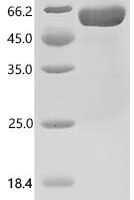
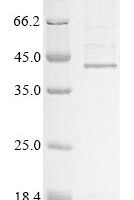
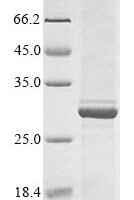
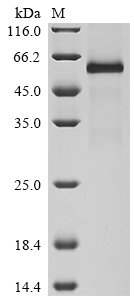
PurityGreater than 90% as determined by SDS-PAGE.
Expression SystemMammalian cell
Expression Region30-212aa
SpeciesHomo sapiens (Human)
Tag InfoC-terminal hFc1-Flag-tagged
Molecular weight50.0kDa
ActivityPlease contact us to obtain bioactivity data.
BufferIf the delivery form is liquid, the default storage buffer is Tris/PBS-based buffer, 5%-50% glycerol. If the delivery form is lyophilized powder, the buffer before lyophilization is Tris/PBS-based buffer, 6% Trehalose.
StorageStore at -20°C/-80°C upon receipt, aliquoting is necessary for mutiple use. Avoid repeated freeze-thaw cycles.
Research AreasImmunology

Function

Receptor for TNFSF11/RANKL/TRANCE/OPGL; essential for RANKL-mediated osteoclastogenesis. Its interaction with EEIG1 promotes osteoclastogenesis via facilitating the transcription of NFATC1 and activation of PLCG2. Involved in the regulation of interactions between T-cells and dendritic cells.

Biological Context

Subcellular Location: Cell membrane (Single-pass type I membrane protein)
Tissue Specificity: Ubiquitous expression with high levels in skeletal muscle, thymus, liver, colon, small intestine and adrenal gland
Disease Association: Familial expansile osteolysis (FEO) : Rare autosomal dominant bone disorder characterized by focal areas of increased bone remodeling. The osteolytic lesions develop usually in the long bones during early adulthood. FEO is often associated with early-onset deafness and loss of dentition. [The disease is caused by variants affecting the gene represented in this entry] | Paget disease of bone 2, early-onset (PDB2) : A form of Paget disease, a disorder of bone remodeling characterized by increased bone turnover affecting one or more sites throughout the skeleton, primarily the axial skeleton. Osteoclastic overactivity followed by compensatory osteoblastic activity leads to a structurally disorganized mosaic of bone (woven bone), which is mechanically weaker, larger, less compact, more vascular, and more susceptible to fracture than normal adult lamellar bone. [The disease is caused by variants affecting the gene represented in this entry] | Osteopetrosis, autosomal recessive 7 (OPTB7) : A rare genetic disease characterized by abnormally dense bone, due to defective resorption of immature bone. Osteopetrosis occurs in two forms: a severe autosomal recessive form occurring in utero, infancy, or childhood, and a benign autosomal dominant form occurring in adolescence or adulthood. Recessive osteopetrosis commonly manifests in early infancy with macrocephaly, feeding difficulties, evolving blindness and deafness, bone marrow failure, severe anemia, and hepatosplenomegaly. Deafness and blindness are generally thought to represent effects of pressure on nerves. OPTB7 is characterized by paucity of osteoclasts, suggesting a molecular defect in osteoclast development. OPTB7 is associated with hypogammaglobulinemia. [The disease is caused by variants affecting the gene represented in this entry]

Product Specifications

Recombinant Human Tumor necrosis factor receptor superfamily member 11A (TNFRSF11A), partial is a recombinant protein from Homo sapiens (Human), expressed in Mammalian cell, covering amino acids 30-212aa, with C-terminal hFc1-Flag-tagged tag, molecular weight 50.0kDa, purity Greater than 90% as determined by SDS-PAGE.. Suitable for ELISA and Western Blot applications.

SDS-PAGE: Single band at expected molecular weight confirming purity.

ELISA: Suitable as coating antigen or detection standard.

Western Blot: Compatible with standard Western Blot protocols.

Protein Interaction: Validated for SPR (Surface Plasmon Resonance) and BLI (Bio-Layer Interferometry) studies.

Shipping: Shipped at ambient temperature. Lyophilized protein is stable during transit.

Storage: Store lyophilized protein at -20°C to -80°C. Reconstituted protein should be aliquoted and stored at -80°C. Avoid repeated freeze-thaw cycles.

Shelf Life: 12 months from date of receipt when stored as recommended.

Shipping Time: Orders placed before 2 PM EST ship same day. International orders typically deliver within 5-10 business days.

Protein Biology

Function

Receptor for TNFSF11/RANKL/TRANCE/OPGL; essential for RANKL-mediated osteoclastogenesis (PubMed:9878548). Its interaction with EEIG1 promotes osteoclastogenesis via facilitating the transcription of NFATC1 and activation of PLCG2 (By similarity). Involved in the regulation of interactions between T-cells and dendritic cells (By similarity)

Subcellular Location

Cell membrane (Single-pass type I membrane protein)

Disease Association

Familial expansile osteolysis (FEO) : Rare autosomal dominant bone disorder characterized by focal areas of increased bone remodeling. The osteolytic lesions develop usually in the long bones during early adulthood. FEO is often associated with early-onset deafness and loss of dentition. [The disease is caused by variants affecting the gene represented in this entry] | Paget disease of bone 2, early-onset (PDB2) : A form of Paget disease, a disorder of bone remodeling characterized by increased bone turnover affecting one or more sites throughout the skeleton, primarily the axial skeleton. Osteoclastic overactivity followed by compensatory osteoblastic activity leads to a structurally disorganized mosaic of bone (woven bone), which is mechanically weaker, larger, less compact, more vascular, and more susceptible to fracture than normal adult lamellar bone. [The disease is caused by variants affecting the gene represented in this entry] | Osteopetrosis, autosomal recessive 7 (OPTB7) : A rare genetic disease characterized by abnormally dense bone, due to defective resorption of immature bone. Osteopetrosis occurs in two forms: a severe autosomal recessive form occurring in utero, infancy, or childhood, and a benign autosomal dominant form occurring in adolescence or adulthood. Recessive osteopetrosis commonly manifests in early infancy with macrocephaly, feeding difficulties, evolving blindness and deafness, bone marrow failure, severe anemia, and hepatosplenomegaly. Deafness and blindness are generally thought to represent effects of pressure on nerves. OPTB7 is characterized by paucity of osteoclasts, suggesting a molecular defect in osteoclast development. OPTB7 is associated with hypogammaglobulinemia. [The disease is caused by variants affecting the gene represented in this entry]

Tissue Specificity

Ubiquitous expression with high levels in skeletal muscle, thymus, liver, colon, small intestine and adrenal gland

Subunit

Binds to the clefts between the subunits of the TNFSF11 ligand trimer to form a heterohexamer (By similarity). Part of a complex composed of EEIG1, TNFRSF11A/RANK, PLCG2, GAB2, TEC and BTK; complex formation increases in the presence of TNFSF11/RANKL (PubMed:23478294). Interacts with TRAF1, TRAF2, TRAF3, TRAF5 and TRAF6 (PubMed:9774460). Interacts (via cytoplasmic domain) with GAB2 (PubMed:15750601). Interacts (via cytoplasmic domain); with EEIG1 (via N-terminus); when in the presence of TNFSF11/RANKL (By similarity). After TNFSF11 stimulation, interacts (via IVVY motif) with STAC2; this interaction affects TNFRSF11A interaction with PLCG2 and GAB2 (By similarity)

Gene: TNFRSF11A  |  Organism: Homo sapiens  |  Synonyms: Osteoclast differentiation factor receptor; Receptor activator of NF-KB
Key Publications

Frequently Asked Questions

How do I order or inquire about this product?

Fill out the Online Inquiry form with your required quantity and specifications. You can also email sales@biocrestsci.com. Our team typically responds within 4 business hours with a quote and availability confirmation.

What is the shipping and delivery time?

Orders placed before 2 PM EST ship the same day. Domestic (US) delivery typically takes 2-3 business days. International orders deliver within 5-10 business days. All products are shipped at ambient temperature with appropriate packaging to ensure stability.

How should I store this recombinant protein?

Lyophilized proteins should be stored at -20°C to -80°C upon receipt. After reconstitution, aliquot and store at -80°C. Avoid repeated freeze-thaw cycles. Shelf life is 12 months from date of receipt when stored as recommended.

What quality controls are performed on your products?

Each product undergoes SDS-PAGE purity analysis (typically >85-95%), endotoxin testing, and bioactivity validation. Products are validated for ELISA, Western Blot, and SPR/BLI applications as specified on this product page. A Certificate of Analysis (CoA) is available upon request.

Shopping Cart
Scroll to Top