,

Recombinant Human Ubiquitin-conjugating enzyme E2 D3 (UBE2D3)

Recombinant Human Ubiquitin-conjugating enzyme E2 D3 (UBE2D3) — Accepts ubiquitin from the E1 complex and catalyzes its covalent attachment to other proteins. Purity >90%.

SKU: BCRECP-001882 Categories: ,

Product Specifications

Product SkuBCRECP-001882
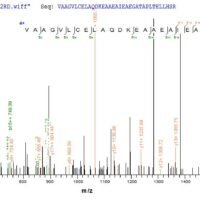
Product DescriptionRecombinant Human Ubiquitin-conjugating enzyme E2 D3 (UBE2D3) Protein is expressed from E.coli with N-terminal 6xHis-SUMO-tagged. It contains 1-147aa. [Accession | P61077].
Uniprot No.P61077
Gene NamesUBE2D3
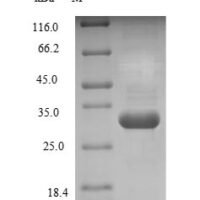
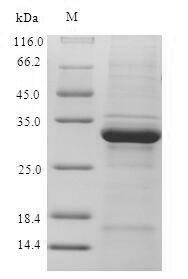
PurityGreater than 90% as determined by SDS-PAGE.
Expression SystemE.coli
Expression Region1-147aa
SpeciesHomo sapiens (Human)
Tag InfoN-terminal 6xHis-SUMO-tagged
Molecular weight32.7kDa
ActivityPlease contact us to obtain bioactivity data.
BufferIf the delivery form is liquid, the default storage buffer is Tris/PBS-based buffer, 5%-50% glycerol. If the delivery form is lyophilized powder, the buffer before lyophilization is Tris/PBS-based buffer, 6% Trehalose.
StorageStore at -20°C/-80°C upon receipt, aliquoting is necessary for mutiple use. Avoid repeated freeze-thaw cycles.
Research AreasApoptosis

Function

Accepts ubiquitin from the E1 complex and catalyzes its covalent attachment to other proteins. In vitro catalyzes 'Lys-11'-, as well as 'Lys-48'-linked polyubiquitination. Cooperates with the E2 CDC34 and the SCF(FBXW11) E3 ligase complex for the polyubiquitination of NFKBIA leading to its subsequent proteasomal degradation.

Biological Context

Subcellular Location: Cell membrane (Peripheral membrane protein); Endosome membrane (Peripheral membrane protein)
Pathway: Protein modification; protein ubiquitination

Product Specifications

Recombinant Human Ubiquitin-conjugating enzyme E2 D3 (UBE2D3) is a recombinant protein from Homo sapiens (Human), expressed in E.coli, covering amino acids 1-147aa, with N-terminal 6xHis-SUMO-tagged tag, molecular weight 32.7kDa, purity Greater than 90% as determined by SDS-PAGE.. Suitable for ELISA and Western Blot applications.

Recommended applications depend on the target, product format, and product-specific validation data. Refer to the product datasheet or Certificate of Analysis (CoA), or contact BioCrest Sci for application guidance.

Biological Activity: Please contact us to obtain bioactivity data.

Storage: Store at -20°C/-80°C upon receipt, aliquoting is necessary for mutiple use. Avoid repeated freeze-thaw cycles.

Shipping & Lead Time: Availability, shipping conditions, and estimated lead time are confirmed in the formal quotation or order confirmation based on the product format, destination, and order requirements.

Protein Biology

Function

Accepts ubiquitin from the E1 complex and catalyzes its covalent attachment to other proteins (PubMed:15247280, PubMed:15496420, PubMed:18284575, PubMed:20061386, PubMed:21532592, PubMed:28322253). In vitro catalyzes 'Lys-11'-, as well as 'Lys-48'-linked polyubiquitination (PubMed:15247280, PubMed:15496420, PubMed:18284575, PubMed:20061386, PubMed:21532592). Cooperates with the E2 CDC34 and the SCF(FBXW11) E3 ligase complex for the polyubiquitination of NFKBIA leading to its subsequent proteasomal degradation (PubMed:20347421). Acts as an initiator E2, priming the phosphorylated NFKBIA target at positions 'Lys-21' and/or 'Lys-22' with a monoubiquitin (PubMed:10329681). Ubiquitin chain elongation is then performed by CDC34, building ubiquitin chains from the UBE2D3-primed NFKBIA-linked ubiquitin (PubMed:10329681). Also acts as an initiator E2, in conjunction with RNF8, for the priming of PCNA (PubMed:18948756). Monoubiquitination of PCNA, and its subsequent polyubiquitination, are essential events in the operation of the DNA damage tolerance (DDT) pathway that is activated after DNA damage caused by UV or chemical agents during S-phase (PubMed:18948756). Associates with the BRCA1/BARD1 E3 ligase complex to perform ubiquitination at DNA damage sites following ionizing radiation leading to DNA repair (PubMed:16628214). Targets DAPK3 for ubiquitination which influences promyelocytic leukemia protein nuclear body (PML-NB) formation in the nucleus (PubMed:18515077). In conjunction with the MDM2 and TOPORS E3 ligases, functions ubiquitination of p53/TP53 (PubMed:12646252, PubMed:15280377). In conjunction with the CBL E3 ligase, targets EGFR for polyubiquitination at the plasma membrane as well as during its internalization and transport on endosomes (PubMed:18508924). In conjunction with the STUB1 E3 quality control E3 ligase, ubiquitinates unfolded proteins to catalyze their immediate destruction (PubMed:11743028). Together with RNF135, catalyzes the viral RNA-dependent 'Lys-63'-linked polyubiquitination of RIGI to activate the downstream signaling pathway that leads to interferon beta production (PubMed:28469175). Together with ZNF598, catalyzes ubiquitination of 40S ribosomal proteins in response to ribosome collisions (PubMed:28685749). In cooperation with the GATOR2 complex, catalyzes 'Lys-6'-linked ubiquitination of NPRL2 (PubMed:36528027)

Subcellular Location

Cell membrane (Peripheral membrane protein); Endosome membrane (Peripheral membrane protein)

Subunit

Interacts with SCF (SKP1-CUL1-F-box protein) E3 ubiquitin ligase complex; when Cullin is neddylated, the interaction between the E2 and the SCF complex is strengthened. Interacts with DAPK3. Interacts with BRCA1; the DNA damage checkpoint promotes the association with BRCA1 after ionizing radiation. Interacts non-covalently with ubiquitin. Interacts with E3 ubiquitin-protein ligase CBLC. Interacts with UBTD1 (PubMed:24211586). Interacts with RIGI and RNF135; involved in RIGI ubiquitination and activation (PubMed:28469175)

Pathway

Protein modification; protein ubiquitination

Gene: UBE2D3  |  Organism: Homo sapiens  |  Synonyms: (E3-independent) E2 ubiquitin-conjugating enzyme D3; E2 ubiquitin-conjugating enzyme D3; Ubiquitin carrier protein D3; Ubiquitin-conjugating enzyme E2(17)KB 3; Ubiquitin-conjugating enzyme E2-17 kDa 3; Ubiquitin-protein ligase D3
Key Publications

Frequently Asked Questions

How do I order or inquire about this product?

Submit the Online Inquiry form with your required quantity and specifications, or email sales@biocrestsci.com. Available sizes, pricing, stock status, documentation, and estimated lead time are confirmed in the formal quotation.

What is the shipping and delivery time?

Availability, dispatch timing, shipping conditions, and delivery estimates depend on the product format, destination, and order requirements. These details are confirmed in the formal quotation or order confirmation.

How should this product be stored?

Follow the storage and handling instructions in the product-specific datasheet and Certificate of Analysis (CoA). Requirements may vary by product form and formulation; contact BioCrest Sci if product-specific guidance is needed.

What quality controls are performed on your products?

Quality-control data such as identity, purity, endotoxin level, or biological activity are provided only when specified on this product page, the datasheet, or Certificate of Analysis (CoA). Biological activity is not implied unless explicitly stated.

Shopping Cart
Scroll to Top