,

Recombinant Human Urokinase-type plasminogen activator (PLAU) (Active)

Recombinant Human Urokinase-type plasminogen activator (PLAU) (Active) — Serine protease that cleaves the inactive precursor plasminogen at a specific Arg-Val peptide bond, converting it into active plasmin. Purity >95%.

SKU: BCRECP-001398 Categories: ,

Product Specifications

Product SkuBCRECP-001398
Product DescriptionRecombinant Human Urokinase-type plasminogen activator (PLAU) (Active) Protein is expressed from Mammalian cell with C-terminal 10xHis-tagged. It contains 21-431aa. [Accession | P00749].
Uniprot No.P00749
Gene NamesPLAU
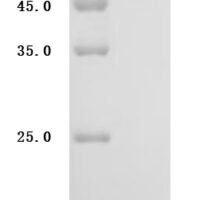
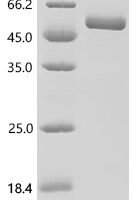
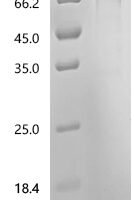
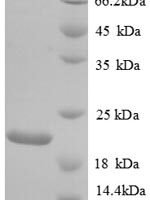
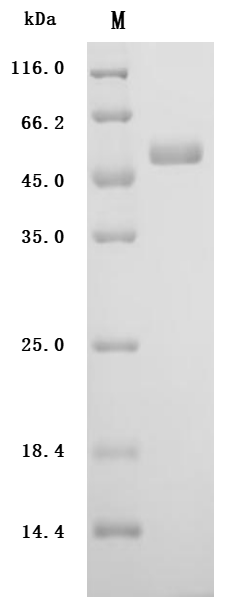
PurityGreater than 95% as determined by SDS-PAGE.
Expression SystemMammalian cell
Expression Region21-431aa
SpeciesHomo sapiens (Human)
Tag InfoC-terminal 10xHis-tagged
Molecular weight47.9kDa
ActivityPlease contact us to obtain bioactivity data.
BufferIf the delivery form is liquid, the default storage buffer is Tris/PBS-based buffer, 5%-50% glycerol. If the delivery form is lyophilized powder, the buffer before lyophilization is Tris/PBS-based buffer, 6% Trehalose.
StorageStore at -20°C/-80°C upon receipt, aliquoting is necessary for mutiple use. Avoid repeated freeze-thaw cycles.
Research AreasCancer

Function

Serine protease that cleaves the inactive precursor plasminogen at a specific Arg-Val peptide bond, converting it into active plasmin. Secreted as an inactive zymogen, it is recruited and activated at the cell surface through interaction with the urokinase plasminogen activator receptor (uPAR). Cell-surface activation enables localized, plasmin-dependent pericellular proteolysis, regulating extracellular matrix degradation in cell migration and tissue remodeling.

Biological Context

Subcellular Location: Secreted
Tissue Specificity: Expressed in the prostate gland and prostate cancers
Disease Association: Quebec platelet disorder (QPD) : An autosomal dominant bleeding disorder due to a gain-of-function defect in fibrinolysis. Although affected individuals do not exhibit systemic fibrinolysis, they show delayed onset bleeding after challenge, such as surgery. The hallmark of the disorder is markedly increased PLAU levels within platelets, which causes intraplatelet plasmin generation and secondary degradation of alpha-granule proteins. [The disease is caused by variants affecting the gene represented in this entry]

Product Specifications

Recombinant Human Urokinase-type plasminogen activator (PLAU) (Active) is a recombinant protein from Homo sapiens (Human), expressed in Mammalian cell, covering amino acids 21-431aa, with C-terminal 10xHis-tagged tag, molecular weight 47.9kDa, purity Greater than 95% as determined by SDS-PAGE.. Suitable for ELISA and Western Blot applications.

Recommended applications depend on the target, product format, and product-specific validation data. Refer to the product datasheet or Certificate of Analysis (CoA), or contact BioCrest Sci for application guidance.

Biological Activity: Please contact us to obtain bioactivity data.

Storage: Store at -20°C/-80°C upon receipt, aliquoting is necessary for mutiple use. Avoid repeated freeze-thaw cycles.

Shipping & Lead Time: Availability, shipping conditions, and estimated lead time are confirmed in the formal quotation or order confirmation based on the product format, destination, and order requirements.

Protein Biology

Function

Serine protease that cleaves the inactive precursor plasminogen at a specific Arg-Val peptide bond, converting it into active plasmin (PubMed:1969415, PubMed:2521625, PubMed:4270330). Secreted as an inactive zymogen, it is recruited and activated at the cell surface through interaction with the urokinase plasminogen activator receptor (uPAR). Cell-surface activation enables localized, plasmin-dependent pericellular proteolysis, regulating extracellular matrix degradation in cell migration and tissue remodeling (PubMed:1829461, PubMed:2521625, PubMed:28849762). Also contributes to fibrinolysis and blood clot clearance by promoting plasmin generation (By similarity)

Subcellular Location

Secreted

Disease Association

Quebec platelet disorder (QPD) : An autosomal dominant bleeding disorder due to a gain-of-function defect in fibrinolysis. Although affected individuals do not exhibit systemic fibrinolysis, they show delayed onset bleeding after challenge, such as surgery. The hallmark of the disorder is markedly increased PLAU levels within platelets, which causes intraplatelet plasmin generation and secondary degradation of alpha-granule proteins. [The disease is caused by variants affecting the gene represented in this entry]

Tissue Specificity

Expressed in the prostate gland and prostate cancers

Subunit

Found in high and low molecular mass forms. Each consists of two chains, A and B. The high molecular mass form contains a long chain A which is cleaved to yield a short chain A. Forms heterodimer with SERPINA5. Binds LRP1B; binding is followed by internalization and degradation. Interacts with MRC2. Interacts with PLAUR. In complex with SERPINE1, interacts with PLAUR/uPAR (PubMed:15053742). Interacts with SORL1 and LRP1, either alone or in complex with SERPINE1; these interactions are abolished in the presence of LRPAP1/RAP (PubMed:15053742). The ternary complex composed of PLAUR-PLAU-PAI1 also interacts with SORLA (PubMed:15053742)

Gene: PLAU  |  Organism: Homo sapiens
Key Publications

Frequently Asked Questions

How do I order or inquire about this product?

Submit the Online Inquiry form with your required quantity and specifications, or email sales@biocrestsci.com. Available sizes, pricing, stock status, documentation, and estimated lead time are confirmed in the formal quotation.

What is the shipping and delivery time?

Availability, dispatch timing, shipping conditions, and delivery estimates depend on the product format, destination, and order requirements. These details are confirmed in the formal quotation or order confirmation.

How should this product be stored?

Follow the storage and handling instructions in the product-specific datasheet and Certificate of Analysis (CoA). Requirements may vary by product form and formulation; contact BioCrest Sci if product-specific guidance is needed.

What quality controls are performed on your products?

Quality-control data such as identity, purity, endotoxin level, or biological activity are provided only when specified on this product page, the datasheet, or Certificate of Analysis (CoA). Biological activity is not implied unless explicitly stated.

Shopping Cart
Scroll to Top