Recombinant Mouse Adenomatous polyposis coli protein (Apc), partial

Recombinant Mouse Adenomatous polyposis coli protein (Apc), partial — Tumor suppressor. Purity >85%.

SKU: BCRECP-002105 Category:

Product Specifications

Product SkuBCRECP-002105
Product DescriptionRecombinant Mouse Adenomatous polyposis coli protein (Apc) Protein is expressed from E.coli with N-terminal 10xHis-tagged and C-terminal Myc-tagged. It contains 958-1335aa. [Accession | Q61315].
Uniprot No.Q61315
Gene NamesApc
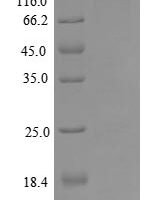
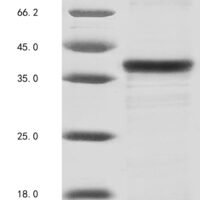
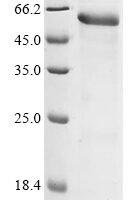
PurityGreater than 85% as determined by SDS-PAGE.
Expression SystemE.coli
Expression Region958-1335aa
SpeciesMus musculus (Mouse)
Tag InfoN-terminal 10xHis-tagged and C-terminal Myc-tagged
Molecular weight49.9kDa
ActivityPlease contact us to obtain bioactivity data.
BufferIf the delivery form is liquid, the default storage buffer is Tris/PBS-based buffer, 5%-50% glycerol. If the delivery form is lyophilized powder, the buffer before lyophilization is Tris/PBS-based buffer, 6% Trehalose.
StorageStore at -20°C/-80°C upon receipt, aliquoting is necessary for mutiple use. Avoid repeated freeze-thaw cycles.
Research AreasOthers

Function

Tumor suppressor. Promotes rapid degradation of CTNNB1 and participates in Wnt signaling as a negative regulator.

Product Specifications

Recombinant Mouse Adenomatous polyposis coli protein (Apc), partial — Tumor suppressor. Purity >85%. Suitable for ELISA and Western Blot applications.

Recommended applications depend on the target, product format, and product-specific validation data. Refer to the product datasheet or Certificate of Analysis (CoA), or contact BioCrest Sci for application guidance.

Biological Activity: Please contact us to obtain bioactivity data.

Storage: Store at -20°C/-80°C upon receipt, aliquoting is necessary for mutiple use. Avoid repeated freeze-thaw cycles.

Shipping & Lead Time: Availability, shipping conditions, and estimated lead time are confirmed in the formal quotation or order confirmation based on the product format, destination, and order requirements.

Protein Biology

Function

Tumor suppressor. Promotes rapid degradation of CTNNB1 and participates in Wnt signaling as a negative regulator. APC activity is correlated with its phosphorylation state. Activates the GEF activity of SPATA13 and ARHGEF4. Plays a role in hepatocyte growth factor (HGF)-induced cell migration (By similarity). Required for MMP9 up-regulation via the JNK signaling pathway in colorectal tumor cells (PubMed:19893577). Associates with both microtubules and actin filaments, components of the cytoskeleton (By similarity). Plays a role in mediating the organization of F-actin into ordered bundles (By similarity). Functions downstream of Rho GTPases and DIAPH1 to selectively stabilize microtubules (PubMed:15311282). Acts as a mediator of ERBB2-dependent stabilization of microtubules at the cell cortex. It is required for the localization of MACF1 to the cell membrane and this localization of MACF1 is critical for its function in microtubule stabilization (By similarity)

Subcellular Location

Cell junction, adherens junction; Cytoplasm, cytoskeleton; Cell projection, lamellipodium; Cell projection, ruffle membrane; Cytoplasm; Cell membrane

Tissue Specificity

Expressed in liver, spleen, kidney, heart, lung, brain, stomach, intestine, testis and ovary

Subunit

Forms homooligomers (Probable). Found in a complex consisting of ARHGEF4, APC and CTNNB1 (By similarity). Found in a complex composed of MACF1, APC, AXIN1, CTNNB1 and GSK3B (By similarity). The complex composed, at least, of APC, CTNNB1 and GSK3B interacts with JPT1; the interaction requires the inactive form of GSK3B (phosphorylated at 'Ser-9') (By similarity). Interacts with APC2 (By similarity). Interacts with DLG1 (via PDZ domains) and DLG3 (via PDZ domains) (By similarity). Interacts with alpha- and beta-catenins (By similarity). Interacts with AXIN1 (via RGS domain) (By similarity). Interacts with ARHGEF4 (via N-terminus) (By similarity). Interacts (via C-terminal residues 2674-2843) with MAPRE1 (via C-terminal residues 206-211); the interaction inhibits association with and bundling of F-actin (PubMed:15311282). Interacts with MAPRE2 and MAPRE3 (via C-terminus) (By similarity). Interacts with DIAPH1; DIAPH1 acts as a scaffold protein for MAPRE1 and APC to stabilize microtubules and promote cell migration (PubMed:15311282). Interacts with DIAPH2 (PubMed:15311282). Interacts with SCRIB; may mediate targeting to adherens junctions of epithelial cells (PubMed:16611247). Interacts with SPATA13 (via N-terminus and SH3 domain) (By similarity). Interacts with ASAP1 (via SH3 domain) (By similarity). Interacts (at the cell membrane) with AMER1 and AMER2 (via ARM repeats) (By similarity). Interacts with KHDRBS1 (By similarity). Interacts with actin; binds both to F-actin and actin filament bundles (By similarity)

Gene: Apc  |  Organism: Mus musculus
Key Publications

Frequently Asked Questions

How do I order or inquire about this product?

Submit the Online Inquiry form with your required quantity and specifications, or email sales@biocrestsci.com. Available sizes, pricing, stock status, documentation, and estimated lead time are confirmed in the formal quotation.

What is the shipping and delivery time?

Availability, dispatch timing, shipping conditions, and delivery estimates depend on the product format, destination, and order requirements. These details are confirmed in the formal quotation or order confirmation.
How should this product be stored?

Follow the storage and handling instructions in the product-specific datasheet and Certificate of Analysis (CoA). Requirements may vary by product form and formulation; contact BioCrest Sci if product-specific guidance is needed.

What quality controls are performed on your products?

Quality-control data such as identity, purity, endotoxin level, or biological activity are provided only when specified on this product page, the datasheet, or Certificate of Analysis (CoA). Biological activity is not implied unless explicitly stated.

Shopping Cart
Scroll to Top