,

Recombinant Mouse Aldehyde dehydrogenase 1A1 (Aldh1a1)

Recombinant Mouse Aldehyde dehydrogenase 1A1 (Aldh1a1) — Cytosolic dehydrogenase that catalyzes the irreversible oxidation of a wide range of aldehydes to their corresponding carboxylic acid. Purity >95%.

SKU: BCRECP-002058 Categories: ,

Product Specifications

Product SkuBCRECP-002058
Product DescriptionRecombinant Mouse Aldehyde dehydrogenase 1A1 (Aldh1a1) Protein is expressed from E.coli with N-terminal 6xHis-tagged. It contains 2-501aa. [Accession | P24549].
Uniprot No.P24549
Gene NamesAldh1a1
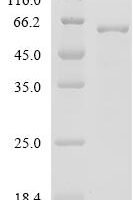
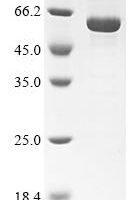
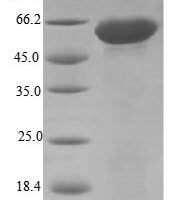
PurityGreater than 95% as determined by SDS-PAGE.
Expression SystemE.coli
Expression Region2-501aa
SpeciesMus musculus (Mouse)
Tag InfoN-terminal 6xHis-tagged
Molecular weight58.4kDa
ActivityPlease contact us to obtain bioactivity data.
BufferIf the delivery form is liquid, the default storage buffer is Tris/PBS-based buffer, 5%-50% glycerol. If the delivery form is lyophilized powder, the buffer before lyophilization is Tris/PBS-based buffer, 6% Trehalose.
StorageStore at -20°C/-80°C upon receipt, aliquoting is necessary for mutiple use. Avoid repeated freeze-thaw cycles.
Research AreasNeuroscience

Function

Cytosolic dehydrogenase that catalyzes the irreversible oxidation of a wide range of aldehydes to their corresponding carboxylic acid. Functions downstream of retinol dehydrogenases and catalyzes the oxidation of retinaldehyde into retinoic acid, the second step in the oxidation of retinol/vitamin A into retinoic acid. This pathway is crucial to control the levels of retinol and retinoic acid, two important molecules which excess can be teratogenic and cytotoxic (Probable).

Biological Context

Subcellular Location: Cytoplasm, cytosol; Cell projection, axon
Tissue Specificity: Expressed in retina. Expressed in lens and cornea (at protein level). Expressed by midbrain dopamine neurons
Pathway: Cofactor metabolism; retinol metabolism

Product Specifications

Recombinant Mouse Aldehyde dehydrogenase 1A1 (Aldh1a1) is a recombinant protein from Mus musculus (Mouse), expressed in E.coli, covering amino acids 2-501aa, with N-terminal 6xHis-tagged tag, molecular weight 58.4kDa, purity Greater than 95% as determined by SDS-PAGE.. Suitable for ELISA and Western Blot applications.

Recommended applications depend on the target, product format, and product-specific validation data. Refer to the product datasheet or Certificate of Analysis (CoA), or contact BioCrest Sci for application guidance.

Biological Activity: Please contact us to obtain bioactivity data.

Storage: Store at -20°C/-80°C upon receipt, aliquoting is necessary for mutiple use. Avoid repeated freeze-thaw cycles.

Shipping & Lead Time: Availability, shipping conditions, and estimated lead time are confirmed in the formal quotation or order confirmation based on the product format, destination, and order requirements.

Protein Biology

Function

Cytosolic dehydrogenase that catalyzes the irreversible oxidation of a wide range of aldehydes to their corresponding carboxylic acid (PubMed:12851412). Functions downstream of retinol dehydrogenases and catalyzes the oxidation of retinaldehyde into retinoic acid, the second step in the oxidation of retinol/vitamin A into retinoic acid (PubMed:12851412). This pathway is crucial to control the levels of retinol and retinoic acid, two important molecules which excess can be teratogenic and cytotoxic (Probable). Also oxidizes aldehydes resulting from lipid peroxidation like (E)-4-hydroxynon-2-enal/HNE, malonaldehyde and hexanal that form protein adducts and are highly cytotoxic. By participating for instance to the clearance of (E)-4-hydroxynon-2-enal/HNE in the lens epithelium prevents the formation of HNE-protein adducts and lens opacification (PubMed:17567582). Also functions downstream of fructosamine-3-kinase in the fructosamine degradation pathway by catalyzing the oxidation of 3-deoxyglucosone, the carbohydrate product of fructosamine 3-phosphate decomposition, which is itself a potent glycating agent that may react with lysine and arginine side-chains of proteins (By similarity). Also has an aminobutyraldehyde dehydrogenase activity and is probably part of an alternative pathway for the biosynthesis of GABA/4-aminobutanoate in midbrain, thereby playing a role in GABAergic synaptic transmission (PubMed:26430123)

Subcellular Location

Cytoplasm, cytosol; Cell projection, axon

Tissue Specificity

Expressed in retina (PubMed:1935685). Expressed in lens and cornea (at protein level) (PubMed:17567582). Expressed by midbrain dopamine neurons (PubMed:26430123)

Subunit

Homotetramer (By similarity). Interacts with PRMT3; the interaction is direct, inhibits ALDH1A1 aldehyde dehydrogenase activity and is independent of the methyltransferase activity of PRMT3 (By similarity)

Pathway

Cofactor metabolism; retinol metabolism

Gene: Aldh1a1  |  Organism: Mus musculus  |  Synonyms: 3-deoxyglucosone dehydrogenase; ALDH-E1; ALHDII; Aldehyde dehydrogenase family 1 member A1; Aldehyde dehydrogenase, cytosolic; Retinal dehydrogenase 1
Key Publications

Frequently Asked Questions

How do I order or inquire about this product?

Submit the Online Inquiry form with your required quantity and specifications, or email sales@biocrestsci.com. Available sizes, pricing, stock status, documentation, and estimated lead time are confirmed in the formal quotation.

What is the shipping and delivery time?

Availability, dispatch timing, shipping conditions, and delivery estimates depend on the product format, destination, and order requirements. These details are confirmed in the formal quotation or order confirmation.

How should this product be stored?

Follow the storage and handling instructions in the product-specific datasheet and Certificate of Analysis (CoA). Requirements may vary by product form and formulation; contact BioCrest Sci if product-specific guidance is needed.

What quality controls are performed on your products?

Quality-control data such as identity, purity, endotoxin level, or biological activity are provided only when specified on this product page, the datasheet, or Certificate of Analysis (CoA). Biological activity is not implied unless explicitly stated.

Shopping Cart
Scroll to Top