,

Recombinant Mouse Complement component C1q receptor (Cd93), partial (Active)

Recombinant Mouse Complement component C1q receptor (Cd93), partial (Active) — Cell surface receptor that plays a role in various physiological processes including inflammation, phagocytosis, and cell adhesion. Purity >95%.

SKU: BCACP-000211 Categories: ,
Product SKUBCACP-000211
Product DescriptionRecombinant Mouse Complement component C1q receptor (Cd93) protein is expressed from Mammalian cell with C-terminal 10xHis-tagged. It contains 23-572aa. [Accession | O89103].
Uniprot No.O89103
Gene NamesCd93
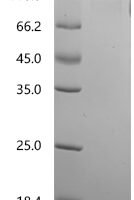
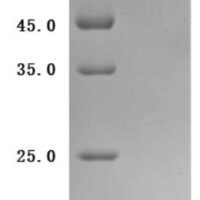
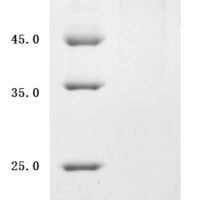
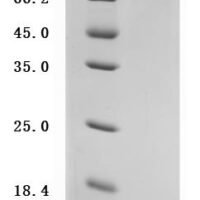
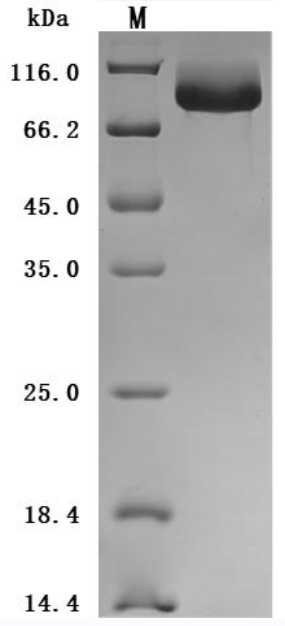
PurityGreater than 95% as determined by SDS-PAGE.
Expression SystemMammalian cell
Expression Region23-572aa
SpeciesMus musculus (Mouse)
Tag InfoC-terminal 10xHis-tagged
Molecular weight60.9 kDa
ActivityMeasured by its binding ability in a functional ELISA. Immobilized PROM1 at 5 μg/mL can bind Anti-PROM1 recombinant antibody , the EC50 is 0.4322-0.7189 ng/mL.
BufferLyophilized from a 0.2 μm filtered 20 mM Tris-HCl, 0.5 M NaCl, 6% Trehalose, pH 8.0
StorageStore at -20°C/-80°C upon receipt, aliquoting is necessary for mutiple use. Avoid repeated freeze-thaw cycles.
Alternative Names(C1q/MBL/SPA receptor)(C1qR(p))(C1qRp)(Cell surface antigen AA4)(Complement component 1 q subcomponent receptor 1)(Lymphocyte antigen 68)(Ly-68)(CD antigen CD93)

Function

Cell surface receptor that plays a role in various physiological processes including inflammation, phagocytosis, and cell adhesion. Plays a role in phagocytosis and enhances the uptake of apoptotic cells and immune complexes by acting as a receptor for defense collagens including surfactant protein A/SFTPA1, C1q, and mannose-binding lectin (MBL2). Plays a role in the regulation of endothelial cell function and adhesion by activating angiogenesis.

Biological Context

Subcellular Location: Cell membrane (Single-pass type I membrane protein)
Tissue Specificity: Expressed in lung, heart and bone marrow. Expressed at lower level in ovary, whole embryo and fetal liver. Not detected in brain, adult liver or thymus. Highly expressed in peritoneal cavity and bone marrow macrophages. Not detected in epithelial cells

Product Specifications

Recombinant Mouse Complement component C1q receptor (Cd93), partial (Active) is a recombinant protein from Mus musculus (Mouse), expressed in Mammalian cell, covering amino acids 23-572aa, with C-terminal 10xHis-tagged tag, molecular weight 60.9 kDa, purity Greater than 95% as determined by SDS-PAGE.. Suitable for ELISA and Western Blot applications.

SDS-PAGE: Single band at expected molecular weight confirming purity.

ELISA: Suitable as coating antigen or detection standard.

Western Blot: Compatible with standard Western Blot protocols.

Protein Interaction: Validated for SPR (Surface Plasmon Resonance) and BLI (Bio-Layer Interferometry) studies.

Shipping: Shipped at ambient temperature. Lyophilized protein is stable during transit.

Storage: Store lyophilized protein at -20°C to -80°C. Reconstituted protein should be aliquoted and stored at -80°C. Avoid repeated freeze-thaw cycles.

Shelf Life: 12 months from date of receipt when stored as recommended.

Shipping Time: Orders placed before 2 PM EST ship same day. International orders typically deliver within 5-10 business days.

Protein Biology

Function

Cell surface receptor that plays a role in various physiological processes including inflammation, phagocytosis, and cell adhesion (PubMed:15004139, PubMed:20439917, PubMed:38441970). Plays a role in phagocytosis and enhances the uptake of apoptotic cells and immune complexes by acting as a receptor for defense collagens including surfactant protein A/SFTPA1, C1q, and mannose-binding lectin (MBL2) (PubMed:15004139). Plays a role in the regulation of endothelial cell function and adhesion by activating angiogenesis. Mechanistically, exerts its angiogenic function by associating with beta-dystroglycan, leading to SRC-dependent phosphorylation and subsequent recruitment of CBL. In turn, CBL provides a docking site for downstream signaling components, such as CRKL to enhance cell migration. Participates in angiogenesis also by acting as a receptor for the ECM pan-endothelial glycoprotein multimerin-2/MMRN2 and IGFBP7 ligands. Both ligands play a non-redundant role in CD93-mediated endothelial cell function (By similarity). Acts as a key regulator of endothelial barrier function through modulating VEGFR2 function (PubMed:38441970)

Subcellular Location

Cell membrane (Single-pass type I membrane protein)

Tissue Specificity

Expressed in lung, heart and bone marrow. Expressed at lower level in ovary, whole embryo and fetal liver. Not detected in brain, adult liver or thymus. Highly expressed in peritoneal cavity and bone marrow macrophages. Not detected in epithelial cells

Subunit

Homodimer. Interacts with C1QBP; the association may represent a cell surface C1q receptor. Interacts with surfactant protein A/SFTPA1. Interacts with multimerin-2/MMRN2. Interacts with DAG1; this interaction plays an important role in endothelial cell migration. Interacts with CBL. Interacts with IGFBP7 (By similarity). Interacts with VEGFR2 (PubMed:38441970)

Gene: Cd93  |  Organism: Mus musculus  |  Synonyms: C1q/MBL/SPA receptor; Cell surface antigen AA4; Complement component 1 q subcomponent receptor 1; Lymphocyte antigen 68
Key Publications

Frequently Asked Questions

How do I order or inquire about this product?

Fill out the Online Inquiry form with your required quantity and specifications. You can also email sales@biocrestsci.com. Our team typically responds within 4 business hours with a quote and availability confirmation.

What is the shipping and delivery time?

Orders placed before 2 PM EST ship the same day. Domestic (US) delivery typically takes 2-3 business days. International orders deliver within 5-10 business days. All products are shipped at ambient temperature with appropriate packaging to ensure stability.

How should I store this recombinant protein?

Lyophilized proteins should be stored at -20°C to -80°C upon receipt. After reconstitution, aliquot and store at -80°C. Avoid repeated freeze-thaw cycles. Shelf life is 12 months from date of receipt when stored as recommended.

What quality controls are performed on your products?

Each product undergoes SDS-PAGE purity analysis (typically >85-95%), endotoxin testing, and bioactivity validation. Products are validated for ELISA, Western Blot, and SPR/BLI applications as specified on this product page. A Certificate of Analysis (CoA) is available upon request.

Shopping Cart
Scroll to Top