, ,

Recombinant Mouse Cyclin-dependent kinase 9 (Cdk9)

Recombinant Mouse Cyclin-dependent kinase 9 (Cdk9) — Protein kinase involved in the regulation of transcription. Purity >95%.

SKU: BCRECP-002347 Categories: , ,

Product Specifications

Product SkuBCRECP-002347
Product DescriptionRecombinant Mouse Cyclin-dependent kinase 9 (Cdk9) Protein is expressed from E.coli with N-terminal 10xHis-tagged and C-terminal Myc-tagged. It contains 1-372aa. [Accession | Q99J95].
Uniprot No.Q99J95
Gene NamesCdk9
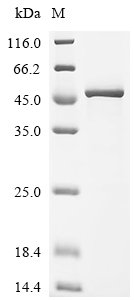
PurityGreater than 95% as determined by SDS-PAGE.
Expression SystemE.coli
Expression Region1-372aa
SpeciesMus musculus (Mouse)
Tag InfoN-terminal 10xHis-tagged and C-terminal Myc-tagged
Molecular weight50.2kDa
ActivityPlease contact us to obtain bioactivity data.
BufferIf the delivery form is liquid, the default storage buffer is Tris/PBS-based buffer, 5%-50% glycerol. If the delivery form is lyophilized powder, the buffer before lyophilization is Tris/PBS-based buffer, 6% Trehalose.
StorageStore at -20°C/-80°C upon receipt, aliquoting is necessary for mutiple use. Avoid repeated freeze-thaw cycles.
Research AreasCell Biology

Function

Protein kinase involved in the regulation of transcription. Member of the cyclin-dependent kinase pair (CDK9/cyclin-T) complex, also called positive transcription elongation factor b (P-TEFb), which facilitates the transition from abortive to productive elongation by phosphorylating the CTD (C-terminal domain) of the large subunit of RNA polymerase II (RNAP II) POLR2A, SUPT5H and RDBP. This complex is inactive when in the 7SK snRNP complex form.

Biological Context

Subcellular Location: Nucleus; Cytoplasm; Nucleus, PML body
Tissue Specificity: Expressed at high levels in brain and kidney

Product Specifications

Recombinant Mouse Cyclin-dependent kinase 9 (Cdk9) is a recombinant protein from Mus musculus (Mouse), expressed in E.coli, covering amino acids 1-372aa, with N-terminal 10xHis-tagged and C-terminal Myc-tagged tag, molecular weight 50.2kDa, purity Greater than 95% as determined by SDS-PAGE.. Suitable for ELISA and Western Blot applications.

SDS-PAGE: Single band at expected molecular weight confirming purity.

ELISA: Suitable as coating antigen or detection standard.

Western Blot: Compatible with standard Western Blot protocols.

Protein Interaction: Validated for SPR (Surface Plasmon Resonance) and BLI (Bio-Layer Interferometry) studies.

Shipping: Shipped at ambient temperature. Lyophilized protein is stable during transit.

Storage: Store lyophilized protein at -20°C to -80°C. Reconstituted protein should be aliquoted and stored at -80°C. Avoid repeated freeze-thaw cycles.

Shelf Life: 12 months from date of receipt when stored as recommended.

Shipping Time: Orders placed before 2 PM EST ship same day. International orders typically deliver within 5-10 business days.

Protein Biology

Function

Protein kinase involved in the regulation of transcription. Member of the cyclin-dependent kinase pair (CDK9/cyclin-T) complex, also called positive transcription elongation factor b (P-TEFb), which facilitates the transition from abortive to productive elongation by phosphorylating the CTD (C-terminal domain) of the large subunit of RNA polymerase II (RNAP II) POLR2A, SUPT5H and RDBP. This complex is inactive when in the 7SK snRNP complex form. Phosphorylates EP300, MYOD1, RPB1/POLR2A and AR and the negative elongation factors DSIF and NELFE. Regulates cytokine inducible transcription networks by facilitating promoter recognition of target transcription factors (e.g. TNF-inducible RELA/p65 activation and IL-6-inducible STAT3 signaling). Promotes RNA synthesis in genetic programs for cell growth, differentiation and viral pathogenesis. P-TEFb is also involved in cotranscriptional histone modification, mRNA processing and mRNA export. Modulates a complex network of chromatin modifications including histone H2B monoubiquitination (H2Bub1), H3 lysine 4 trimethylation (H3K4me3) and H3K36me3; integrates phosphorylation during transcription with chromatin modifications to control co-transcriptional histone mRNA processing. Also catalyzes phosphorylation of histone H1.4 (H1-4) at Ser-187' (H1.4S187Ph), a modification associated with transcription activation. The CDK9/cyclin-K complex has also a kinase activity towards CTD of RNAP II and can substitute for CDK9/cyclin-T P-TEFb in vitro. Replication stress response protein; the CDK9/cyclin-K complex is required for genome integrity maintenance, by promoting cell cycle recovery from replication arrest and limiting single-stranded DNA amount in response to replication stress, thus reducing the breakdown of stalled replication forks and avoiding DNA damage. In addition, probable function in DNA repair of isoform 2 via interaction with KU70/XRCC6. Promotes cardiac myocyte enlargement. RPB1/POLR2A phosphorylation on 'Ser-2' in CTD activates transcription. AR phosphorylation modulates AR transcription factor promoter selectivity and cell growth. DSIF and NELF phosphorylation promotes transcription by inhibiting their negative effect. The phosphorylation of MYOD1 enhances its transcriptional activity and thus promotes muscle differentiation. Catalyzes phosphorylation of KAT5, promoting KAT5 recruitment to chromatin and histone acetyltransferase activity

Subcellular Location

Nucleus; Cytoplasm; Nucleus, PML body

Tissue Specificity

Expressed at high levels in brain and kidney

Subunit

Component of the super elongation complex (SEC), at least composed of EAF1, EAF2, CDK9, MLLT3/AF9, AFF (AFF1 or AFF4), the P-TEFb complex and ELL (ELL, ELL2 or ELL3). Associates with CCNT1/cyclin-T1, CCNT2/cyclin-T2 (isoform A and isoform B) or CCNK/cyclin-K to form active P-TEFb. P-TEFb forms a complex with AFF4/AF5Q31 and is part of the super elongation complex (SEC). Component of a complex which is composed of at least 5 members: HTATSF1/Tat-SF1, P-TEFb complex, RNA pol II, SUPT5H, and NCL/nucleolin. Associates with UBR5 and forms a transcription regulatory complex composed of CDK9, RNAP II, UBR5 and TFIIS/TCEA1 that can stimulate target gene transcription (e.g. gamma fibrinogen/FGG) by recruiting their promoters. Component of the 7SK snRNP inactive complex which is composed of at least 8 members: P-TEFb (composed of CDK9 and CCNT1/cyclin-T1), HEXIM1, HEXIM2, LARP7, BCDIN3, SART3 proteins and 7SK and U6 snRNAs. This inactive 7SK snRNP complex can also interact with NCOR1 and HDAC3, probably to regulate CDK9 acetylation. Release of P-TEFb from P-TEFb/7SK snRNP complex requires both PP2B to transduce calcium Ca(2+) signaling in response to stimuli (e.g. UV or hexamethylene bisacetamide (HMBA)), and PPP1CA to dephosphorylate Thr-186. This released P-TEFb remains inactive in the pre-initiation complex with BRD4 until new Thr-186 phosphorylation occurs after the synthesis of a short RNA. Interacts with BRD4; to target chromatin binding. Interacts with JMJD6. Interacts with activated nuclear STAT3 and RELA/p65. Binds to AR and MYOD1. Forms a complex composed of CDK9, CCNT1/cyclin-T1, EP300 and GATA4 that stimulates hypertrophy in cardiomyocytes (By similarity). The large PER complex involved in the repression of transcriptional termination is composed of at least PER2, CDK9, DDX5, DHX9, NCBP1 and POLR2A (active) (PubMed:22767893). Interacts with HSF1 (By similarity). Interacts with TBX21 (PubMed:27292648). Interacts with WDR43 (PubMed:31128943). Interacts with ZMYND8; the association appears to occur between homodimeric ZMYND8 and the activated form of the P-TEFb complex (By similarity)

Gene: Cdk9  |  Organism: Mus musculus  |  Synonyms: Cell division protein kinase 9
Key Publications

Frequently Asked Questions

How do I order or inquire about this product?

Fill out the Online Inquiry form with your required quantity and specifications. You can also email sales@biocrestsci.com. Our team typically responds within 4 business hours with a quote and availability confirmation.

What is the shipping and delivery time?

Orders placed before 2 PM EST ship the same day. Domestic (US) delivery typically takes 2-3 business days. International orders deliver within 5-10 business days. All products are shipped at ambient temperature with appropriate packaging to ensure stability.

How should I store this recombinant protein?

Lyophilized proteins should be stored at -20°C to -80°C upon receipt. After reconstitution, aliquot and store at -80°C. Avoid repeated freeze-thaw cycles. Shelf life is 12 months from date of receipt when stored as recommended.

What quality controls are performed on your products?

Each product undergoes SDS-PAGE purity analysis (typically >85-95%), endotoxin testing, and bioactivity validation. Products are validated for ELISA, Western Blot, and SPR/BLI applications as specified on this product page. A Certificate of Analysis (CoA) is available upon request.

Shopping Cart
Scroll to Top