,

Recombinant Mouse E3 ubiquitin-protein ligase Mdm2 (Mdm2)

Recombinant Mouse E3 ubiquitin-protein ligase Mdm2 (Mdm2) — E3 ubiquitin-protein ligase that mediates ubiquitination of p53/TP53, leading to its degradation by the proteasome. Purity >90%.

SKU: BCRECP-003374 Categories: ,

Product Specifications

Product SkuBCRECP-003374
Product DescriptionRecombinant Mouse E3 ubiquitin-protein ligase Mdm2 (Mdm2) Protein is expressed from Yeast with N-terminal 6xHis-tagged. It contains 1-489aa. [Accession | P23804].
Uniprot No.P23804
Gene NamesMdm2
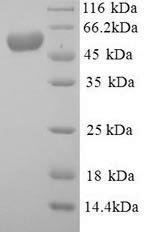
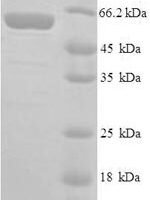
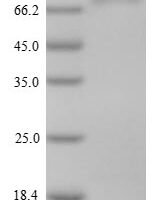
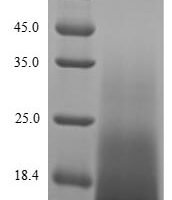
PurityGreater than 90% as determined by SDS-PAGE.
Expression SystemYeast
Expression Region1-489aa
SpeciesMus musculus (Mouse)
Tag InfoN-terminal 6xHis-tagged
Molecular weight56.6kDa
ActivityPlease contact us to obtain bioactivity data.
BufferIf the delivery form is liquid, the default storage buffer is Tris/PBS-based buffer, 5%-50% glycerol. If the delivery form is lyophilized powder, the buffer before lyophilization is Tris/PBS-based buffer, 6% Trehalose.
StorageStore at -20°C/-80°C upon receipt, aliquoting is necessary for mutiple use. Avoid repeated freeze-thaw cycles.
Research AreasOthers

Function

E3 ubiquitin-protein ligase that mediates ubiquitination of p53/TP53, leading to its degradation by the proteasome. Inhibits p53/TP53- and p73/TP73-mediated cell cycle arrest and apoptosis by binding its transcriptional activation domain.

Product Specifications

Recombinant Mouse E3 ubiquitin-protein ligase Mdm2 (Mdm2) — E3 ubiquitin-protein ligase that mediates ubiquitination of p53/TP53, leading to its degradation by the proteasome. Purity >90%. Suitable for ELISA and Western Blot applications.

SDS-PAGE: Single band at expected molecular weight confirming purity.

ELISA: Suitable as coating antigen or detection standard.

Western Blot: Compatible with standard Western Blot protocols.

Protein Interaction: Validated for SPR (Surface Plasmon Resonance) and BLI (Bio-Layer Interferometry) studies.

Shipping: Shipped at ambient temperature. Lyophilized protein is stable during transit.

Storage: Store lyophilized protein at -20°C to -80°C. Reconstituted protein should be aliquoted and stored at -80°C. Avoid repeated freeze-thaw cycles.

Shelf Life: 12 months from date of receipt when stored as recommended.

Shipping Time: Orders placed before 2 PM EST ship same day. International orders typically deliver within 5-10 business days.

Protein Biology

Function

E3 ubiquitin-protein ligase that mediates ubiquitination of p53/TP53, leading to its degradation by the proteasome (PubMed:15195100, PubMed:21804542). Inhibits p53/TP53- and p73/TP73-mediated cell cycle arrest and apoptosis by binding its transcriptional activation domain (By similarity). Also acts as a ubiquitin ligase E3 toward itself, ARRB1 and ARBB2 (PubMed:11588219). Permits the nuclear export of p53/TP53 (By similarity). Promotes proteasome-dependent ubiquitin-independent degradation of retinoblastoma RB1 protein (By similarity). Inhibits DAXX-mediated apoptosis by inducing its ubiquitination and degradation (By similarity). Component of the TRIM28/KAP1-MDM2-p53/TP53 complex involved in stabilizing p53/TP53 (By similarity). Also a component of the TRIM28/KAP1-ERBB4-MDM2 complex which links growth factor and DNA damage response pathways (By similarity). Mediates ubiquitination and subsequent proteasome degradation of DYRK2 in nucleus (By similarity). Ubiquitinates IGF1R and SNAI1 and promotes them to proteasomal degradation (By similarity). Ubiquitinates DCX, leading to DCX degradation and reduction of the dendritic spine density of olfactory bulb granule cells (PubMed:25088421). Ubiquitinates DLG4, leading to proteasomal degradation of DLG4 which is required for AMPA receptor endocytosis (PubMed:14642282). Negatively regulates NDUFS1, leading to decreased mitochondrial respiration, marked oxidative stress, and commitment to the mitochondrial pathway of apoptosis (PubMed:30879903). Binds NDUFS1 leading to its cytosolic retention rather than mitochondrial localization resulting in decreased supercomplex assembly (interactions between complex I and complex III), decreased complex I activity, ROS production, and apoptosis (PubMed:30879903)

Subcellular Location

Nucleus, nucleoplasm; Cytoplasm; Nucleus, nucleolus; Nucleus

Tissue Specificity

Ubiquitously expressed at low-level throughout embryo development and in adult tissues. MDM2-p90 is much more abundant than MDM2-p76 in testis, brain, heart, and kidney, but in the thymus, spleen, and intestine, the levels of the MDM2 proteins are roughly equivalent

Subunit

Component of a ternary complex composed of FAM193A, MDM4 and MDM2; interaction of FAM193A with MDM4 is mediated by the MDM4 RING-type zinc finger and results in MDM4 destabilization, leading to enhanced p53/TP53 transcriptional activity (By similarity). Although FAM193A interacts with MDM4 and MDM2, it does not affect formation of the p53-MDM2-MDM4 transcriptional repressor complex (By similarity). Interacts with TP53/p53 (By similarity). Interacts with TP73/p73. Binds specifically to RNA. Can interact with RB1, E1A-associated protein EP300 and the E2F1 transcription factor. Forms a ternary complex with p53/TP53 and WWOX. Interacts with CDKN2AIP, RFWD3, USP7, PYHIN1 and RBBP6. Interacts with ARRB1 and ARRB2. Interacts with PSMA3. Found in a trimeric complex with MDM2, MDM4 and USP2. Interacts with USP2 (via N-terminus and C-terminus). Interacts with MDM4. Part of a complex with MDM2, DAXX, RASSF1 and USP7. Part of a complex with DAXX, MDM2 and USP7. Interacts directly with DAXX and USP7. Interacts (via C-terminus) with RASSF1 isoform A (via N-terminus); the interaction is independent of TP53. Interacts with APEX1; leading to its ubiquitination and degradation. Interacts with RYBP; this inhibits ubiquitination of TP53. Identified in a complex with RYBP and p53/TP53. Also a component of the TRIM28/KAP1-MDM2-p53/TP53 complex involved in regulating p53/TP53 stabilization and activity. Binds directly both p53/TP53 and TRIM28. Component of the TRIM28/KAP1-ERBB4-MDM2 complex involved in connecting growth factor responses with DNA damage. Interacts directly with both TRIM28 and ERBB4 in the complex. Interacts with DYRK2. Interacts with IGF1R. Interacts with TRIM13; the interaction ubiquitinates MDM2 leading to its proteasomal degradation. Interacts with SNAI1; this interaction promotes SNAI1 ubiquitination. Interacts with NOTCH1 (via intracellular domain). Interacts with FHIT. Interacts with RFFL and RNF34; the interaction stabilizes MDM2. Interacts with CDK5RAP3 and CDKN2A/ARF; form a ternary complex involved in regulation of p53/TP53. Interacts with MTA1 (By similarity). Interacts with AARB2 (PubMed:11588219). Interacts with MTBP (PubMed:10906133). Interacts with PML (PubMed:15195100). Interacts with TBRG1 (PubMed:17110379). Interacts (via its RanBP2-type zinc finger domain) with RPL11 in the 5S RNP complex composed of 5S RNA, RPL5 and RPL11; this interaction occurs in the nucleoplasm and negatively regulates MDM2-mediated TP53 ubiquitination and degradation (PubMed:15195100, PubMed:21804542). Interacts with ADGRB1; the interaction results in inhibition of MDM2-mediated ubiquitination and degradation of DLG4/PSD95, promoting DLG4 stability and regulating synaptic plasticity (PubMed:25751059). Interacts with RPL23A; this interaction may promote p53/TP53 polyubiquitination (By similarity). Interacts with NDUFS1 (PubMed:30879903). Interacts with MORN3; the interaction enhances the ubiquitination of p53/TP53 (By similarity). Interacts with RAD54B; RAD54B enhances the ubiquitin ligase activity of MDM2 on TP53 by promoting MDM2-MDM4 heterodimerization (By similarity)

Gene: Mdm2  |  Organism: Mus musculus  |  Synonyms: Double minute 2 protein; Oncoprotein Mdm2; RING-type E3 ubiquitin transferase Mdm2; p53-binding protein Mdm2
Key Publications

Frequently Asked Questions

How do I order or inquire about this product?

Fill out the Online Inquiry form with your required quantity and specifications. You can also email sales@biocrestsci.com. Our team typically responds within 4 business hours with a quote and availability confirmation.

What is the shipping and delivery time?

Orders placed before 2 PM EST ship the same day. Domestic (US) delivery typically takes 2-3 business days. International orders deliver within 5-10 business days. All products are shipped at ambient temperature with appropriate packaging to ensure stability.

How should I store this recombinant protein?

Lyophilized proteins should be stored at -20°C to -80°C upon receipt. After reconstitution, aliquot and store at -80°C. Avoid repeated freeze-thaw cycles. Shelf life is 12 months from date of receipt when stored as recommended.

What quality controls are performed on your products?

Each product undergoes SDS-PAGE purity analysis (typically >85-95%), endotoxin testing, and bioactivity validation. Products are validated for ELISA, Western Blot, and SPR/BLI applications as specified on this product page. A Certificate of Analysis (CoA) is available upon request.

Shopping Cart
Scroll to Top