,

Recombinant Mouse Ectonucleotide pyrophosphatase/phosphodiesterase family member 1 (Enpp1), partial

Recombinant Mouse Ectonucleotide pyrophosphatase/phosphodiesterase family member 1 (Enpp1), partial — Nucleotide pyrophosphatase that generates diphosphate (PPi) and functions in bone mineralization and soft tissue calcification by regulating pyrophosphate levels. Purity >90%.

SKU: BCRECP-002611 Categories: ,

Product Specifications

Product SkuBCRECP-002611
Product DescriptionRecombinant Mouse Ectonucleotide pyrophosphatase/phosphodiesterase family member 1 (Enpp1) Protein is expressed from E.coli with N-terminal 6xHis-tagged. It contains 635-906aa. [Accession | P06802].
Uniprot No.P06802
Gene NamesEnpp1
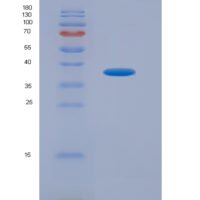
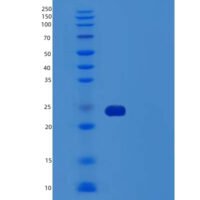
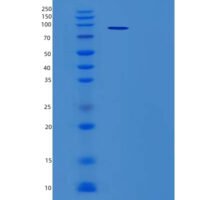
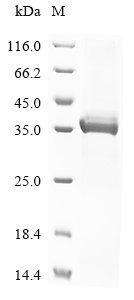
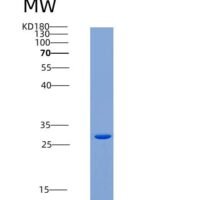
PurityGreater than 90% as determined by SDS-PAGE.
Expression SystemE.coli
Expression Region635-906aa
SpeciesMus musculus (Mouse)
Tag InfoN-terminal 6xHis-tagged
Molecular weight37.8kDa
ActivityPlease contact us to obtain bioactivity data.
BufferIf the delivery form is liquid, the default storage buffer is Tris/PBS-based buffer, 5%-50% glycerol. If the delivery form is lyophilized powder, the buffer before lyophilization is Tris/PBS-based buffer, 6% Trehalose.
StorageStore at -20°C/-80°C upon receipt, aliquoting is necessary for mutiple use. Avoid repeated freeze-thaw cycles.
Research AreasMetabolism

Function

Nucleotide pyrophosphatase that generates diphosphate (PPi) and functions in bone mineralization and soft tissue calcification by regulating pyrophosphate levels. PPi inhibits bone mineralization and soft tissue calcification by binding to nascent hydroxyapatite crystals, thereby preventing further growth of these crystals.

Product Specifications

Recombinant Mouse Ectonucleotide pyrophosphatase/phosphodiesterase family member 1 (Enpp1), partial — Nucleotide pyrophosphatase that generates diphosphate (PPi) and functions in bone mineralization and soft tissue calcification by regulating pyrophosphate levels. Purity >90%. Suitable for ELISA and Western Blot applications.

SDS-PAGE: Single band at expected molecular weight confirming purity.

ELISA: Suitable as coating antigen or detection standard.

Western Blot: Compatible with standard Western Blot protocols.

Protein Interaction: Validated for SPR (Surface Plasmon Resonance) and BLI (Bio-Layer Interferometry) studies.

Shipping: Shipped at ambient temperature. Lyophilized protein is stable during transit.

Storage: Store lyophilized protein at -20°C to -80°C. Reconstituted protein should be aliquoted and stored at -80°C. Avoid repeated freeze-thaw cycles.

Shelf Life: 12 months from date of receipt when stored as recommended.

Shipping Time: Orders placed before 2 PM EST ship same day. International orders typically deliver within 5-10 business days.

Protein Biology

Function

Nucleotide pyrophosphatase that generates diphosphate (PPi) and functions in bone mineralization and soft tissue calcification by regulating pyrophosphate levels (PubMed:10352096, PubMed:11004006, PubMed:12082181, PubMed:22510396, PubMed:25260930, PubMed:9662402). PPi inhibits bone mineralization and soft tissue calcification by binding to nascent hydroxyapatite crystals, thereby preventing further growth of these crystals (PubMed:10352096, PubMed:11004006, PubMed:12082181, PubMed:19419305, PubMed:22510396, PubMed:25260930, PubMed:25479107, PubMed:26910915, PubMed:30111653, PubMed:35147247, PubMed:9662402). Preferentially hydrolyzes ATP, but can also hydrolyze other nucleoside 5' triphosphates such as GTP, CTP and UTP to their corresponding monophosphates with release of pyrophosphate, as well as diadenosine polyphosphates, and also 3',5'-cAMP to AMP (PubMed:11027689, PubMed:1647027, PubMed:23027977, PubMed:8223581). May also be involved in the regulation of the availability of nucleotide sugars in the endoplasmic reticulum and Golgi, and the regulation of purinergic signaling (PubMed:1647027). Inhibits ectopic joint calcification and maintains articular chondrocytes by repressing hedgehog signaling; it is however unclear whether hedgehog inhibition is direct or indirect (PubMed:30111653). Appears to modulate insulin sensitivity (By similarity). Also involved in melanogenesis (By similarity). Also able to hydrolyze 2',3'-cGAMP (cyclic GMP-AMP), a second messenger that activates TMEM173/STING and triggers type-I interferon production (PubMed:25344812). 2',3'-cGAMP degradation takes place in the lumen or extracellular space, and not in the cytosol where it is produced; the role of 2',3'-cGAMP hydrolysis is therefore unclear (By similarity). Not able to hydrolyze the 2',3'-cGAMP linkage isomer 3',3'-cGAMP (By similarity)

Subcellular Location

Secreted

Disease Association

[Defects in Enpp1 are the cause of the tiptoe walking (ttw) phenotype. Ttw mice exhibit ossification of the spinal ligaments (PubMed:9662402). Mice display increased bone formation process in joints and develop spontaneous osteoarthritis-like changes (PubMed:22510396)] | [Defects in Enpp1 are the cause of spontaneous asj-2J mutant characterized by gait due to stiffening of the joints (PubMed:25479107). Defects are caused by a significant reduction in the plasma diphosphate (PPi) concentration, leading to extensive aberrant mineralization affecting the arterial vasculature, a number of internal organs and the dermal sheath of vibrissae (PubMed:25479107). Asj-2J mice are used as a model for arterial calcification of infancy disorder (GACI1) (PubMed:25479107). Mice also show ectopic mineralization of cartilage and collagen-rich tendons and ligaments (PubMed:26910915)]

Tissue Specificity

Selectively expressed on the surface of antibody-secreting cells (PubMed:3104326). Expressed in osteocytes and osteoclasts (PubMed:25260930)

Subunit

Ectonucleotide pyrophosphatase/phosphodiesterase family member 1: Homodimer (PubMed:23027977, PubMed:23041369). Ectonucleotide pyrophosphatase/phosphodiesterase family member 1: Interacts with INSR; leading to inhibit INSR autophosphorylation and subsequent activation of INSR kinase activity (By similarity). Ectonucleotide pyrophosphatase/phosphodiesterase family member 1, secreted form: Monomeric (PubMed:23041369)

Gene: Enpp1  |  Organism: Mus musculus  |  Synonyms: Alkaline phosphodiesterase I; Lymphocyte antigen 41; Nucleotide diphosphatase; Nucleotide pyrophosphatase; Phosphodiesterase I/nucleotide pyrophosphatase 1; Plasma-cell membrane glycoprotein PC-1
Key Publications

Frequently Asked Questions

How do I order or inquire about this product?

Fill out the Online Inquiry form with your required quantity and specifications. You can also email sales@biocrestsci.com. Our team typically responds within 4 business hours with a quote and availability confirmation.

What is the shipping and delivery time?

Orders placed before 2 PM EST ship the same day. Domestic (US) delivery typically takes 2-3 business days. International orders deliver within 5-10 business days. All products are shipped at ambient temperature with appropriate packaging to ensure stability.
How should I store this recombinant protein?

Lyophilized proteins should be stored at -20°C to -80°C upon receipt. After reconstitution, aliquot and store at -80°C. Avoid repeated freeze-thaw cycles. Shelf life is 12 months from date of receipt when stored as recommended.

What quality controls are performed on your products?

Each product undergoes SDS-PAGE purity analysis (typically >85-95%), endotoxin testing, and bioactivity validation. Products are validated for ELISA, Western Blot, and SPR/BLI applications as specified on this product page. A Certificate of Analysis (CoA) is available upon request.

Shopping Cart
Scroll to Top