Recombinant Mouse Glutamate receptor 1 (Gria1), partial

Recombinant Mouse Glutamate receptor 1 (Gria1), partial — Ionotropic glutamate receptor that functions as a ligand-gated cation channel, gated by L-glutamate and glutamatergic agonists such as alpha-amino-3-hydroxy-5-methyl-4-isoxazolepropionic acid (AMPA… Purity >85%.

SKU: BCRECP-002914 Category:

Product Specifications

Product SkuBCRECP-002914
Product DescriptionRecombinant Mouse Glutamate receptor 1 (Gria1) Protein is expressed from E.coli with N-terminal 10xHis-tagged. It contains 19-536aa. [Accession | P23818].
Uniprot No.P23818
Gene NamesGria1
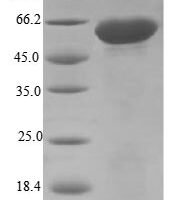
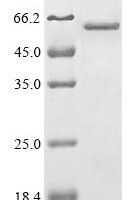
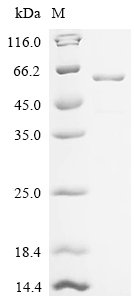
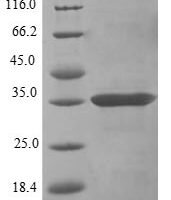
PurityGreater than 85% as determined by SDS-PAGE.
Expression SystemE.coli
Expression Region19-536aa
SpeciesMus musculus (Mouse)
Tag InfoN-terminal 10xHis-tagged
Molecular weight62.5kDa
ActivityPlease contact us to obtain bioactivity data.
BufferIf the delivery form is liquid, the default storage buffer is Tris/PBS-based buffer, 5%-50% glycerol. If the delivery form is lyophilized powder, the buffer before lyophilization is Tris/PBS-based buffer, 6% Trehalose.
StorageStore at -20°C/-80°C upon receipt, aliquoting is necessary for mutiple use. Avoid repeated freeze-thaw cycles.
Research AreasNeuroscience

Function

Ionotropic glutamate receptor that functions as a ligand-gated cation channel, gated by L-glutamate and glutamatergic agonists such as alpha-amino-3-hydroxy-5-methyl-4-isoxazolepropionic acid (AMPA), quisqualic acid, and kainic acid. L-glutamate acts as an excitatory neurotransmitter at many synapses in the central nervous system. Binding of the excitatory neurotransmitter L-glutamate induces a conformation change, leading to the opening of the cation channel, and thereby converts the chemical signal to an electrical impulse upon entry of monovalent and divalent cations such as sodium and calcium.

Biological Context

Subcellular Location: Cell membrane (Multi-pass membrane protein); Endoplasmic reticulum membrane (Multi-pass membrane protein); Postsynaptic cell membrane (Multi-pass membrane protein); Postsynaptic density membrane (Multi-pass membrane protein); Cell projection, dendrite; Cell projection, dendritic spine; Early endosome membrane (Multi-pass membrane protein); Recycling endosome membrane (Multi-pass membrane protein); Presynapse; Synapse
Tissue Specificity: Expressed in the outer plexiform layer of the retina of the eye (at protein level). Expressed in the forebrain and hippocampus (at protein level)

Product Specifications

Recombinant Mouse Glutamate receptor 1 (Gria1), partial is a recombinant protein from Mus musculus (Mouse), expressed in E.coli, covering amino acids 19-536aa, with N-terminal 10xHis-tagged tag, molecular weight 62.5kDa, purity Greater than 85% as determined by SDS-PAGE.. Suitable for ELISA and Western Blot applications.
Recommended applications depend on the target, product format, and product-specific validation data. Refer to the product datasheet or Certificate of Analysis (CoA), or contact BioCrest Sci for application guidance.

Biological Activity: Please contact us to obtain bioactivity data.

Storage: Store at -20°C/-80°C upon receipt, aliquoting is necessary for mutiple use. Avoid repeated freeze-thaw cycles.

Shipping & Lead Time: Availability, shipping conditions, and estimated lead time are confirmed in the formal quotation or order confirmation based on the product format, destination, and order requirements.

Protein Biology

Function

Ionotropic glutamate receptor that functions as a ligand-gated cation channel, gated by L-glutamate and glutamatergic agonists such as alpha-amino-3-hydroxy-5-methyl-4-isoxazolepropionic acid (AMPA), quisqualic acid, and kainic acid (PubMed:1699805). L-glutamate acts as an excitatory neurotransmitter at many synapses in the central nervous system. Binding of the excitatory neurotransmitter L-glutamate induces a conformation change, leading to the opening of the cation channel, and thereby converts the chemical signal to an electrical impulse upon entry of monovalent and divalent cations such as sodium and calcium. The receptor then desensitizes rapidly and enters in a transient inactive state, characterized by the presence of bound agonist. In the presence of CACNG2 or CACNG4 or CACNG7 or CACNG8, shows resensitization which is characterized by a delayed accumulation of current flux upon continued application of L-glutamate. Calcium (Ca(2+)) permeability depends on subunits composition and, heteromeric channels containing edited GRIA2 subunit are calcium-impermeable. Also permeable to other divalents cations such as strontium(2+) and magnesium(2+) and monovalent cations such as potassium(1+) and lithium(1+) (By similarity)

Subcellular Location

Cell membrane (Multi-pass membrane protein); Endoplasmic reticulum membrane (Multi-pass membrane protein); Postsynaptic cell membrane (Multi-pass membrane protein); Postsynaptic density membrane (Multi-pass membrane protein); Cell projection, dendrite; Cell projection, dendritic spine; Early endosome membrane (Multi-pass membrane protein); Recycling endosome membrane (Multi-pass membrane protein); Presynapse; Synapse

Tissue Specificity

Expressed in the outer plexiform layer of the retina of the eye (at protein level) (PubMed:28334377). Expressed in the forebrain and hippocampus (at protein level) (PubMed:31651360)

Subunit

Homotetramer or heterotetramer of pore-forming glutamate receptor subunits (PubMed:1699805, PubMed:33981040). Heteromeric assembly can be the result of both receptor subtype and flip or flop form and according the composition, one partner can be dominant with respect to the fast desensitizing current component, whereas the other can determine the steady-state component (By similarity). Tetramers may be formed by the dimerization of dimers (By similarity). Found in a complex with GRIA2, GRIA3, GRIA4, CNIH2, CNIH3, CACNG2, CACNG3, CACNG4, CACNG5, CACNG7 and CACNG8 (By similarity). Interacts with HIP1 and RASGRF2 (PubMed:12839988, PubMed:16407208). Interacts with SYNDIG1 and GRIA2 (PubMed:20152115). Interacts with DLG1 (via C-terminus). Interacts with LRFN1. Interacts with PRKG2. Interacts with CNIH2 and CACNG2. Interacts with CACNG5; this interaction modulates the gating. Interacts (via C-terminus) with PDLIM4 (via LIM domain); this interaction as well as the interaction of PDLIM4 with alpha-actinin is required for their colocalization in early endosomes. Interacts with SNX27 (via PDZ domain); the interaction is required for recycling to the plasma membrane when endocytosed and prevent degradation in lysosomes (PubMed:23524343). Interacts (via PDZ-binding motif) with SHANK3 (via PDZ domain) (PubMed:16606358). Interacts with CACNG3; associates GRIA1 with the adapter protein complex 4 (AP-4) to target GRIA1 to the somatodendritic compartment of neurons (PubMed:18341993). Interacts with CACNG2; this interaction mediates traffick to the plasma membrane and modulation of desensitization. Interacts with CNIH2 and CNIH3; this interaction promotes expression at the plasma membrane and extensively modulates their gating properties by slowing deactivation and desensitization kinetics (By similarity). Found in a complex with GRIA2, GRIA3, GRIA4, DLG4, CACNG8 and CNIH2 (PubMed:33981040)

Gene: Gria1  |  Organism: Mus musculus  |  Synonyms: AMPA-selective glutamate receptor 1; GluR-A; GluR-K1; Glutamate receptor ionotropic, AMPA 1
Key Publications

Frequently Asked Questions

How do I order or inquire about this product?

Submit the Online Inquiry form with your required quantity and specifications, or email sales@biocrestsci.com. Available sizes, pricing, stock status, documentation, and estimated lead time are confirmed in the formal quotation.

What is the shipping and delivery time?

Availability, dispatch timing, shipping conditions, and delivery estimates depend on the product format, destination, and order requirements. These details are confirmed in the formal quotation or order confirmation.

How should this product be stored?

Follow the storage and handling instructions in the product-specific datasheet and Certificate of Analysis (CoA). Requirements may vary by product form and formulation; contact BioCrest Sci if product-specific guidance is needed.

What quality controls are performed on your products?

Quality-control data such as identity, purity, endotoxin level, or biological activity are provided only when specified on this product page, the datasheet, or Certificate of Analysis (CoA). Biological activity is not implied unless explicitly stated.

Shopping Cart
Scroll to Top