Recombinant Mouse Histone H3-like centromeric protein A (Cenpa)

Recombinant Mouse Histone H3-like centromeric protein A (Cenpa) — Histone H3-like nucleosomal protein that is specifically found in centromeric nucleosomes. Purity >90%.

SKU: BCRECP-002354 Category:

Product Specifications

Product SkuBCRECP-002354
Product DescriptionRecombinant Mouse Histone H3-like centromeric protein A (Cenpa) Protein is expressed from Yeast with N-terminal 6xHis-tagged. It contains 1-134aa. [Accession | O35216].
Uniprot No.O35216
Gene NamesCenpa
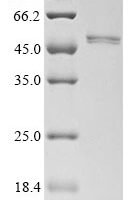
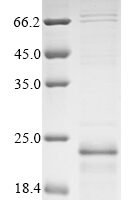
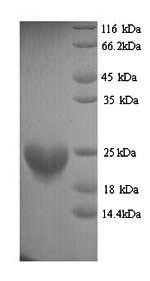
PurityGreater than 90% as determined by SDS-PAGE.
Expression SystemYeast
Expression Region1-134aa
SpeciesMus musculus (Mouse)
Tag InfoN-terminal 6xHis-tagged
Molecular weight17.5kDa
ActivityPlease contact us to obtain bioactivity data.
BufferIf the delivery form is liquid, the default storage buffer is Tris/PBS-based buffer, 5%-50% glycerol. If the delivery form is lyophilized powder, the buffer before lyophilization is Tris/PBS-based buffer, 6% Trehalose.
StorageStore at -20°C/-80°C upon receipt, aliquoting is necessary for mutiple use. Avoid repeated freeze-thaw cycles.
Research AreasOthers

Function

Histone H3-like nucleosomal protein that is specifically found in centromeric nucleosomes. Replaces conventional H3 in the nucleosome core of centromeric chromatin that serves as an assembly site for the inner kinetochore. The presence of CENPA subtly modifies the nucleosome structure and the way DNA is wrapped around the nucleosome and gives rise to protruding DNA ends that are less well-ordered and rigid compared to nucleosomes containing histone H3.

Biological Context

Subcellular Location: Nucleus; Chromosome, centromere

Product Specifications

Recombinant Mouse Histone H3-like centromeric protein A (Cenpa) is a recombinant protein from Mus musculus (Mouse), expressed in Yeast, covering amino acids 1-134aa, with N-terminal 6xHis-tagged tag, molecular weight 17.5kDa, purity Greater than 90% as determined by SDS-PAGE.. Suitable for ELISA and Western Blot applications.
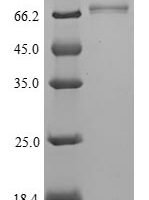
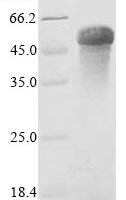
SDS-PAGE: Single band at expected molecular weight confirming purity.

ELISA: Suitable as coating antigen or detection standard.

Western Blot: Compatible with standard Western Blot protocols.

Protein Interaction: Validated for SPR (Surface Plasmon Resonance) and BLI (Bio-Layer Interferometry) studies.

Shipping: Shipped at ambient temperature. Lyophilized protein is stable during transit.

Storage: Store lyophilized protein at -20°C to -80°C. Reconstituted protein should be aliquoted and stored at -80°C. Avoid repeated freeze-thaw cycles.

Shelf Life: 12 months from date of receipt when stored as recommended.

Shipping Time: Orders placed before 2 PM EST ship same day. International orders typically deliver within 5-10 business days.

Protein Biology

Function

Histone H3-like nucleosomal protein that is specifically found in centromeric nucleosomes. Replaces conventional H3 in the nucleosome core of centromeric chromatin that serves as an assembly site for the inner kinetochore. The presence of CENPA subtly modifies the nucleosome structure and the way DNA is wrapped around the nucleosome and gives rise to protruding DNA ends that are less well-ordered and rigid compared to nucleosomes containing histone H3. May serve as an epigenetic mark that propagates centromere identity through replication and cell division (By similarity). Required for recruitment and assembly of kinetochore proteins, and as a consequence required for progress through mitosis, chromosome segregation and cytokinesis (PubMed:27499292)

Subcellular Location

Nucleus; Chromosome, centromere

Subunit

Component of centromeric nucleosomes, where DNA is wrapped around a histone octamer core. The octamer contains two molecules each of H2A, H2B, CENPA and H4 assembled in one CENPA-H4 heterotetramer and two H2A-H2B heterodimers. CENPA modulates the DNA-binding characteristics of nucleosomes so that protruding DNA ends have higher flexibility than in nucleosomes containing conventional histone H3. Inhibits binding of histone H1 to nucleosomes, since histone H1 binds preferentially to rigid DNA linkers that protrude from nucleosomes. Nucleosomes containing CENPA also contain histone H2A variants such as MACROH2A and H2A.Z/H2AZ1. The CENPA-H4 heterotetramer is more compact and structurally more rigid than corresponding H3-H4 heterotetramers. Can assemble into nucleosomes that contain both CENPA and histone H3.3; these nucleosomes interact with a single CENPC chain. Heterotrimer composed of HJURP, CENPA and histone H4, where HJURP interacts with the dimer formed by CENPA and histone H4 and prevents tetramerization of CENPA and H4. Component of the CENPA-NAC complex, at least composed of CENPA, CENPC, CENPH, CENPM, CENPN, CENPT and CENPU. Interacts (via CATD domain) with HJURP; the interaction is direct and is required for its localization to centromeres. Interacts with CENPC, CENPN and CENPT; interaction is direct. Part of a centromere complex consisting of CENPA, CENPT and CENPW. Identified in centromere complexes containing histones H2A, H2B and H4, and at least CENPA, CENPB, CENPC, CENPT, CENPN, HJURP, SUPT16H, SSRP1 and RSF1. Can self-associate. The CENPA-H4 heterotetramer can bind DNA by itself (in vitro). Interacts with CDK1, PPP1CA and RBBP7

Gene: Cenpa  |  Organism: Mus musculus  |  Synonyms: Centromere protein A

Frequently Asked Questions

How do I order or inquire about this product?

Fill out the Online Inquiry form with your required quantity and specifications. You can also email sales@biocrestsci.com. Our team typically responds within 4 business hours with a quote and availability confirmation.

What is the shipping and delivery time?

Orders placed before 2 PM EST ship the same day. Domestic (US) delivery typically takes 2-3 business days. International orders deliver within 5-10 business days. All products are shipped at ambient temperature with appropriate packaging to ensure stability.

How should I store this recombinant protein?

Lyophilized proteins should be stored at -20°C to -80°C upon receipt. After reconstitution, aliquot and store at -80°C. Avoid repeated freeze-thaw cycles. Shelf life is 12 months from date of receipt when stored as recommended.

What quality controls are performed on your products?

Each product undergoes SDS-PAGE purity analysis (typically >85-95%), endotoxin testing, and bioactivity validation. Products are validated for ELISA, Western Blot, and SPR/BLI applications as specified on this product page. A Certificate of Analysis (CoA) is available upon request.

Shopping Cart
Scroll to Top