Recombinant Mouse Lys-63-specific deubiquitinase BRCC36 (Brcc3)

Recombinant Mouse Lys-63-specific deubiquitinase BRCC36 (Brcc3) — Metalloprotease that specifically cleaves ‘Lys-63’-linked polyubiquitin chains. Purity >95%.

SKU: BCRECP-002232 Category:

Product Specifications

Product SkuBCRECP-002232
Product DescriptionRecombinant Mouse Lys-63-specific deubiquitinase BRCC36 (Brcc3) Protein is expressed from E.coli with N-terminal 10xHis-tagged and C-terminal Myc-tagged. It contains 2-291aa. [Accession | P46737].
Uniprot No.P46737
Gene NamesBrcc3
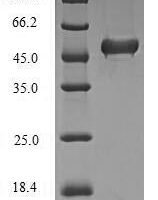
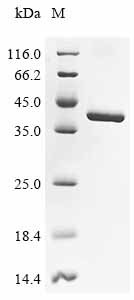
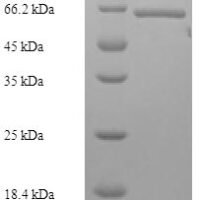
PurityGreater than 95% as determined by SDS-PAGE.
Expression SystemE.coli
Expression Region2-291aa
SpeciesMus musculus (Mouse)
Tag InfoN-terminal 10xHis-tagged and C-terminal Myc-tagged
Molecular weight40.7kDa
ActivityPlease contact us to obtain bioactivity data.
BufferIf the delivery form is liquid, the default storage buffer is Tris/PBS-based buffer, 5%-50% glycerol. If the delivery form is lyophilized powder, the buffer before lyophilization is Tris/PBS-based buffer, 6% Trehalose.
StorageStore at -20°C/-80°C upon receipt, aliquoting is necessary for mutiple use. Avoid repeated freeze-thaw cycles.
Research AreasCancer

Function

Metalloprotease that specifically cleaves 'Lys-63'-linked polyubiquitin chains. Does not have activity toward 'Lys-48'-linked polyubiquitin chains. Component of the BRCA1-A complex, a complex that specifically recognizes 'Lys-63'-linked ubiquitinated histones H2A and H2AX at DNA lesions sites, leading to target the BRCA1-BARD1 heterodimer to sites of DNA damage at double-strand breaks (DSBs).

Biological Context

Subcellular Location: Nucleus; Cytoplasm; Cytoplasm, cytoskeleton, spindle pole

Product Specifications

Recombinant Mouse Lys-63-specific deubiquitinase BRCC36 (Brcc3) is a recombinant protein from Mus musculus (Mouse), expressed in E.coli, covering amino acids 2-291aa, with N-terminal 10xHis-tagged and C-terminal Myc-tagged tag, molecular weight 40.7kDa, purity Greater than 95% as determined by SDS-PAGE.. Suitable for ELISA and Western Blot applications.

Recommended applications depend on the target, product format, and product-specific validation data. Refer to the product datasheet or Certificate of Analysis (CoA), or contact BioCrest Sci for application guidance.

Biological Activity: Please contact us to obtain bioactivity data.

Storage: Store at -20°C/-80°C upon receipt, aliquoting is necessary for mutiple use. Avoid repeated freeze-thaw cycles.

Shipping & Lead Time: Availability, shipping conditions, and estimated lead time are confirmed in the formal quotation or order confirmation based on the product format, destination, and order requirements.

Protein Biology

Function

Metalloprotease that specifically cleaves 'Lys-63'-linked polyubiquitin chains (PubMed:23246432, PubMed:34180153). Does not have activity toward 'Lys-48'-linked polyubiquitin chains (By similarity). Component of the BRCA1-A complex, a complex that specifically recognizes 'Lys-63'-linked ubiquitinated histones H2A and H2AX at DNA lesions sites, leading to target the BRCA1-BARD1 heterodimer to sites of DNA damage at double-strand breaks (DSBs) (By similarity). In the BRCA1-A complex, it specifically removes 'Lys-63'-linked ubiquitin on histones H2A and H2AX, antagonizing the RNF8-dependent ubiquitination at double-strand breaks (DSBs) (By similarity). Catalytic subunit of the BRISC complex, a multiprotein complex that specifically cleaves 'Lys-63'-linked ubiquitin in various substrates (By similarity). Mediates the specific 'Lys-63'-specific deubiquitination associated with the COP9 signalosome complex (CSN), via the interaction of the BRISC complex with the CSN complex (By similarity). The BRISC complex is required for normal mitotic spindle assembly and microtubule attachment to kinetochores via its role in deubiquitinating NUMA1 (By similarity). Plays a role in interferon signaling via its role in the deubiquitination of the interferon receptor IFNAR1; deubiquitination increases IFNAR1 activity by enhancing its stability and cell surface expression (By similarity). Acts as a regulator of the NLRP3 inflammasome by mediating deubiquitination of NLRP3, leading to NLRP3 inflammasome assembly (PubMed:23246432, PubMed:28943315). Down-regulates the response to bacterial lipopolysaccharide (LPS) via its role in IFNAR1 deubiquitination (By similarity). Deubiquitinates HDAC1 and PWWP2B leading to their stabilization (PubMed:34180153)

Subcellular Location

Nucleus; Cytoplasm; Cytoplasm, cytoskeleton, spindle pole

Subunit

Component of the ARISC complex, at least composed of UIMC1/RAP80, ABRAXAS1, BRCC3/BRCC36, BABAM2 and BABAM1/NBA1. Component of the BRCA1-A complex, at least composed of BRCA1, BARD1, UIMC1/RAP80, ABRAXAS1, BRCC3/BRCC36, BABAM2 and BABAM1/NBA1. In the BRCA1-A complex, interacts directly with ABRAXAS1 and BABAM2. Component of the BRISC complex, at least composed of ABRAXAS2, BRCC3/BRCC36, BABAM2 and BABAM1/NBA1. Identified in a complex with SHMT2 and the other subunits of the BRISC complex. In the BRISC complex, interacts directly with ABRAXAS2. Identified in a complex with ABRAXAS2 and NUMA1. The BRISC complex interacts with the CSN complex. Component of the BRCA1/BRCA2 containing complex (BRCC), which also contains BRCA1, BRCA2, BARD1, BABAM2 and RAD51. BRCC is a ubiquitin E3 ligase complex that enhances cellular survival following DNA damage. Interacts with BRCA1. Binds polyubiquitin (By similarity). Interacts with PWWP2B (PubMed:34180153). Interacts with HDAC1; this interaction is enhanced in the presence of PWWP2B (PubMed:34180153)

Gene: Brcc3  |  Organism: Mus musculus  |  Synonyms: BRCA1-A complex subunit BRCC36; BRCA1/BRCA2-containing complex subunit 3; BRCA1/BRCA2-containing complex subunit 36; BRISC complex subunit BRCC36
Key Publications

Frequently Asked Questions

How do I order or inquire about this product?

Submit the Online Inquiry form with your required quantity and specifications, or email sales@biocrestsci.com. Available sizes, pricing, stock status, documentation, and estimated lead time are confirmed in the formal quotation.

What is the shipping and delivery time?

Availability, dispatch timing, shipping conditions, and delivery estimates depend on the product format, destination, and order requirements. These details are confirmed in the formal quotation or order confirmation.

How should this product be stored?

Follow the storage and handling instructions in the product-specific datasheet and Certificate of Analysis (CoA). Requirements may vary by product form and formulation; contact BioCrest Sci if product-specific guidance is needed.

What quality controls are performed on your products?

Quality-control data such as identity, purity, endotoxin level, or biological activity are provided only when specified on this product page, the datasheet, or Certificate of Analysis (CoA). Biological activity is not implied unless explicitly stated.

Shopping Cart
Scroll to Top