Recombinant Mouse Myocilin (Myoc), partial

Recombinant Mouse Myocilin (Myoc), partial — Secreted glycoprotein regulating the activation of different signaling pathways in adjacent cells to control different processes including cell adhesion, cell-matrix adhesion, cytoskeleton organiza… Purity >85%.

SKU: BCRECP-003448 Category:

Product Specifications

Product SkuBCRECP-003448
Product DescriptionRecombinant Mouse Myocilin (Myoc) Protein is expressed from E.coli with N-terminal 6xHis-tagged. It contains 213-490aa. [Accession | O70624].
Uniprot No.O70624
Gene NamesMyoc
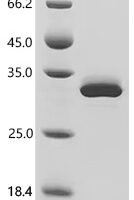
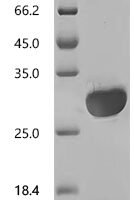
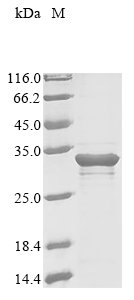
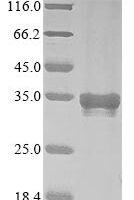
PurityGreater than 85% as determined by SDS-PAGE.
Expression SystemE.coli
Expression Region213-490aa
SpeciesMus musculus (Mouse)
Tag InfoN-terminal 6xHis-tagged
Molecular weight35.4kDa
ActivityPlease contact us to obtain bioactivity data.
BufferIf the delivery form is liquid, the default storage buffer is Tris/PBS-based buffer, 5%-50% glycerol. If the delivery form is lyophilized powder, the buffer before lyophilization is Tris/PBS-based buffer, 6% Trehalose.
StorageStore at -20°C/-80°C upon receipt, aliquoting is necessary for mutiple use. Avoid repeated freeze-thaw cycles.
Research AreasEpigenetics and Nuclear Signaling

Function

Secreted glycoprotein regulating the activation of different signaling pathways in adjacent cells to control different processes including cell adhesion, cell-matrix adhesion, cytoskeleton organization and cell migration. Promotes substrate adhesion, spreading and formation of focal contacts.

Product Specifications

Recombinant Mouse Myocilin (Myoc), partial — Secreted glycoprotein regulating the activation of different signaling pathways in adjacent cells to control different processes including cell adhesion, cell-matrix adhesion, cytoskeleton organiza… Purity >85%. Suitable for ELISA and Western Blot applications.
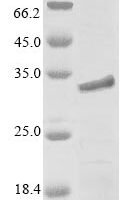
Recommended applications depend on the target, product format, and product-specific validation data. Refer to the product datasheet or Certificate of Analysis (CoA), or contact BioCrest Sci for application guidance.

Biological Activity: Please contact us to obtain bioactivity data.

Storage: Store at -20°C/-80°C upon receipt, aliquoting is necessary for mutiple use. Avoid repeated freeze-thaw cycles.

Shipping & Lead Time: Availability, shipping conditions, and estimated lead time are confirmed in the formal quotation or order confirmation based on the product format, destination, and order requirements.

Protein Biology

Function

Secreted glycoprotein regulating the activation of different signaling pathways in adjacent cells to control different processes including cell adhesion, cell-matrix adhesion, cytoskeleton organization and cell migration. Promotes substrate adhesion, spreading and formation of focal contacts. Negatively regulates cell-matrix adhesion and stress fiber assembly through Rho protein signal transduction. Modulates the organization of actin cytoskeleton by stimulating the formation of stress fibers through interactions with components of Wnt signaling pathways. Promotes cell migration through activation of PTK2 and the downstream phosphatidylinositol 3-kinase signaling (By similarity). Plays a role in bone formation and promotes osteoblast differentiation in a dose-dependent manner through mitogen-activated protein kinase signaling (PubMed:23629661). Mediates myelination in the peripheral nervous system through ERBB2/ERBB3 signaling (PubMed:23897819). Plays a role as a regulator of muscle hypertrophy through the components of dystrophin-associated protein complex (PubMed:22371502). Involved in positive regulation of mitochondrial depolarization. Plays a role in neurite outgrowth. May participate in the obstruction of fluid outflow in the trabecular meshwork (By similarity)

Subcellular Location

Endoplasmic reticulum

Tissue Specificity

Expressed in ciliary body, iris, retina, trabecular network and sclera but not in lens or cornea. Also expressed strongly in skeletal muscle and weakly in heart, brain, testis, liver, kidney, thyroid and epididymis. No expression detected in embryo. Expressed in sciatic nerve

Subunit

Homodimer (via N-terminus). Interacts with OLFM3, FN1, NRCAM, GLDN and NFASC. Interacts (via N-terminus) with MYL2. Interacts with SFRP1, FRZB, FZD7, FZD10, FZD1 and WIF1; regulates Wnt signaling. Interacts with SNTA1; regulates muscle hypertrophy (PubMed:22371502). Interacts with ERBB2 and ERBB3; activates ERBB2-ERBB3 signaling pathway (PubMed:23897819). Interacts with SNCG; affects its secretion and its aggregation (PubMed:16392033)

Gene: Myoc  |  Organism: Mus musculus  |  Synonyms: Trabecular meshwork-induced glucocorticoid response protein
Key Publications

Frequently Asked Questions

How do I order or inquire about this product?

Submit the Online Inquiry form with your required quantity and specifications, or email sales@biocrestsci.com. Available sizes, pricing, stock status, documentation, and estimated lead time are confirmed in the formal quotation.

What is the shipping and delivery time?

Availability, dispatch timing, shipping conditions, and delivery estimates depend on the product format, destination, and order requirements. These details are confirmed in the formal quotation or order confirmation.

How should this product be stored?

Follow the storage and handling instructions in the product-specific datasheet and Certificate of Analysis (CoA). Requirements may vary by product form and formulation; contact BioCrest Sci if product-specific guidance is needed.

What quality controls are performed on your products?

Quality-control data such as identity, purity, endotoxin level, or biological activity are provided only when specified on this product page, the datasheet, or Certificate of Analysis (CoA). Biological activity is not implied unless explicitly stated.

Shopping Cart
Scroll to Top