,

Recombinant Mouse NAD (+) hydrolase SARM1 (Sarm1), partial

Recombinant Mouse NAD (+) hydrolase SARM1 (Sarm1), partial — NAD(+) hydrolase, which plays a key role in axonal degeneration following injury by regulating NAD(+) metabolism. Purity >90%.

SKU: BCRECP-004375 Categories: ,

Product Specifications

Product SkuBCRECP-004375
Product DescriptionRecombinant Mouse NAD (+) hydrolase SARM1 (Sarm1) Protein is expressed from E.coli with C-terminal 6xHis-tagged. It contains 409-705aa. [Accession | Q6PDS3].
Uniprot No.Q6PDS3
Gene NamesSarm1
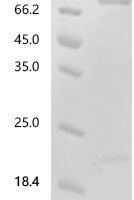
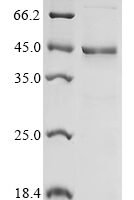
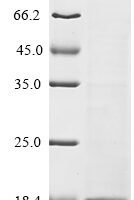
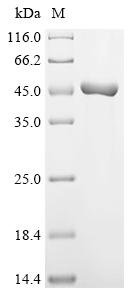
PurityGreater than 90% as determined by SDS-PAGE.
Expression SystemE.coli
Expression Region409-705aa
SpeciesMus musculus (Mouse)
Tag InfoC-terminal 6xHis-tagged
Molecular weight40.7kDa
ActivityPlease contact us to obtain bioactivity data.
BufferIf the delivery form is liquid, the default storage buffer is Tris/PBS-based buffer, 5%-50% glycerol. If the delivery form is lyophilized powder, the buffer before lyophilization is Tris/PBS-based buffer, 6% Trehalose.
StorageStore at -20°C/-80°C upon receipt, aliquoting is necessary for mutiple use. Avoid repeated freeze-thaw cycles.
Research AreasOthers

Function

NAD(+) hydrolase, which plays a key role in axonal degeneration following injury by regulating NAD(+) metabolism. Acts as a negative regulator of MYD88- and TRIF-dependent toll-like receptor signaling pathway by promoting Wallerian degeneration, an injury-induced form of programmed subcellular death which involves degeneration of an axon distal to the injury site. Wallerian degeneration is triggered by NAD(+) depletion: in response to injury, SARM1 is activated and catalyzes cleavage of NAD(+) into ADP-D-ribose (ADPR), cyclic ADPR (cADPR) and nicotinamide; NAD(+) cleavage promoting cytoskeletal degradation and axon destruction.

Biological Context

Subcellular Location: Cytoplasm; Cell projection, axon; Cell projection, dendrite; Synapse; Mitochondrion
Tissue Specificity: Widely expressed in the brain and neurons (at protein level). Expressed in photoreceptor cells of the neural retina

Product Specifications

Recombinant Mouse NAD (+) hydrolase SARM1 (Sarm1), partial is a recombinant protein from Mus musculus (Mouse), expressed in E.coli, covering amino acids 409-705aa, with C-terminal 6xHis-tagged tag, molecular weight 40.7kDa, purity Greater than 90% as determined by SDS-PAGE.. Suitable for ELISA and Western Blot applications.

Recommended applications depend on the target, product format, and product-specific validation data. Refer to the product datasheet or Certificate of Analysis (CoA), or contact BioCrest Sci for application guidance.

Biological Activity: Please contact us to obtain bioactivity data.

Storage: Store at -20°C/-80°C upon receipt, aliquoting is necessary for mutiple use. Avoid repeated freeze-thaw cycles.

Shipping & Lead Time: Availability, shipping conditions, and estimated lead time are confirmed in the formal quotation or order confirmation based on the product format, destination, and order requirements.

Protein Biology

Function

NAD(+) hydrolase, which plays a key role in axonal degeneration following injury by regulating NAD(+) metabolism (PubMed:25818290, PubMed:26686637, PubMed:27735788, PubMed:32312889). Acts as a negative regulator of MYD88- and TRIF-dependent toll-like receptor signaling pathway by promoting Wallerian degeneration, an injury-induced form of programmed subcellular death which involves degeneration of an axon distal to the injury site (PubMed:21555464, PubMed:22678360, PubMed:25818290, PubMed:26423149, PubMed:26686637). Wallerian degeneration is triggered by NAD(+) depletion: in response to injury, SARM1 is activated and catalyzes cleavage of NAD(+) into ADP-D-ribose (ADPR), cyclic ADPR (cADPR) and nicotinamide; NAD(+) cleavage promoting cytoskeletal degradation and axon destruction (PubMed:28334607). Also able to hydrolyze NADP(+), but not other NAD(+)-related molecules (By similarity). Can activate neuronal cell death in response to stress (PubMed:19587044). Regulates dendritic arborization through the MAPK4-JNK pathway (PubMed:17724133, PubMed:21555464). Involved in innate immune response: inhibits both TICAM1/TRIF- and MYD88-dependent activation of JUN/AP-1, TRIF-dependent activation of NF-kappa-B and IRF3, and the phosphorylation of MAPK14/p38 (PubMed:21555464). Acts as a non-self dsDNA sensor in a sequence-independent manner to elicit NAD(+) degradation and thus to promote programmed cell death (By similarity)

Subcellular Location

Cytoplasm; Cell projection, axon; Cell projection, dendrite; Synapse; Mitochondrion

Tissue Specificity

Widely expressed in the brain and neurons (at protein level) (PubMed:21555464). Expressed in photoreceptor cells of the neural retina (PubMed:32312889)

Subunit

Homooctamer; forms an octameric ring via SAM domains (By similarity). Interacts with TICAM1/TRIF and thereby interferes with TICAM1/TRIF function (By similarity). Interacts with SDC2 (via cytoplasmic domain) and MAPK10/JNK3 (PubMed:17724133, PubMed:21555464)

Gene: Sarm1  |  Organism: Mus musculus  |  Synonyms: NADP(+) hydrolase SARM1; Sterile alpha and TIR motif-containing protein 1
Key Publications

Frequently Asked Questions

How do I order or inquire about this product?

Submit the Online Inquiry form with your required quantity and specifications, or email sales@biocrestsci.com. Available sizes, pricing, stock status, documentation, and estimated lead time are confirmed in the formal quotation.

What is the shipping and delivery time?

Availability, dispatch timing, shipping conditions, and delivery estimates depend on the product format, destination, and order requirements. These details are confirmed in the formal quotation or order confirmation.

How should this product be stored?

Follow the storage and handling instructions in the product-specific datasheet and Certificate of Analysis (CoA). Requirements may vary by product form and formulation; contact BioCrest Sci if product-specific guidance is needed.

What quality controls are performed on your products?

Quality-control data such as identity, purity, endotoxin level, or biological activity are provided only when specified on this product page, the datasheet, or Certificate of Analysis (CoA). Biological activity is not implied unless explicitly stated.

Shopping Cart
Scroll to Top