Recombinant Mouse Protein PML (Pml), partial

Recombinant Mouse Protein PML (Pml), partial — Functions via its association with PML-nuclear bodies (PML-NBs) in a wide range of important cellular processes, including tumor suppression, transcriptional regulation, apoptosis, senescence, DNA … Purity >85%.

SKU: BCRECP-004121 Category:

Product Specifications

Product SkuBCRECP-004121
Product DescriptionRecombinant Mouse Protein PML (Pml) Protein is expressed from E.coli with N-terminal 10xHis-tagged and C-terminal Myc-tagged. It contains 60-243aa. [Accession | Q60953].
Uniprot No.Q60953
Gene NamesPml
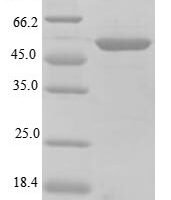
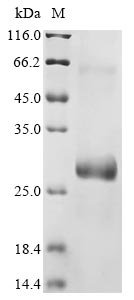
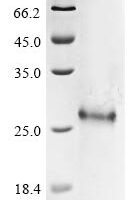
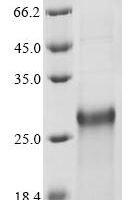
PurityGreater than 85% as determined by SDS-PAGE.
Expression SystemE.coli
Expression Region60-243aa
SpeciesMus musculus (Mouse)
Tag InfoN-terminal 10xHis-tagged and C-terminal Myc-tagged
Molecular weight28.1kDa
ActivityPlease contact us to obtain bioactivity data.
BufferIf the delivery form is liquid, the default storage buffer is Tris/PBS-based buffer, 5%-50% glycerol. If the delivery form is lyophilized powder, the buffer before lyophilization is Tris/PBS-based buffer, 6% Trehalose.
StorageStore at -20°C/-80°C upon receipt, aliquoting is necessary for mutiple use. Avoid repeated freeze-thaw cycles.
Research AreasCancer

Function

Functions via its association with PML-nuclear bodies (PML-NBs) in a wide range of important cellular processes, including tumor suppression, transcriptional regulation, apoptosis, senescence, DNA damage response, and viral defense mechanisms. Acts as the scaffold of PML-NBs allowing other proteins to shuttle in and out, a process which is regulated by SUMO-mediated modifications and interactions. Inhibits EIF4E-mediated mRNA nuclear export by reducing EIF4E affinity for the 5' 7-methylguanosine (m7G) cap of target mRNAs.

Biological Context

Subcellular Location: Nucleus; Nucleus, nucleoplasm; Cytoplasm; Nucleus, PML body; Nucleus, nucleolus; Endoplasmic reticulum membrane (Peripheral membrane protein); Early endosome membrane (Peripheral membrane protein)

Product Specifications

Recombinant Mouse Protein PML (Pml), partial is a recombinant protein from Mus musculus (Mouse), expressed in E.coli, covering amino acids 60-243aa, with N-terminal 10xHis-tagged and C-terminal Myc-tagged tag, molecular weight 28.1kDa, purity Greater than 85% as determined by SDS-PAGE.. Suitable for ELISA and Western Blot applications.
Recommended applications depend on the target, product format, and product-specific validation data. Refer to the product datasheet or Certificate of Analysis (CoA), or contact BioCrest Sci for application guidance.

Biological Activity: Please contact us to obtain bioactivity data.

Storage: Store at -20°C/-80°C upon receipt, aliquoting is necessary for mutiple use. Avoid repeated freeze-thaw cycles.

Shipping & Lead Time: Availability, shipping conditions, and estimated lead time are confirmed in the formal quotation or order confirmation based on the product format, destination, and order requirements.

Protein Biology

Function

Functions via its association with PML-nuclear bodies (PML-NBs) in a wide range of important cellular processes, including tumor suppression, transcriptional regulation, apoptosis, senescence, DNA damage response, and viral defense mechanisms. Acts as the scaffold of PML-NBs allowing other proteins to shuttle in and out, a process which is regulated by SUMO-mediated modifications and interactions. Inhibits EIF4E-mediated mRNA nuclear export by reducing EIF4E affinity for the 5' 7-methylguanosine (m7G) cap of target mRNAs (By similarity). Positively regulates p53/TP53 by acting at different levels (by promoting its acetylation and phosphorylation and by inhibiting its MDM2-dependent degradation). Regulates phosphorylation of ITPR3 and plays a role in the regulation of calcium homeostasis at the endoplasmic reticulum. Regulates RB1 phosphorylation and activity. Acts as both a negative regulator of PPARGC1A acetylation and a potent activator of PPAR signaling and fatty acid oxidation. Regulates translation of HIF1A by sequestering MTOR, and thereby plays a role in neoangiogenesis and tumor vascularization. Regulates PER2 nuclear localization and circadian function. Cytoplasmic PML is involved in the regulation of the TGF-beta signaling pathway. Required for normal development of the brain cortex during embryogenesis. Plays a role in granulopoiesis or monopoiesis of myeloid progenitor cells. May play a role regulating stem and progenitor cell fate in tissues as diverse as blood, brain and breast. Shows antiviral activity towards lymphocytic choriomeningitis virus (LCMV) and the vesicular stomatitis virus (VSV)

Subcellular Location

Nucleus; Nucleus, nucleoplasm; Cytoplasm; Nucleus, PML body; Nucleus, nucleolus; Endoplasmic reticulum membrane (Peripheral membrane protein); Early endosome membrane (Peripheral membrane protein)

Subunit

Key component of PML bodies. PML bodies are formed by the interaction of PML homodimers (via SUMO-binding motif) with sumoylated PML, leading to the assembly of higher oligomers. Several types of PML bodies have been observed. PML bodies can form hollow spheres that can sequester target proteins inside. Interacts (via SUMO-binding motif) with sumoylated proteins. Interacts (via C-terminus) with p53/TP53. Recruits p53/TP53 and CHEK2 into PML bodies, which promotes p53/TP53 phosphorylation at 'Ser-20' and prevents its proteasomal degradation. Interacts with MDM2, and sequesters MDM2 in the nucleolus, thereby preventing ubiquitination of p53/TP53. Interaction with PML-RARA oncoprotein and certain viral proteins causes disassembly of PML bodies and abolishes the normal PML function. Interacts with TERT, SIRT1, TOPBP1, TRIM27 and TRIM69. Interacts with ELF4 (via C-terminus). Interacts with Lassa virus Z protein and rabies virus phosphoprotein. Interacts (in the cytoplasm) with TGFBR1, TGFBR2 and PKM. Interacts (via the coiled-coil domain and when sumoylated) with SATB1. Interacts with UBE2I; the interaction is enhanced by arsenic binding. Interacts with SMAD2, SMAD3, DAXX, RPL11, HIPK2 and MTOR. Interacts with ITPR3, PPP1A and RB1. Interacts with RNF4, NLRP3, MAGEA2, RBL2, PER2, E2F4 and MAPK7/BMK1. Interacts with CSNK2A1 and CSNK2A3. Interacts with ANKRD2; the interaction is direct. Interacts with PPARGC1A and KAT2A. Interacts (via SUMO-interacting motif) with sumoylated MORC3 (By similarity). Interacts with TRIM16. Interacts with PRDM1 (By similarity). Interacts (via RING-type zinc finger) with EIF4E; the interaction reduces EIF4E affinity for the 5' m7G cap of mRNA, thus reducing nuclear export of cyclin CCND1 (PubMed:11500381, PubMed:11575918)

Gene: Pml  |  Organism: Mus musculus

Frequently Asked Questions

How do I order or inquire about this product?

Submit the Online Inquiry form with your required quantity and specifications, or email sales@biocrestsci.com. Available sizes, pricing, stock status, documentation, and estimated lead time are confirmed in the formal quotation.

What is the shipping and delivery time?

Availability, dispatch timing, shipping conditions, and delivery estimates depend on the product format, destination, and order requirements. These details are confirmed in the formal quotation or order confirmation.

How should this product be stored?

Follow the storage and handling instructions in the product-specific datasheet and Certificate of Analysis (CoA). Requirements may vary by product form and formulation; contact BioCrest Sci if product-specific guidance is needed.

What quality controls are performed on your products?

Quality-control data such as identity, purity, endotoxin level, or biological activity are provided only when specified on this product page, the datasheet, or Certificate of Analysis (CoA). Biological activity is not implied unless explicitly stated.

Shopping Cart
Scroll to Top