, ,

Recombinant Mouse Serine/threonine-protein kinase VRK1 (Vrk1)

Recombinant Mouse Serine/threonine-protein kinase VRK1 (Vrk1) — Serine/threonine kinase involved in the regulation of key cellular processes including the cell cycle, nuclear condensation, transcription regulation, and DNA damage response. Purity >85%.

SKU: BCRECP-004744 Categories: , ,

Product Specifications

Product SkuBCRECP-004744
Product DescriptionRecombinant Mouse Serine/threonine-protein kinase VRK1 (Vrk1) Protein is expressed from E.coli with N-terminal 6xHis-tagged and C-terminal Myc-tagged. It contains 1-440aa. [Accession | Q80X41].
Uniprot No.Q80X41
Gene NamesVrk1
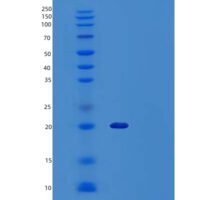
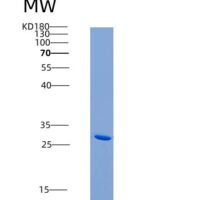
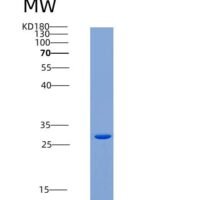
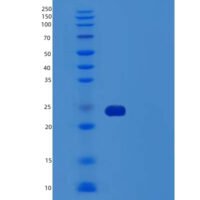
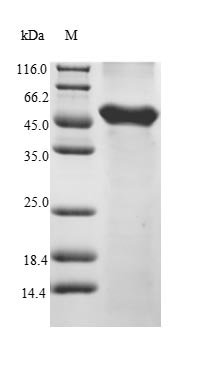
PurityGreater than 85% as determined by SDS-PAGE.
Expression SystemE.coli
Expression Region1-440aa
SpeciesMus musculus (Mouse)
Tag InfoN-terminal 6xHis-tagged and C-terminal Myc-tagged
Molecular weight55.2kDa
ActivityPlease contact us to obtain bioactivity data.
BufferIf the delivery form is liquid, the default storage buffer is Tris/PBS-based buffer, 5%-50% glycerol. If the delivery form is lyophilized powder, the buffer before lyophilization is Tris/PBS-based buffer, 6% Trehalose.
StorageStore at -20°C/-80°C upon receipt, aliquoting is necessary for mutiple use. Avoid repeated freeze-thaw cycles.
Research AreasCell Biology

Function

Serine/threonine kinase involved in the regulation of key cellular processes including the cell cycle, nuclear condensation, transcription regulation, and DNA damage response. Controls chromatin organization and remodeling by mediating phosphorylation of histone H3 on 'Thr-4' and histone H2AX (H2aXT4ph). It also phosphorylates KAT5 in response to DNA damage, promoting KAT5 association with chromatin and histone acetyltransferase activity.

Biological Context

Subcellular Location: Nucleus; Cytoplasm; Nucleus, Cajal body
Tissue Specificity: Highly expressed in testis. Expressed in liver, kidney and muscle. Weakly expressed in thymus, bone marrow and spleen

Product Specifications

Recombinant Mouse Serine/threonine-protein kinase VRK1 (Vrk1) is a recombinant protein from Mus musculus (Mouse), expressed in E.coli, covering amino acids 1-440aa, with N-terminal 6xHis-tagged and C-terminal Myc-tagged tag, molecular weight 55.2kDa, purity Greater than 85% as determined by SDS-PAGE.. Suitable for ELISA and Western Blot applications.

SDS-PAGE: Single band at expected molecular weight confirming purity.

ELISA: Suitable as coating antigen or detection standard.

Western Blot: Compatible with standard Western Blot protocols.

Protein Interaction: Validated for SPR (Surface Plasmon Resonance) and BLI (Bio-Layer Interferometry) studies.

Shipping: Shipped at ambient temperature. Lyophilized protein is stable during transit.

Storage: Store lyophilized protein at -20°C to -80°C. Reconstituted protein should be aliquoted and stored at -80°C. Avoid repeated freeze-thaw cycles.

Shelf Life: 12 months from date of receipt when stored as recommended.

Shipping Time: Orders placed before 2 PM EST ship same day. International orders typically deliver within 5-10 business days.

Protein Biology

Function

Serine/threonine kinase involved in the regulation of key cellular processes including the cell cycle, nuclear condensation, transcription regulation, and DNA damage response (PubMed:14645249, PubMed:33076429, PubMed:9521809). Controls chromatin organization and remodeling by mediating phosphorylation of histone H3 on 'Thr-4' and histone H2AX (H2aXT4ph) (By similarity). It also phosphorylates KAT5 in response to DNA damage, promoting KAT5 association with chromatin and histone acetyltransferase activity (PubMed:33076429). Is involved in the regulation of cell cycle progression of neural progenitors, and is required for proper cortical neuronal migration (PubMed:25609612). Is involved in neurite elongation and branching in motor neurons, and has an essential role in Cajal bodies assembly, acting through COIL phosphorylation and the control of coilin degradation (By similarity). Involved in Golgi disassembly during the cell cycle: following phosphorylation by PLK3 during mitosis, required to induce Golgi fragmentation (By similarity). Phosphorylates BANF1: disrupts its ability to bind DNA, reduces its binding to LEM domain-containing proteins and causes its relocalization from the nucleus to the cytoplasm (By similarity). Phosphorylates TP53BP1 and p53/TP53 on 'Thr-18', preventing the interaction between p53/TP53 and MDM2 (By similarity). Phosphorylates ATF2 which activates its transcriptional activity (By similarity). Phosphorylates JUN (By similarity)

Subcellular Location

Nucleus; Cytoplasm; Nucleus, Cajal body

Tissue Specificity

Highly expressed in testis. Expressed in liver, kidney and muscle. Weakly expressed in thymus, bone marrow and spleen

Subunit

Interacts with HDAC1, KAT2B, SETDB1, KDM3A and KDM4A (By similarity). Associates with the nucleosome through interactions with nucleosome DNA, histone H2A and histone H2B; the interaction with H2A and H2B is mediated by the nucleosome acidic patch, a cluster of negatively charged residues of H2A and H2B forming a cleft within the nucleosome core

Gene: Vrk1  |  Organism: Mus musculus  |  Synonyms: Serine/threonine-protein kinase 51PK; Vaccinia-related kinase 1
Key Publications

Frequently Asked Questions

How do I order or inquire about this product?

Fill out the Online Inquiry form with your required quantity and specifications. You can also email sales@biocrestsci.com. Our team typically responds within 4 business hours with a quote and availability confirmation.

What is the shipping and delivery time?

Orders placed before 2 PM EST ship the same day. Domestic (US) delivery typically takes 2-3 business days. International orders deliver within 5-10 business days. All products are shipped at ambient temperature with appropriate packaging to ensure stability.

How should I store this recombinant protein?

Lyophilized proteins should be stored at -20°C to -80°C upon receipt. After reconstitution, aliquot and store at -80°C. Avoid repeated freeze-thaw cycles. Shelf life is 12 months from date of receipt when stored as recommended.

What quality controls are performed on your products?

Each product undergoes SDS-PAGE purity analysis (typically >85-95%), endotoxin testing, and bioactivity validation. Products are validated for ELISA, Western Blot, and SPR/BLI applications as specified on this product page. A Certificate of Analysis (CoA) is available upon request.

Shopping Cart
Scroll to Top