Recombinant Mouse Transcription factor AP-1 (Jun)

Recombinant Mouse Transcription factor AP-1 (Jun) — Transcription factor that recognizes and binds to the AP-1 consensus motif 5′-TGA[GC]TCA-3′. Purity >85%.

SKU: BCRECP-003204 Category:

Product Specifications

Product SkuBCRECP-003204
Product DescriptionRecombinant Mouse Transcription factor AP-1 (Jun) Protein is expressed from E.coli with N-terminal 6xHis-tagged. It contains 1-334aa. [Accession | P05627].
Uniprot No.P05627
Gene NamesJun
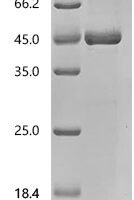
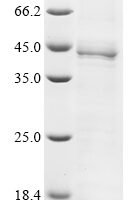
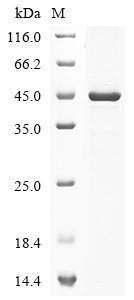
PurityGreater than 85% as determined by SDS-PAGE.
Expression SystemE.coli
Expression Region1-334aa
SpeciesMus musculus (Mouse)
Tag InfoN-terminal 6xHis-tagged
Molecular weight41.9kDa
ActivityPlease contact us to obtain bioactivity data.
BufferIf the delivery form is liquid, the default storage buffer is Tris/PBS-based buffer, 5%-50% glycerol. If the delivery form is lyophilized powder, the buffer before lyophilization is Tris/PBS-based buffer, 6% Trehalose.
StorageStore at -20°C/-80°C upon receipt, aliquoting is necessary for mutiple use. Avoid repeated freeze-thaw cycles.
Research AreasEpigenetics and Nuclear Signaling

Function

Transcription factor that recognizes and binds to the AP-1 consensus motif 5'-TGA[GC]TCA-3'. Heterodimerizes with proteins of the FOS family to form an AP-1 transcription factor complex, thereby enhancing its DNA binding activity to the AP-1 consensus sequence 5'-TGA[GC]TCA-3' and enhancing its transcriptional activity. Together with FOSB, plays a role in activation-induced cell death of T cells by binding to the AP-1 promoter site of FASLG/CD95L, and inducing its transcription in response to activation of the TCR/CD3 signaling pathway.

Biological Context

Subcellular Location: Nucleus

Product Specifications

Recombinant Mouse Transcription factor AP-1 (Jun) is a recombinant protein from Mus musculus (Mouse), expressed in E.coli, covering amino acids 1-334aa, with N-terminal 6xHis-tagged tag, molecular weight 41.9kDa, purity Greater than 85% as determined by SDS-PAGE.. Suitable for ELISA and Western Blot applications.
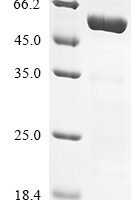
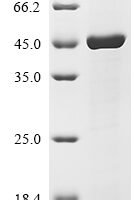
SDS-PAGE: Single band at expected molecular weight confirming purity.

ELISA: Suitable as coating antigen or detection standard.

Western Blot: Compatible with standard Western Blot protocols.

Protein Interaction: Validated for SPR (Surface Plasmon Resonance) and BLI (Bio-Layer Interferometry) studies.

Shipping: Shipped at ambient temperature. Lyophilized protein is stable during transit.

Storage: Store lyophilized protein at -20°C to -80°C. Reconstituted protein should be aliquoted and stored at -80°C. Avoid repeated freeze-thaw cycles.

Shelf Life: 12 months from date of receipt when stored as recommended.

Shipping Time: Orders placed before 2 PM EST ship same day. International orders typically deliver within 5-10 business days.

Protein Biology

Function

Transcription factor that recognizes and binds to the AP-1 consensus motif 5'-TGA[GC]TCA-3' (PubMed:14707112). Heterodimerizes with proteins of the FOS family to form an AP-1 transcription factor complex, thereby enhancing its DNA binding activity to the AP-1 consensus sequence 5'-TGA[GC]TCA-3' and enhancing its transcriptional activity (PubMed:2498083). Together with FOSB, plays a role in activation-induced cell death of T cells by binding to the AP-1 promoter site of FASLG/CD95L, and inducing its transcription in response to activation of the TCR/CD3 signaling pathway (By similarity). Promotes activity of NR5A1 when phosphorylated by HIPK3 leading to increased steroidogenic gene expression upon cAMP signaling pathway stimulation (PubMed:17210646). Involved in activated KRAS-mediated transcriptional activation of USP28 (By similarity). Binds to the USP28 promoter (By similarity)

Subcellular Location

Nucleus

Subunit

Heterodimer with either BATF3 or ATF7 (By similarity). Heterodimer with FOS (PubMed:29272704). Heterodimer with FOSB isoform 1 and 2 (PubMed:29272704). Component of an AP-1 transcription factor complex composed of JUN-FOS heterodimers (PubMed:2498083). As part of the AP-1 transcription factor complex, forms heterodimers with FOSB, thereby binding to the AP-1 consensus sequence and stimulating transcription (PubMed:2498083). The ATF7/JUN heterodimer is essential for ATF7 transactivation activity. Interacts with SP1, SPIB and TCF20. Interacts with COPS5; the interaction leads indirectly to its phosphorylation. Component of the SMAD3/SMAD4/JUN/FOS/complex which forms at the AP1 promoter site. The SMAD3/SMAD4 heterodimer acts synergistically with the JUN/FOS heterodimer to activate transcription in response to TGF-beta (By similarity). Interacts (via its basic DNA binding and leucine zipper domains) with SMAD3 (via an N-terminal domain); the interaction is required for TGF-beta-mediated transactivation of the SMAD3/SMAD4/JUN/FOS/complex (By similarity). Interacts with TSC22D3 (via N-terminus); the interaction inhibits the binding of active AP1 to its target DNA (PubMed:11397794). Interacts with HIVEP3 and MYBBP1A (PubMed:14707112, PubMed:9447996). Interacts with methylated RNF187 (PubMed:20852630). Binds to HIPK3. Interacts (when phosphorylated) with FBXW7 (By similarity). Interacts with PRR7 (PubMed:27458189). Found in a complex with PRR7 and FBXW7 (By similarity). Interacts with PRR7 and FBXW7; the interaction inhibits ubiquitination-mediated JUN degradation promoting its phosphorylation and transcriptional activity (By similarity). Interacts with RBM39 (PubMed:11704680). Interacts with PAGE4 (By similarity). Interacts with FOSL1 and FOSL2 (PubMed:29272704). Interacts with ARK2N and CSNK2B; the interaction with ARK2N is mediated by CSNK2B (By similarity)

Gene: Jun  |  Organism: Mus musculus  |  Synonyms: AH119; Activator protein 1; Proto-oncogene c-Jun; Transcription factor AP-1 subunit Jun; V-jun avian sarcoma virus 17 oncogene homolog
Key Publications

Frequently Asked Questions

How do I order or inquire about this product?

Fill out the Online Inquiry form with your required quantity and specifications. You can also email sales@biocrestsci.com. Our team typically responds within 4 business hours with a quote and availability confirmation.

What is the shipping and delivery time?

Orders placed before 2 PM EST ship the same day. Domestic (US) delivery typically takes 2-3 business days. International orders deliver within 5-10 business days. All products are shipped at ambient temperature with appropriate packaging to ensure stability.

How should I store this recombinant protein?

Lyophilized proteins should be stored at -20°C to -80°C upon receipt. After reconstitution, aliquot and store at -80°C. Avoid repeated freeze-thaw cycles. Shelf life is 12 months from date of receipt when stored as recommended.

What quality controls are performed on your products?

Each product undergoes SDS-PAGE purity analysis (typically >85-95%), endotoxin testing, and bioactivity validation. Products are validated for ELISA, Western Blot, and SPR/BLI applications as specified on this product page. A Certificate of Analysis (CoA) is available upon request.

Shopping Cart
Scroll to Top