Function
Multifunctional protein that regulates the growth and differentiation of various cell types and is involved in various processes, such as normal development, immune function, microglia function and responses to neurodegeneration. Activation into mature form follows different steps: following cleavage of the proprotein in the Golgi apparatus, Latency-associated peptide (LAP) and Transforming growth factor beta-1 (TGF-beta-1) chains remain non-covalently linked rendering TGF-beta-1 inactive during storage in extracellular matrix. At the same time, LAP chain interacts with 'milieu molecules', such as LTBP1, LRRC32/GARP and LRRC33/NRROS that control activation of TGF-beta-1 and maintain it in a latent state during storage in extracellular milieus.
Biological Context
Subcellular Location: Secreted
Tissue Specificity: Expressed in cardiomyocytes. Weakly expressed in the mammary glands, with a slight increase of expression following onset of involution
Product Specifications
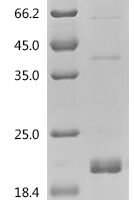
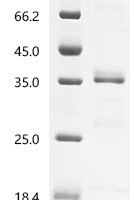
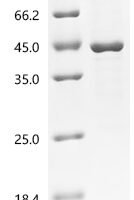
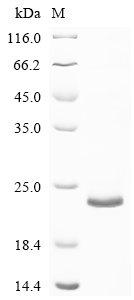
Recombinant Mouse Transforming growth factor beta-1 proprotein (Tgfb1), partial is a recombinant protein from Mus musculus (Mouse), expressed in E.coli, covering amino acids 279-390aa, with N-terminal 6xHis-tagged and C-terminal Avi-tagged tag, molecular weight 21.5kDa, purity Greater than 90% as determined by SDS-PAGE.. Suitable for ELISA and Western Blot applications. Explore more Growth Factor proteins →