Recombinant Mouse Transient receptor potential cation channel subfamily V member 4 (Trpv4), partial

Recombinant Mouse Transient receptor potential cation channel subfamily V member 4 (Trpv4), partial — Non-selective calcium permeant cation channel involved in osmotic sensitivity and mechanosensitivity. Purity >90%.

SKU: BCRECP-004626 Category:

Product Specifications

Product SkuBCRECP-004626
Product DescriptionRecombinant Mouse Transient receptor potential cation channel subfamily V member 4 (Trpv4) Protein is expressed from E.coli with N-terminal 6xHis-tagged. It contains 1-469aa. [Accession | Q9EPK8].
Uniprot No.Q9EPK8
Gene NamesTrpv4
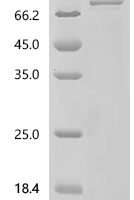
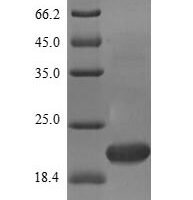
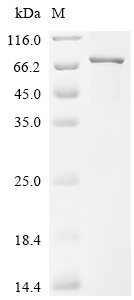
PurityGreater than 90% as determined by SDS-PAGE.
Expression SystemE.coli
Expression Region1-469aa
SpeciesMus musculus (Mouse)
Tag InfoN-terminal 6xHis-tagged
Molecular weight59.9kDa
ActivityPlease contact us to obtain bioactivity data.
BufferIf the delivery form is liquid, the default storage buffer is Tris/PBS-based buffer, 5%-50% glycerol. If the delivery form is lyophilized powder, the buffer before lyophilization is Tris/PBS-based buffer, 6% Trehalose.
StorageStore at -20°C/-80°C upon receipt, aliquoting is necessary for mutiple use. Avoid repeated freeze-thaw cycles.
Research AreasNeuroscience

Function

Non-selective calcium permeant cation channel involved in osmotic sensitivity and mechanosensitivity. Activation by exposure to hypotonicity within the physiological range exhibits an outward rectification. Also activated by heat, low pH, citrate and phorbol esters.

Biological Context

Subcellular Location: Cell membrane; Apical cell membrane (Multi-pass membrane protein); Cell junction, adherens junction; Cell projection, cilium
Tissue Specificity: Detected in liver, kidney, heart, brain cortex, cerebellum and brainstem (at protein level). Expressed in salivary glands (at protein level). Expressed in heart, lung, spleen, liver, kidney, brain, skeletal muscle and testis. In the central nervous system, expressed in the lamina terminalis (arched vascular organ and neurons of the subfornical organ), median preoptic area, ventral hippocampal commissure, and ependymal cells of the choroid plexus. In the cochlea, expressed in both inner and outer hair cells, and in marginal cells of the cochlear stria vascularis. Expressed in large neurons of the trigeminal ganglion. In the kidney cortex, strongly expressed by epithelial cells of tubules and much weaker in glomeruli

Product Specifications

Recombinant Mouse Transient receptor potential cation channel subfamily V member 4 (Trpv4), partial is a recombinant protein from Mus musculus (Mouse), expressed in E.coli, covering amino acids 1-469aa, with N-terminal 6xHis-tagged tag, molecular weight 59.9kDa, purity Greater than 90% as determined by SDS-PAGE.. Suitable for ELISA and Western Blot applications.
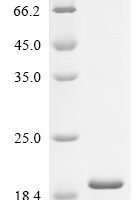
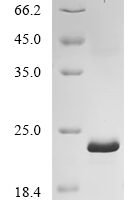
SDS-PAGE: Single band at expected molecular weight confirming purity.

ELISA: Suitable as coating antigen or detection standard.

Western Blot: Compatible with standard Western Blot protocols.

Protein Interaction: Validated for SPR (Surface Plasmon Resonance) and BLI (Bio-Layer Interferometry) studies.

Shipping: Shipped at ambient temperature. Lyophilized protein is stable during transit.

Storage: Store lyophilized protein at -20°C to -80°C. Reconstituted protein should be aliquoted and stored at -80°C. Avoid repeated freeze-thaw cycles.

Shelf Life: 12 months from date of receipt when stored as recommended.

Shipping Time: Orders placed before 2 PM EST ship same day. International orders typically deliver within 5-10 business days.

Protein Biology

Function

Non-selective calcium permeant cation channel involved in osmotic sensitivity and mechanosensitivity (PubMed:11094154, PubMed:12093812, PubMed:12538589). Activation by exposure to hypotonicity within the physiological range exhibits an outward rectification (PubMed:12093812, PubMed:14691263, PubMed:16368742, PubMed:16571723). Also activated by heat, low pH, citrate and phorbol esters (PubMed:14691263). Increase of intracellular Ca(2+) potentiates currents. Channel activity seems to be regulated by a calmodulin-dependent mechanism with a negative feedback mechanism (By similarity). Acts as a regulator of intracellular Ca(2+) in synoviocytes (By similarity). Plays an obligatory role as a molecular component in the nonselective cation channel activation induced by 4-alpha-phorbol 12,13-didecanoate and hypotonic stimulation in synoviocytes and also regulates production of IL-8 (By similarity). Together with PKD2, forms mechano- and thermosensitive channels in cilium (PubMed:18695040). Promotes cell-cell junction formation in skin keratinocytes and plays an important role in the formation and/or maintenance of functional intercellular barriers (PubMed:20413591). Negatively regulates expression of PPARGC1A, UCP1, oxidative metabolism and respiration in adipocytes (PubMed:23021218). Regulates expression of chemokines and cytokines related to pro-inflammatory pathway in adipocytes (PubMed:23021218). Together with AQP5, controls regulatory volume decrease in salivary epithelial cells (PubMed:16571723). Required for normal development and maintenance of bone and cartilage (By similarity). In its inactive state, may sequester DDX3X at the plasma membrane. When activated, the interaction between both proteins is affected and DDX3X relocalizes to the nucleus (By similarity). In neurons of the central nervous system, could play a role in triggering voluntary water intake in response to increased sodium concentration in body fluid (PubMed:27252474)

Subcellular Location

Cell membrane; Apical cell membrane (Multi-pass membrane protein); Cell junction, adherens junction; Cell projection, cilium

Tissue Specificity

Detected in liver, kidney, heart, brain cortex, cerebellum and brainstem (at protein level). Expressed in salivary glands (at protein level) (PubMed:16571723). Expressed in heart, lung, spleen, liver, kidney, brain, skeletal muscle and testis. In the central nervous system, expressed in the lamina terminalis (arched vascular organ and neurons of the subfornical organ), median preoptic area, ventral hippocampal commissure, and ependymal cells of the choroid plexus. In the cochlea, expressed in both inner and outer hair cells, and in marginal cells of the cochlear stria vascularis. Expressed in large neurons of the trigeminal ganglion. In the kidney cortex, strongly expressed by epithelial cells of tubules and much weaker in glomeruli

Subunit

Homotetramer. Interacts with calmodulin (By similarity). Interacts with CTNNB1 (PubMed:20413591). The TRPV4 and CTNNB1 complex can interact with CDH1 (PubMed:20413591). Part of a complex containing MLC1, AQP4, HEPACAM and ATP1B1 (By similarity). Interacts with MAP7 and Src family Tyr protein kinases LYN, SRC, FYN, HCK, LCK and YES (PubMed:12538589, PubMed:14517216). Interacts with PACSIN1, PACSIN2 and PACSIN3 (via SH3 domain) (PubMed:16627472, PubMed:18174177). Interacts with ITPR3 (By similarity). Interacts with AQP5; the interaction is probably indirect and regulates TRPV4 activation by hypotonicity (PubMed:16571723). Interacts with ANO1 (PubMed:24509911). Interacts (via C-terminus) with PKD2 (via C-terminus) (PubMed:18695040). Interacts with DDX3X; this interaction is decreased when the channel is activated (By similarity)

Gene: Trpv4  |  Organism: Mus musculus  |  Synonyms: Osm-9-like TRP channel 4; Transient receptor potential protein 12; Vanilloid receptor-like channel 2; Vanilloid receptor-like protein 2; Vanilloid receptor-related osmotically-activated channel
Key Publications

Frequently Asked Questions

How do I order or inquire about this product?

Fill out the Online Inquiry form with your required quantity and specifications. You can also email sales@biocrestsci.com. Our team typically responds within 4 business hours with a quote and availability confirmation.

What is the shipping and delivery time?

Orders placed before 2 PM EST ship the same day. Domestic (US) delivery typically takes 2-3 business days. International orders deliver within 5-10 business days. All products are shipped at ambient temperature with appropriate packaging to ensure stability.

How should I store this recombinant protein?

Lyophilized proteins should be stored at -20°C to -80°C upon receipt. After reconstitution, aliquot and store at -80°C. Avoid repeated freeze-thaw cycles. Shelf life is 12 months from date of receipt when stored as recommended.

What quality controls are performed on your products?

Each product undergoes SDS-PAGE purity analysis (typically >85-95%), endotoxin testing, and bioactivity validation. Products are validated for ELISA, Western Blot, and SPR/BLI applications as specified on this product page. A Certificate of Analysis (CoA) is available upon request.

Shopping Cart
Scroll to Top