Recombinant Pig Heat shock protein HSP 90-alpha (HSP90AA1), partial

Recombinant Pig Heat shock protein HSP 90-alpha (HSP90AA1), partial — Molecular chaperone that promotes the maturation, structural maintenance and proper regulation of specific target proteins involved for instance in cell cycle control and signal transduction. Purity >90%.

SKU: BCRECP-003033 Category:

Product Specifications

Product SkuBCRECP-003033
Product DescriptionRecombinant Pig Heat shock protein HSP 90-alpha (HSP90AA1) Protein is expressed from Baculovirus with N-terminal 6xHis-tagged. It contains 222-367aa. [Accession | O02705].
Uniprot No.O02705
Gene NamesHSP90AA1
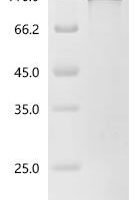
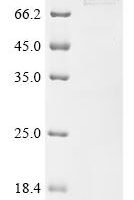
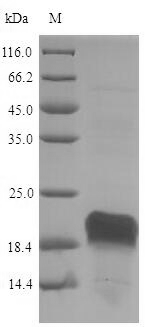
PurityGreater than 90% as determined by SDS-PAGE.
Expression SystemBaculovirus
Expression Region222-367aa
SpeciesSus scrofa (Pig)
Tag InfoN-terminal 6xHis-tagged
Molecular weight19.7kDa
ActivityPlease contact us to obtain bioactivity data.
BufferIf the delivery form is liquid, the default storage buffer is Tris/PBS-based buffer, 5%-50% glycerol. If the delivery form is lyophilized powder, the buffer before lyophilization is Tris/PBS-based buffer, 6% Trehalose.
StorageStore at -20°C/-80°C upon receipt, aliquoting is necessary for mutiple use. Avoid repeated freeze-thaw cycles.
Research AreasSignal Transduction

Function

Molecular chaperone that promotes the maturation, structural maintenance and proper regulation of specific target proteins involved for instance in cell cycle control and signal transduction. Undergoes a functional cycle that is linked to its ATPase activity which is essential for its chaperone activity. This cycle probably induces conformational changes in the client proteins, thereby causing their activation.

Biological Context

Subcellular Location: Nucleus; Cytoplasm; Melanosome; Cell membrane; Mitochondrion
Tissue Specificity: Preferentially expressed in pituitary gland, brain, adrenal gland, and testis, in comparison to other tissues

Product Specifications

Recombinant Pig Heat shock protein HSP 90-alpha (HSP90AA1), partial is a recombinant protein from Sus scrofa (Pig), expressed in Baculovirus, covering amino acids 222-367aa, with N-terminal 6xHis-tagged tag, molecular weight 19.7kDa, purity Greater than 90% as determined by SDS-PAGE.. Suitable for ELISA and Western Blot applications.
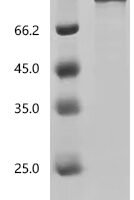
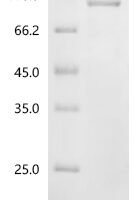
SDS-PAGE: Single band at expected molecular weight confirming purity.

ELISA: Suitable as coating antigen or detection standard.

Western Blot: Compatible with standard Western Blot protocols.

Protein Interaction: Validated for SPR (Surface Plasmon Resonance) and BLI (Bio-Layer Interferometry) studies.

Shipping: Shipped at ambient temperature. Lyophilized protein is stable during transit.

Storage: Store lyophilized protein at -20°C to -80°C. Reconstituted protein should be aliquoted and stored at -80°C. Avoid repeated freeze-thaw cycles.

Shelf Life: 12 months from date of receipt when stored as recommended.

Shipping Time: Orders placed before 2 PM EST ship same day. International orders typically deliver within 5-10 business days.

Protein Biology

Function

Molecular chaperone that promotes the maturation, structural maintenance and proper regulation of specific target proteins involved for instance in cell cycle control and signal transduction. Undergoes a functional cycle that is linked to its ATPase activity which is essential for its chaperone activity. This cycle probably induces conformational changes in the client proteins, thereby causing their activation. Interacts dynamically with various co-chaperones that modulate its substrate recognition, ATPase cycle and chaperone function. Engages with a range of client protein classes via its interaction with various co-chaperone proteins or complexes, that act as adapters, simultaneously able to interact with the specific client and the central chaperone itself. Recruitment of ATP and co-chaperone followed by client protein forms a functional chaperone. After the completion of the chaperoning process, properly folded client protein and co-chaperone leave HSP90 in an ADP-bound partially open conformation and finally, ADP is released from HSP90 which acquires an open conformation for the next cycle. Plays a critical role in mitochondrial import, delivers preproteins to the mitochondrial import receptor TOMM70. Apart from its chaperone activity, it also plays a role in the regulation of the transcription machinery. HSP90 and its co-chaperones modulate transcription at least at three different levels. In the first place, they alter the steady-state levels of certain transcription factors in response to various physiological cues. Second, they modulate the activity of certain epigenetic modifiers, such as histone deacetylases or DNA methyl transferases, and thereby respond to the change in the environment. Third, they participate in the eviction of histones from the promoter region of certain genes and thereby turn on gene expression. Binds bacterial lipopolysaccharide (LPS) and mediates LPS-induced inflammatory response, including TNF secretion by monocytes. Antagonizes STUB1-mediated inhibition of TGF-beta signaling via inhibition of STUB1-mediated SMAD3 ubiquitination and degradation. Mediates the association of TOMM70 with IRF3 or TBK1 in mitochondrial outer membrane which promotes host antiviral response

Subcellular Location

Nucleus; Cytoplasm; Melanosome; Cell membrane; Mitochondrion

Tissue Specificity

Preferentially expressed in pituitary gland, brain, adrenal gland, and testis, in comparison to other tissues

Subunit

Homodimer. Identified in NR3C1/GCR steroid receptor-chaperone complexes formed at least by NR3C1, HSP90AA1 and a variety of proteins containing TPR repeats such as FKBP4, FKBP5, PPID, PPP5C or STIP1. Forms a complex containing HSP90AA1, TSC1 and TSC2; TSC1 is required to recruit TCS2 to the complex. The closed form interacts (via the middle domain and TPR repeat-binding motif) with co-chaperone TSC1 (via C-terminus). Interacts with TOM34. Interacts with TERT; the interaction, together with PTGES3, is required for correct assembly and stabilization of the TERT holoenzyme complex. Interacts with CHORDC1 and DNAJC7. Interacts with STUB1 and UBE2N; may couple the chaperone and ubiquitination systems. Interacts (via TPR repeat-binding motif) with PPP5C (via TPR repeats); the interaction is direct and activates PPP5C phosphatase activity. Following LPS binding, may form a complex with CXCR4, GDF5 and HSPA8. Interacts with KSR1. Interacts with co-chaperone CDC37 (via C-terminus); the interaction inhibits HSP90AA1 ATPase activity. May interact with NWD1. Interacts with FNIP1 and FNIP2; the interaction inhibits HSP90AA1 ATPase activity. Interacts with co-chaperone AHSA1 (phosphorylated on 'Tyr-223'); the interaction activates HSP90AA1 ATPase activity and results in the dissociation of TSC1 from HSP90AA1. Interacts with FLCN in the presence of FNIP1. Interacts with HSP70, STIP1 and PTGES3. Interacts with SMYD3; this interaction enhances SMYD3 histone-lysine N-methyltransferase. Interacts with SGTA (via TPR repeats). Interacts with TTC1 (via TPR repeats). Interacts with HSF1 in an ATP-dependent manner. Interacts with MET; the interaction suppresses MET kinase activity. Interacts with ERBB2 in an ATP-dependent manner; the interaction suppresses ERBB2 kinase activity. Interacts with HIF1A, KEAP1 and RHOBTB2. Interacts with HSF1; this interaction is decreased in a IER5-dependent manner, promoting HSF1 accumulation in the nucleus, homotrimerization and DNA-binding activities. Interacts with STUB1 and SMAD3. Interacts with HSP90AB1; interaction is constitutive (By similarity). Interacts with HECTD1 (via N-terminus) (By similarity). Interacts with NR3C1 (via domain NR LBD) and NR1D1 (via domain NR LBD) (By similarity). Interacts with NLPR12 (By similarity). Interacts with PDCL3 (By similarity). Interacts with TOMM70; the interaction is required for preprotein mitochondrial import. Interacts with TOMM70, IRF3 and TBK1; the interactions are direct and mediate the association of TOMM70 with IRF3 and TBK1 (By similarity). Forms a complex with ASL, ASS1 and NOS2; the complex regulates cell-autonomous L-arginine synthesis and citrulline recycling while channeling extracellular L-arginine to nitric oxide synthesis pathway

Gene: HSP90AA1  |  Organism: Sus scrofa

Frequently Asked Questions

How do I order or inquire about this product?

Fill out the Online Inquiry form with your required quantity and specifications. You can also email sales@biocrestsci.com. Our team typically responds within 4 business hours with a quote and availability confirmation.

What is the shipping and delivery time?

Orders placed before 2 PM EST ship the same day. Domestic (US) delivery typically takes 2-3 business days. International orders deliver within 5-10 business days. All products are shipped at ambient temperature with appropriate packaging to ensure stability.

How should I store this recombinant protein?

Lyophilized proteins should be stored at -20°C to -80°C upon receipt. After reconstitution, aliquot and store at -80°C. Avoid repeated freeze-thaw cycles. Shelf life is 12 months from date of receipt when stored as recommended.

What quality controls are performed on your products?

Each product undergoes SDS-PAGE purity analysis (typically >85-95%), endotoxin testing, and bioactivity validation. Products are validated for ELISA, Western Blot, and SPR/BLI applications as specified on this product page. A Certificate of Analysis (CoA) is available upon request.

Shopping Cart
Scroll to Top