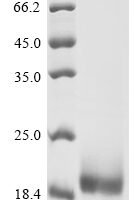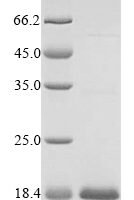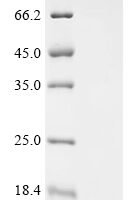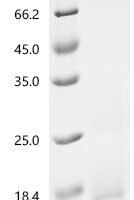
,

Recombinant Pig T-cell surface glycoprotein CD3 epsilon chain (CD3E), partial

Recombinant Pig T-cell surface glycoprotein CD3 epsilon chain (CD3E), partial — Part of the TCR-CD3 complex present on T-lymphocyte cell surface that plays an essential role in adaptive immune response. Purity >90%.

SKU: BCRECP-002325 Categories: ,

Product Specifications

Product SkuBCRECP-002325
Product DescriptionRecombinant Pig T-cell surface glycoprotein CD3 epsilon chain (CD3E) Protein is expressed from E.coli with N-terminal 6xHis-tagged. It contains 22-116aa. [Accession | Q7YRN2].
Uniprot No.Q7YRN2
Gene NamesCD3E
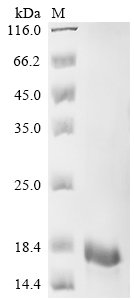
PurityGreater than 90% as determined by SDS-PAGE.
Expression SystemE.coli
Expression Region22-116aa
SpeciesSus scrofa (Pig)
Tag InfoN-terminal 6xHis-tagged
Molecular weight15.2kDa
ActivityPlease contact us to obtain bioactivity data.
BufferIf the delivery form is liquid, the default storage buffer is Tris/PBS-based buffer, 5%-50% glycerol. If the delivery form is lyophilized powder, the buffer before lyophilization is Tris/PBS-based buffer, 6% Trehalose.
StorageStore at -20°C/-80°C upon receipt, aliquoting is necessary for mutiple use. Avoid repeated freeze-thaw cycles.
Research AreasOthers

Function

Part of the TCR-CD3 complex present on T-lymphocyte cell surface that plays an essential role in adaptive immune response. When antigen presenting cells (APCs) activate T-cell receptor (TCR), TCR-mediated signals are transmitted across the cell membrane by the CD3 chains CD3D, CD3E, CD3G and CD247/CD3Z. All CD3 chains contain immunoreceptor tyrosine-based activation motifs (ITAMs) in their cytoplasmic domain.

Biological Context

Subcellular Location: Cell membrane (Single-pass type I membrane protein)

Product Specifications

Recombinant Pig T-cell surface glycoprotein CD3 epsilon chain (CD3E), partial is a recombinant protein from Sus scrofa (Pig), expressed in E.coli, covering amino acids 22-116aa, with N-terminal 6xHis-tagged tag, molecular weight 15.2kDa, purity Greater than 90% as determined by SDS-PAGE.. Suitable for ELISA and Western Blot applications.

Recommended applications depend on the target, product format, and product-specific validation data. Refer to the product datasheet or Certificate of Analysis (CoA), or contact BioCrest Sci for application guidance.

Biological Activity: Please contact us to obtain bioactivity data.

Storage: Store at -20°C/-80°C upon receipt, aliquoting is necessary for mutiple use. Avoid repeated freeze-thaw cycles.

Shipping & Lead Time: Availability, shipping conditions, and estimated lead time are confirmed in the formal quotation or order confirmation based on the product format, destination, and order requirements.

Protein Biology

Function

Part of the TCR-CD3 complex present on T-lymphocyte cell surface that plays an essential role in adaptive immune response. When antigen presenting cells (APCs) activate T-cell receptor (TCR), TCR-mediated signals are transmitted across the cell membrane by the CD3 chains CD3D, CD3E, CD3G and CD247/CD3Z. All CD3 chains contain immunoreceptor tyrosine-based activation motifs (ITAMs) in their cytoplasmic domain. Upon TCR engagement, these motifs become phosphorylated by Src family protein tyrosine kinases LCK and FYN, resulting in the activation of downstream signaling pathways. CD3E ITAM phosphorylation creates docking sites for the protein kinase ZAP70 leading to ZAP70 phosphorylation and its conversion into a catalytically active enzyme. In addition of this role of signal transduction in T-cell activation, CD3E plays an essential role in correct T-cell development (By similarity). Also participates in internalization and cell surface down-regulation of TCR-CD3 complexes via endocytosis sequences present in CD3E cytosolic region (By similarity). In addition to its role as a TCR coreceptor, it serves as a receptor for ITPRIPL1 (By similarity). Ligand recognition inhibits T-cell activation by promoting interaction with NCK1, which prevents CD3E-ZAP70 interaction and blocks the ERK-NFkB signaling cascade and calcium influx (By similarity)

Subcellular Location

Cell membrane (Single-pass type I membrane protein)

Subunit

The TCR-CD3 complex is composed of a CD3D-CD3E and a CD3G-CD3E heterodimers that preferentially associate with TCRalpha and TCRbeta, respectively, to form TCRalpha-CD3E-CD3G and TCRbeta/CD3G-CD3E trimers. In turn, the hexamer interacts with CD247/CD3Z homodimer to form the TCR-CD3 complex. Alternatively, TCRalpha and TCRbeta can be replaced by TCRgamma and TCRdelta. Interacts with CD6. Interacts (via Proline-rich sequence) with NCK1; the interaction is ligand dependent but independent of tyrosine kinase activation. Interacts with NUMB; this interaction is important for TCR-CD3 internalization and subsequent degradation. Interacts (when tyrosine phosphorylated) with LAG3; disrupting the association between CD3E and LCK and preventing TCR activation

Gene: CD3E  |  Organism: Sus scrofa

Frequently Asked Questions

How do I order or inquire about this product?

Submit the Online Inquiry form with your required quantity and specifications, or email sales@biocrestsci.com. Available sizes, pricing, stock status, documentation, and estimated lead time are confirmed in the formal quotation.

What is the shipping and delivery time?

Availability, dispatch timing, shipping conditions, and delivery estimates depend on the product format, destination, and order requirements. These details are confirmed in the formal quotation or order confirmation.

How should this product be stored?

Follow the storage and handling instructions in the product-specific datasheet and Certificate of Analysis (CoA). Requirements may vary by product form and formulation; contact BioCrest Sci if product-specific guidance is needed.

What quality controls are performed on your products?

Quality-control data such as identity, purity, endotoxin level, or biological activity are provided only when specified on this product page, the datasheet, or Certificate of Analysis (CoA). Biological activity is not implied unless explicitly stated.

Shopping Cart
Scroll to Top