Recombinant Rabbit Dystroglycan (DAG1), partial

Recombinant Rabbit Dystroglycan (DAG1), partial — Transmembrane protein that plays important roles in connecting the extracellular matrix to the cytoskeleton. Purity >85%.

SKU: BCRECP-002504 Category:

Product Specifications

Product SkuBCRECP-002504
Product DescriptionRecombinant Rabbit Dystroglycan (DAG1) Protein is expressed from E.coli with N-terminal 6xHis-tagged. It contains 30-653aa. [Accession | Q28685].
Uniprot No.Q28685
Gene NamesDAG1
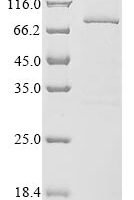
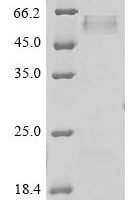
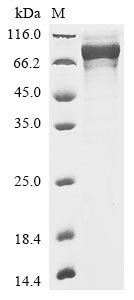
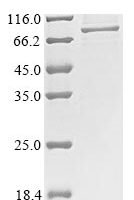
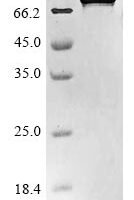
PurityGreater than 85% as determined by SDS-PAGE.
Expression SystemE.coli
Expression Region30-653aa
SpeciesOryctolagus cuniculus (Rabbit)
Tag InfoN-terminal 6xHis-tagged
Molecular weight73.5kDa
ActivityPlease contact us to obtain bioactivity data.
BufferIf the delivery form is liquid, the default storage buffer is Tris/PBS-based buffer, 5%-50% glycerol. If the delivery form is lyophilized powder, the buffer before lyophilization is Tris/PBS-based buffer, 6% Trehalose.
StorageStore at -20°C/-80°C upon receipt, aliquoting is necessary for mutiple use. Avoid repeated freeze-thaw cycles.
Research AreasNeuroscience

Function

Transmembrane protein that plays important roles in connecting the extracellular matrix to the cytoskeleton. Acts as a cell adhesion receptor in both muscle and non-muscle tissues. Receptor for both DMD and UTRN and, through these interactions, scaffolds axin to the cytoskeleton.

Biological Context

Subcellular Location: Cell membrane (Single-pass type I membrane protein); Cytoplasm, cytoskeleton; Nucleus, nucleoplasm; Cell membrane, sarcolemma; Synapse; Postsynaptic cell membrane
Tissue Specificity: Detected in brain, cardiac muscle and skeletal muscle (at protein level). Expressed in lung, brain, liver, kidney, diaphragm and stomach

Product Specifications

Recombinant Rabbit Dystroglycan (DAG1), partial is a recombinant protein from Oryctolagus cuniculus (Rabbit), expressed in E.coli, covering amino acids 30-653aa, with N-terminal 6xHis-tagged tag, molecular weight 73.5kDa, purity Greater than 85% as determined by SDS-PAGE.. Suitable for ELISA and Western Blot applications.
Recommended applications depend on the target, product format, and product-specific validation data. Refer to the product datasheet or Certificate of Analysis (CoA), or contact BioCrest Sci for application guidance.

Biological Activity: Please contact us to obtain bioactivity data.

Storage: Store at -20°C/-80°C upon receipt, aliquoting is necessary for mutiple use. Avoid repeated freeze-thaw cycles.

Shipping & Lead Time: Availability, shipping conditions, and estimated lead time are confirmed in the formal quotation or order confirmation based on the product format, destination, and order requirements.

Protein Biology

Function

Transmembrane protein that plays important roles in connecting the extracellular matrix to the cytoskeleton. Acts as a cell adhesion receptor in both muscle and non-muscle tissues. Receptor for both DMD and UTRN and, through these interactions, scaffolds axin to the cytoskeleton. Also functions in cell adhesion-mediated signaling and implicated in cell polarity (By similarity)

Subcellular Location

Cell membrane (Single-pass type I membrane protein); Cytoplasm, cytoskeleton; Nucleus, nucleoplasm; Cell membrane, sarcolemma; Synapse; Postsynaptic cell membrane

Tissue Specificity

Detected in brain, cardiac muscle and skeletal muscle (at protein level) (PubMed:16709410). Expressed in lung, brain, liver, kidney, diaphragm and stomach (PubMed:1741056)

Subunit

Monomer. Heterodimer of alpha- and beta-dystroglycan subunits which are the central components of the dystrophin-glycoprotein complex. This complex then can form a dystrophin-associated glycoprotein complex (DGC) which is composed of three subcomplexes: a cytoplasmic complex comprised of DMD (or UTRN), DTNA and a number of syntrophins, such as SNTB1, SNTB2, SNTG1 and SNTG2, the transmembrane dystroglycan complex, and the sarcoglycan-sarcospan complex. Interacts (via the N-terminal of alpha-dystroglycan) with LARGE1; the interaction enhances laminin binding (PubMed:15210115). Interacts with SGCD. Interacts with AGR2 and AGR3. Interacts (beta-dystroglycan) with DMD; the interaction is inhibited by phosphorylation on the PPXY motif. Interacts (beta-dystroglycan, via its PPXY motif) with UTRN (via its WWW and ZZ domains); the interaction is inhibited by phosphorylation on the PPXY motif. Interacts (beta-dystroglycan, via its phosphorylated PPXY motif) with the SH2 domain-containing proteins, FYN, CSK, NCK and SHC. Interacts (beta-dystroglycan) with CAV3 (via a central WW-like domain); the interaction disrupts the binding of DMD. beta-dystroglycan directly interacts with ANK3, but not with ANK2; this interaction does not interfere with DMD-binding and is required for retention at costameres (By similarity). Identified in a dystroglycan complex that contains at least PRX, DRP2, UTRN, DMD and DAG1 (By similarity). Interacts with POMGNT1 (By similarity). beta-dystroglycan interacts with CD93 (By similarity). Alpha-dystroglycan interacts with HSPG2; the interaction is required for acetylcholinesterase (AChE) localization at the neuromuscular junctions (NMJ) (By similarity). Alpha-dystroglycan interacts with AGRN; the interaction is required for up-regulation of SOX9 and cartilage formation (By similarity). Alpha-dystroglycan interacts with pikachurin (EGFLAM); the interaction is required for photoreceptor ribbon synapse formation (By similarity)

Gene: DAG1  |  Organism: Oryctolagus cuniculus  |  Synonyms: Dystroglycan; Dystrophin-associated glycoprotein 1
Key Publications

Frequently Asked Questions

How do I order or inquire about this product?

Submit the Online Inquiry form with your required quantity and specifications, or email sales@biocrestsci.com. Available sizes, pricing, stock status, documentation, and estimated lead time are confirmed in the formal quotation.

What is the shipping and delivery time?

Availability, dispatch timing, shipping conditions, and delivery estimates depend on the product format, destination, and order requirements. These details are confirmed in the formal quotation or order confirmation.

How should this product be stored?

Follow the storage and handling instructions in the product-specific datasheet and Certificate of Analysis (CoA). Requirements may vary by product form and formulation; contact BioCrest Sci if product-specific guidance is needed.

What quality controls are performed on your products?

Quality-control data such as identity, purity, endotoxin level, or biological activity are provided only when specified on this product page, the datasheet, or Certificate of Analysis (CoA). Biological activity is not implied unless explicitly stated.

Shopping Cart
Scroll to Top