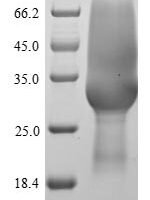
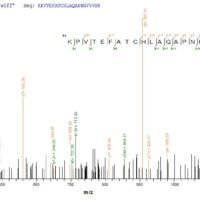
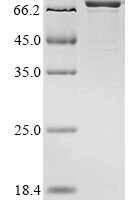
Recombinant Rat Apelin (Apln), partial

Recombinant Rat Apelin (Apln), partial — Peptide hormone that functions as endogenous ligand for the G protein-coupled apelin receptor (APLNR/APJ), that plays a role in cadiovascular homeostasis. Purity >95%.

SKU: BCRECP-002107 Category:

Product Specifications

Product SkuBCRECP-002107
Product DescriptionRecombinant Rat Apelin (Apln) Protein is expressed from Yeast with N-terminal 6xHis-tagged. It contains 65-77aa. [Accession | Q9R0R3].
Uniprot No.Q9R0R3
Gene NamesApln
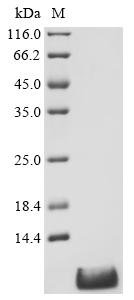
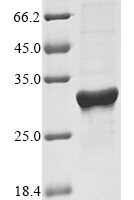
PurityGreater than 95% as determined by SDS-PAGE.
Expression SystemYeast
Expression Region65-77aa
SpeciesRattus norvegicus (Rat)
Tag InfoN-terminal 6xHis-tagged
Molecular weight2.4kDa
ActivityPlease contact us to obtain bioactivity data.
BufferIf the delivery form is liquid, the default storage buffer is Tris/PBS-based buffer, 5%-50% glycerol. If the delivery form is lyophilized powder, the buffer before lyophilization is Tris/PBS-based buffer, 6% Trehalose.
StorageStore at -20°C/-80°C upon receipt, aliquoting is necessary for mutiple use. Avoid repeated freeze-thaw cycles.
Research AreasCardiovascular

Function

Peptide hormone that functions as endogenous ligand for the G protein-coupled apelin receptor (APLNR/APJ), that plays a role in cadiovascular homeostasis. Functions as a balanced agonist activating both G(i) protein pathway and beta-arrestin pathway of APLNR.

Product Specifications

Recombinant Rat Apelin (Apln), partial — Peptide hormone that functions as endogenous ligand for the G protein-coupled apelin receptor (APLNR/APJ), that plays a role in cadiovascular homeostasis. Purity >95%. Suitable for ELISA and Western Blot applications.

Recommended applications depend on the target, product format, and product-specific validation data. Refer to the product datasheet or Certificate of Analysis (CoA), or contact BioCrest Sci for application guidance.

Biological Activity: Please contact us to obtain bioactivity data.

Storage: Store at -20°C/-80°C upon receipt, aliquoting is necessary for mutiple use. Avoid repeated freeze-thaw cycles.

Shipping & Lead Time: Availability, shipping conditions, and estimated lead time are confirmed in the formal quotation or order confirmation based on the product format, destination, and order requirements.

Protein Biology

Function

Peptide hormone that functions as endogenous ligand for the G protein-coupled apelin receptor (APLNR/APJ), that plays a role in cadiovascular homeostasis (PubMed:11336787, PubMed:11359874, PubMed:26611206). Functions as a balanced agonist activating both G(i) protein pathway and beta-arrestin pathway of APLNR (By similarity). Downstream G proteins activation, apelin can inhibit cAMP production and activate key intracellular effectors such as ERKs (PubMed:26611206). On the other hand, APLNR activation induces beta-arrestin recruitment to the membrane leading to desensitization and internalization of the receptor (PubMed:11359874). Apelin blunts cardiac hypertrophic induction from APLNR on response to pathological stimuli, but also induces myocardial hypertrophy under normal conditions (By similarity). Apelin-36 dissociates more hardly than (pyroglu)apelin-13 from APLNR (PubMed:11336787). Involved in the regulation of cardiac precursor cell movements during gastrulation and heart morphogenesis (By similarity). Has an inhibitory effect on cytokine production in response to T-cell receptor/CD3 cross-linking; the oral intake of apelin in the colostrum and the milk might therefore modulate immune responses in neonates. Plays a role in early coronary blood vessels formation (By similarity). Mediates myocardial contractility in an ERK1/2-dependent manner (PubMed:11359874, PubMed:26611206). May also have a role in the central control of body fluid homeostasis by influencing vasopressin release and drinking behavior (PubMed:10617103)

Subcellular Location

Secreted; Secreted, extracellular space

Tissue Specificity

Expressed in the lung, testis, ovary, uterus and mammary gland (PubMed:11336787). Expressed in neurons in the thalamic paraventricular and hypothalamic supraoptic nuclei (PubMed:11359874). The lung, testis and uterus mainly contain a large form that looks like apelin-36, whereas the mammary gland seems to contain 2 forms of apelin, a large form close to apelin-36 and a small form close to apelin-13 (at protein level) (PubMed:11336787). Widely expressed in the adult, with highest levels in the mammary gland of lactating animals, very high levels in the lung, intermediate levels in the spinal cord, ovary, adipose tissue, brain (neuronal cell bodies and fibers in the supraoptic and the paraventricular nuclei), heart and testis, and lowest levels in the pituitary gland, kidney, stomach, uterus and pancreas (PubMed:10525157, PubMed:10617103, PubMed:11336787)

Gene: Apln  |  Organism: Rattus norvegicus  |  Synonyms: APJ endogenous ligand

Frequently Asked Questions

How do I order or inquire about this product?

Submit the Online Inquiry form with your required quantity and specifications, or email sales@biocrestsci.com. Available sizes, pricing, stock status, documentation, and estimated lead time are confirmed in the formal quotation.

What is the shipping and delivery time?

Availability, dispatch timing, shipping conditions, and delivery estimates depend on the product format, destination, and order requirements. These details are confirmed in the formal quotation or order confirmation.
How should this product be stored?

Follow the storage and handling instructions in the product-specific datasheet and Certificate of Analysis (CoA). Requirements may vary by product form and formulation; contact BioCrest Sci if product-specific guidance is needed.

What quality controls are performed on your products?

Quality-control data such as identity, purity, endotoxin level, or biological activity are provided only when specified on this product page, the datasheet, or Certificate of Analysis (CoA). Biological activity is not implied unless explicitly stated.

Shopping Cart
Scroll to Top