Recombinant Rat Chondroitin sulfate proteoglycan 4 (Cspg4), partial

Recombinant Rat Chondroitin sulfate proteoglycan 4 (Cspg4), partial — Proteoglycan playing a role in cell proliferation and migration which stimulates endothelial cells motility during microvascular morphogenesis. Purity >85%.

SKU: BCRECP-002461 Category:

Product Specifications

Product SkuBCRECP-002461
Product DescriptionRecombinant Rat Chondroitin sulfate proteoglycan 4 (Cspg4) Protein is expressed from E.coli with C-terminal 6xHis-tagged. It contains 575-1044aa. [Accession | Q00657].
Uniprot No.Q00657
Gene NamesCspg4
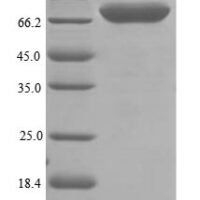
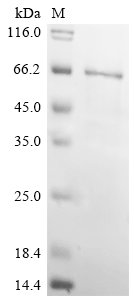
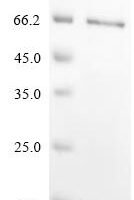
PurityGreater than 85% as determined by SDS-PAGE.
Expression SystemE.coli
Expression Region575-1044aa
SpeciesRattus norvegicus (Rat)
Tag InfoC-terminal 6xHis-tagged
Molecular weight58.4kDa
ActivityPlease contact us to obtain bioactivity data.
BufferIf the delivery form is liquid, the default storage buffer is Tris/PBS-based buffer, 5%-50% glycerol. If the delivery form is lyophilized powder, the buffer before lyophilization is Tris/PBS-based buffer, 6% Trehalose.
StorageStore at -20°C/-80°C upon receipt, aliquoting is necessary for mutiple use. Avoid repeated freeze-thaw cycles.
Research AreasOthers

Function

Proteoglycan playing a role in cell proliferation and migration which stimulates endothelial cells motility during microvascular morphogenesis. May also inhibit neurite outgrowth and growth cone collapse during axon regeneration. Cell surface receptor for collagen alpha 2(VI) which may confer cells ability to migrate on that substrate.

Biological Context

Subcellular Location: Cell membrane (Single-pass type I membrane protein); Apical cell membrane (Single-pass type I membrane protein); Cell projection, lamellipodium membrane (Single-pass type I membrane protein); Cell surface
Tissue Specificity: Neural cells and also extraneural tissues, especially in the developing mesenchyme

Product Specifications

Recombinant Rat Chondroitin sulfate proteoglycan 4 (Cspg4), partial is a recombinant protein from Rattus norvegicus (Rat), expressed in E.coli, covering amino acids 575-1044aa, with C-terminal 6xHis-tagged tag, molecular weight 58.4kDa, purity Greater than 85% as determined by SDS-PAGE.. Suitable for ELISA and Western Blot applications.
Recommended applications depend on the target, product format, and product-specific validation data. Refer to the product datasheet or Certificate of Analysis (CoA), or contact BioCrest Sci for application guidance.

Biological Activity: Please contact us to obtain bioactivity data.

Storage: Store at -20°C/-80°C upon receipt, aliquoting is necessary for mutiple use. Avoid repeated freeze-thaw cycles.

Shipping & Lead Time: Availability, shipping conditions, and estimated lead time are confirmed in the formal quotation or order confirmation based on the product format, destination, and order requirements.

Protein Biology

Function

Proteoglycan playing a role in cell proliferation and migration which stimulates endothelial cells motility during microvascular morphogenesis. May also inhibit neurite outgrowth and growth cone collapse during axon regeneration. Cell surface receptor for collagen alpha 2(VI) which may confer cells ability to migrate on that substrate. Binds through its extracellular N-terminus growth factors, extracellular matrix proteases modulating their activity. May regulate MPP16-dependent degradation and invasion of type I collagen participating in melanoma cells invasion properties. May modulate the plasminogen system by enhancing plasminogen activation and inhibiting angiostatin. Also functions as a signal transducing protein by binding through its cytoplasmic C-terminus scaffolding and signaling proteins. May promote retraction fiber formation and cell polarization through Rho GTPase activation. May stimulate alpha-4, beta-1 integrin-mediated adhesion and spreading by recruiting and activating a signaling cascade through CDC42, ACK1 and BCAR1. May activate FAK and ERK1/ERK2 signaling cascades

Subcellular Location

Cell membrane (Single-pass type I membrane protein); Apical cell membrane (Single-pass type I membrane protein); Cell projection, lamellipodium membrane (Single-pass type I membrane protein); Cell surface

Tissue Specificity

Neural cells and also extraneural tissues, especially in the developing mesenchyme

Subunit

Interacts with GRIP1, GRIP2 and GRIA2. Forms a ternary complex with GRIP1 and GRIA2. Interacts with ITGA4 through its chondroitin sulfate glycosaminoglycan. Interacts with BCAR1, CDC42 and ACK1. Interacts with MMP16 (By similarity). Interacts with the first PDZ domain of MPDZ. Interacts with PRKCA. Interacts with LGALS3 and the integrin composed of ITGB1 and ITGA3. Binds TNC, laminin-1, COL5A1 and COL6A2. Interacts with PLG and angiostatin. Binds FGF2 and PDGFA

Gene: Cspg4  |  Organism: Rattus norvegicus  |  Synonyms: Chondroitin sulfate proteoglycan NG2; HSN tumor-specific antigen
Key Publications

Frequently Asked Questions

How do I order or inquire about this product?

Submit the Online Inquiry form with your required quantity and specifications, or email sales@biocrestsci.com. Available sizes, pricing, stock status, documentation, and estimated lead time are confirmed in the formal quotation.

What is the shipping and delivery time?

Availability, dispatch timing, shipping conditions, and delivery estimates depend on the product format, destination, and order requirements. These details are confirmed in the formal quotation or order confirmation.

How should this product be stored?

Follow the storage and handling instructions in the product-specific datasheet and Certificate of Analysis (CoA). Requirements may vary by product form and formulation; contact BioCrest Sci if product-specific guidance is needed.

What quality controls are performed on your products?

Quality-control data such as identity, purity, endotoxin level, or biological activity are provided only when specified on this product page, the datasheet, or Certificate of Analysis (CoA). Biological activity is not implied unless explicitly stated.

Shopping Cart
Scroll to Top