Recombinant Rat Melanopsin (Opn4) Protein

Recombinant Rat Melanopsin (Opn4) Protein — G protein-coupled photoreceptor that signals through the G(q/11) family of G proteins in response to light in intrinsically photosensitive retinal ganglion cells (ipRGCs). Purity >85%.

SKU: BCRECP-00263TM Category:

Product Specifications

Uniprot No.Q8R456
Gene NamesOpn4
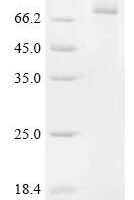
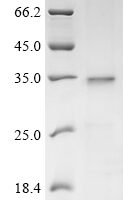
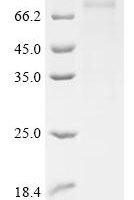
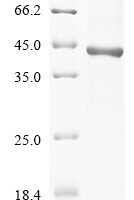
PurityGreater than 85% as determined by SDS-PAGE.
Expression Systemin vitro E.coli expression system
Expression Region1-474aa
SpeciesRattus norvegicus (Rat)
Tag InfoN-terminal 10xHis-tagged
Molecular weight53.9kDa
BufferIf the delivery form is liquid, the default storage buffer is Tris/PBS-based buffer, 5%-50% glycerol.If the delivery form is lyophilized powder, the buffer before lyophilization is Tris/PBS-based buffer, 6% Trehalose.
StorageStore at -20°C/-80°C upon receipt, aliquoting is necessary for mutiple use. Avoid repeated freeze-thaw cycles.

Function

G protein-coupled photoreceptor that signals through the G(q/11) family of G proteins in response to light in intrinsically photosensitive retinal ganglion cells (ipRGCs). Can also activate other G proteins, including G(i/o) and G(s), depending on the cell type, leading to either activation or inhibition of adenylate cyclase and cAMP-dependent signaling. Activation occurs when opsin-bound cis-retinal chromophore absorbs a photon and isomerizes to all-trans-retinal, inducing a conformational change in the opsin that triggers a G protein-mediated phototransduction cascade.

Biological Context

Subcellular Location: Cell membrane (Multi-pass membrane protein); Cell projection, axon; Cell projection, dendrite; Perikaryon
Tissue Specificity: Eye; expressed in a photosensitive subset of retinal ganglion cells (at protein level)

Product Specifications

Recombinant Rat Melanopsin (Opn4) Protein is a recombinant protein from Rattus norvegicus (Rat), expressed in in vitro E.coli expression system, covering amino acids 1-474aa, with N-terminal 10xHis-tagged tag, molecular weight 53.9kDa, purity Greater than 85% as determined by SDS-PAGE.. Suitable for ELISA and Western Blot applications.
Recommended applications depend on the target, product format, and product-specific validation data. Refer to the product datasheet or Certificate of Analysis (CoA), or contact BioCrest Sci for application guidance.

Biological Activity: Not implied unless activity data are explicitly listed on this product page, the datasheet, or the CoA.

Storage: Store at -20°C/-80°C upon receipt, aliquoting is necessary for mutiple use. Avoid repeated freeze-thaw cycles.

Shipping & Lead Time: Availability, shipping conditions, and estimated lead time are confirmed in the formal quotation or order confirmation based on the product format, destination, and order requirements.

Protein Biology

Function

G protein-coupled photoreceptor that signals through the G(q/11) family of G proteins in response to light in intrinsically photosensitive retinal ganglion cells (ipRGCs). Can also activate other G proteins, including G(i/o) and G(s), depending on the cell type, leading to either activation or inhibition of adenylate cyclase and cAMP-dependent signaling. Activation occurs when opsin-bound cis-retinal chromophore absorbs a photon and isomerizes to all-trans-retinal, inducing a conformational change in the opsin that triggers a G protein-mediated phototransduction cascade (By similarity). Acts as a bistable protein, allowing photoreversible regeneration of the cis-retinal chromophore after stimulation (By similarity). Contributes to non-image-forming visual response to light in ipRGCs, including the pupillary light reflex and the regulation of circadian rhythms. In M1 ipRGCs (non-image forming) subtypes, activates a G(q)-phospholipase C (PLC) signaling cascade leading to depolarization through opening of TRPC6/7 channels and decreased intrisic excitability. Mediates phototransduction in M4 ipRGCs (image forming) subtypes across dim to bright light conditions via G(q)-PLC signaling, resulting in increased intrisic excitability through closure of potassium leak channels (most likely TASK channels), thereby enhancing contrast sensitivity. At bright light intensities, further enhances depolarization in M4 ipRGCs via activation of TRPC channels. Functions in the iris to control the intrinsic pupillary light reflex in nocturnal/crepuscular non-primate mammals. May be involved in the optokinetic visual tracking response. May also play a role in regulating retinal hyaloid vessel growth and regression (By similarity)

Subcellular Location

Cell membrane (Multi-pass membrane protein); Cell projection, axon; Cell projection, dendrite; Perikaryon

Tissue Specificity

Eye; expressed in a photosensitive subset of retinal ganglion cells (at protein level)

Gene: Opn4  |  Organism: Rattus norvegicus  |  Synonyms: Opsin-4

Frequently Asked Questions

How do I order or inquire about this product?

Submit the Online Inquiry form with your required quantity and specifications, or email sales@biocrestsci.com. Available sizes, pricing, stock status, documentation, and estimated lead time are confirmed in the formal quotation.

What is the shipping and delivery time?

Availability, dispatch timing, shipping conditions, and delivery estimates depend on the product format, destination, and order requirements. These details are confirmed in the formal quotation or order confirmation.

How should this product be stored?

Follow the storage and handling instructions in the product-specific datasheet and Certificate of Analysis (CoA). Requirements may vary by product form and formulation; contact BioCrest Sci if product-specific guidance is needed.

What quality controls are performed on your products?

Quality-control data such as identity, purity, endotoxin level, or biological activity are provided only when specified on this product page, the datasheet, or Certificate of Analysis (CoA). Biological activity is not implied unless explicitly stated.

Shopping Cart
Scroll to Top