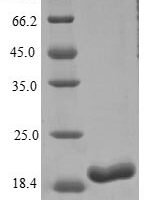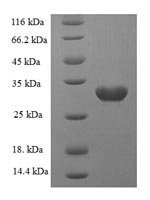
Recombinant Rat Sortilin (Sort1), partial

Recombinant Rat Sortilin (Sort1), partial — Functions as a sorting receptor in the Golgi compartment and as a clearance receptor on the cell surface. Purity >90%.

SKU: BCRECP-004450 Category:

Product Specifications

Product SkuBCRECP-004450
Product DescriptionRecombinant Rat Sortilin (Sort1) Protein is expressed from E.coli with N-terminal 6xHis-SUMO-tagged. It contains 610-754aa. [Accession | O54861].
Uniprot No.O54861
Gene NamesSort1
PurityGreater than 90% as determined by SDS-PAGE.
Expression SystemE.coli
Expression Region610-754aa
SpeciesRattus norvegicus (Rat)
Tag InfoN-terminal 6xHis-SUMO-tagged
Molecular weight32.5kDa
ActivityPlease contact us to obtain bioactivity data.
BufferIf the delivery form is liquid, the default storage buffer is Tris/PBS-based buffer, 5%-50% glycerol. If the delivery form is lyophilized powder, the buffer before lyophilization is Tris/PBS-based buffer, 6% Trehalose.
StorageStore at -20°C/-80°C upon receipt, aliquoting is necessary for mutiple use. Avoid repeated freeze-thaw cycles.
Research AreasOthers

Function

Functions as a sorting receptor in the Golgi compartment and as a clearance receptor on the cell surface. Required for protein transport from the Golgi apparatus to the lysosomes by a pathway that is independent of the mannose-6-phosphate receptor (M6PR). Lysosomal proteins bind specifically to the receptor in the Golgi apparatus and the resulting receptor-ligand complex is transported to an acidic prelysosomal compartment where the low pH mediates the dissociation of the complex.

Biological Context

Subcellular Location: Golgi apparatus, Golgi stack membrane (Single-pass type I membrane protein); Endosome membrane (Single-pass type I membrane protein); Endoplasmic reticulum membrane (Single-pass type I membrane protein); Nucleus membrane (Single-pass type I membrane protein); Cell membrane (Single-pass type I membrane protein); Lysosome membrane (Single-pass type I membrane protein)
Tissue Specificity: Highly expressed in fat, brain, and lung. Expressed in neuronal bodies and dendrites of the piriform cortex and hippocampus. Also expressed in the islands of Calleja, medial and lateral septal nuclei, amygdaloid nuclei, thalamic nuclei, the supraoptic nucleus, the substantia nigra, the Purkinje layer of the cerebellar cortex and the cranial motor nerve nuclei of the brainstem

Product Specifications

Recombinant Rat Sortilin (Sort1), partial is a recombinant protein from Rattus norvegicus (Rat), expressed in E.coli, covering amino acids 610-754aa, with N-terminal 6xHis-SUMO-tagged tag, molecular weight 32.5kDa, purity Greater than 90% as determined by SDS-PAGE.. Suitable for ELISA and Western Blot applications.
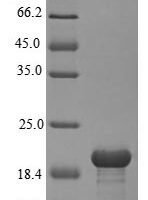
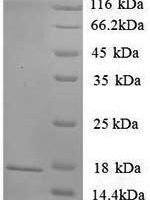
SDS-PAGE: Single band at expected molecular weight confirming purity.

ELISA: Suitable as coating antigen or detection standard.

Western Blot: Compatible with standard Western Blot protocols.

Protein Interaction: Validated for SPR (Surface Plasmon Resonance) and BLI (Bio-Layer Interferometry) studies.

Shipping: Shipped at ambient temperature. Lyophilized protein is stable during transit.

Storage: Store lyophilized protein at -20°C to -80°C. Reconstituted protein should be aliquoted and stored at -80°C. Avoid repeated freeze-thaw cycles.

Shelf Life: 12 months from date of receipt when stored as recommended.

Shipping Time: Orders placed before 2 PM EST ship same day. International orders typically deliver within 5-10 business days.

Protein Biology

Function

Functions as a sorting receptor in the Golgi compartment and as a clearance receptor on the cell surface. Required for protein transport from the Golgi apparatus to the lysosomes by a pathway that is independent of the mannose-6-phosphate receptor (M6PR). Lysosomal proteins bind specifically to the receptor in the Golgi apparatus and the resulting receptor-ligand complex is transported to an acidic prelysosomal compartment where the low pH mediates the dissociation of the complex. The receptor is then recycled back to the Golgi for another round of trafficking through its binding to the retromer. Also required for protein transport from the Golgi apparatus to the endosomes. Promotes neuronal apoptosis by mediating endocytosis of the proapoptotic precursor forms of BDNF (proBDNF) and NGFB (proNGFB). Also acts as a receptor for neurotensin. May promote mineralization of the extracellular matrix during osteogenic differentiation by scavenging extracellular LPL. Probably required in adipocytes for the formation of specialized storage vesicles containing the glucose transporter SLC2A4/GLUT4 (GLUT4 storage vesicles, or GSVs). These vesicles provide a stable pool of SLC2A4 and confer increased responsiveness to insulin (By similarity). May also mediate transport from the endoplasmic reticulum to the Golgi (PubMed:12771154)

Subcellular Location

Golgi apparatus, Golgi stack membrane (Single-pass type I membrane protein); Endosome membrane (Single-pass type I membrane protein); Endoplasmic reticulum membrane (Single-pass type I membrane protein); Nucleus membrane (Single-pass type I membrane protein); Cell membrane (Single-pass type I membrane protein); Lysosome membrane (Single-pass type I membrane protein)

Tissue Specificity

Highly expressed in fat, brain, and lung. Expressed in neuronal bodies and dendrites of the piriform cortex and hippocampus. Also expressed in the islands of Calleja, medial and lateral septal nuclei, amygdaloid nuclei, thalamic nuclei, the supraoptic nucleus, the substantia nigra, the Purkinje layer of the cerebellar cortex and the cranial motor nerve nuclei of the brainstem

Subunit

Interacts with LPL and SLC2A4 (By similarity). Interacts with the cytosolic adapter proteins GGA1 and GGA2. Interacts with numerous ligands including the receptor-associated protein LRPAP1/RAP, GM2A and NTS. Forms a complex with NGFR which binds specifically to the precursor forms of NGFB (proNGFB) and BDNF (proBDNF) (PubMed:15987945). Interacts with the Trk receptors NTRK1, NTRK2 and NTRK3; may regulate their anterograde axonal transport and signaling. Interacts with CLN5. Interacts with PSAP. Interacts with GRN; this interaction mediates endocytosis and lysosome delivery of progranulin; interaction occurs at the neuronal cell surface in a stressed nervous system (By similarity). Interacts with the heterotrimeric retromer cargo-selective complex (CSC), also described as vacuolar protein sorting subcomplex (VPS), formed by VPS26 (VPS26A or VPS26B), VPS29 and VPS35; which is involved in retrograde trafficking of the receptor from endosomes to the Golgi apparatus (By similarity). Interacts with SMPD1; the interaction is required for SMPD1 targeting to lysosomes (By similarity)

Gene: Sort1  |  Organism: Rattus norvegicus  |  Synonyms: Glycoprotein 110; Neurotensin receptor 3
Key Publications

Frequently Asked Questions

How do I order or inquire about this product?

Fill out the Online Inquiry form with your required quantity and specifications. You can also email sales@biocrestsci.com. Our team typically responds within 4 business hours with a quote and availability confirmation.

What is the shipping and delivery time?

Orders placed before 2 PM EST ship the same day. Domestic (US) delivery typically takes 2-3 business days. International orders deliver within 5-10 business days. All products are shipped at ambient temperature with appropriate packaging to ensure stability.

How should I store this recombinant protein?

Lyophilized proteins should be stored at -20°C to -80°C upon receipt. After reconstitution, aliquot and store at -80°C. Avoid repeated freeze-thaw cycles. Shelf life is 12 months from date of receipt when stored as recommended.

What quality controls are performed on your products?

Each product undergoes SDS-PAGE purity analysis (typically >85-95%), endotoxin testing, and bioactivity validation. Products are validated for ELISA, Western Blot, and SPR/BLI applications as specified on this product page. A Certificate of Analysis (CoA) is available upon request.

Shopping Cart
Scroll to Top