Recombinant Rabbit Dystroglycan (DAG1), partial

Recombinant Rabbit Dystroglycan (DAG1), partial — Transmembrane protein that plays important roles in connecting the extracellular matrix to the cytoskeleton. Purity >85%.

SKU: BCRECP-002504 Category:

Product Specifications

Product SkuBCRECP-002504
Product DescriptionRecombinant Rabbit Dystroglycan (DAG1) Protein is expressed from E.coli with N-terminal 6xHis-tagged. It contains 30-653aa. [Accession | Q28685].
Uniprot No.Q28685
Gene NamesDAG1
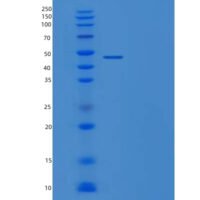
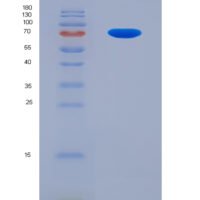
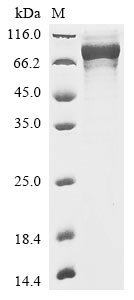
PurityGreater than 85% as determined by SDS-PAGE.
Expression SystemE.coli
Expression Region30-653aa
SpeciesOryctolagus cuniculus (Rabbit)
Tag InfoN-terminal 6xHis-tagged
Molecular weight73.5kDa
ActivityPlease contact us to obtain bioactivity data.
BufferIf the delivery form is liquid, the default storage buffer is Tris/PBS-based buffer, 5%-50% glycerol. If the delivery form is lyophilized powder, the buffer before lyophilization is Tris/PBS-based buffer, 6% Trehalose.
StorageStore at -20°C/-80°C upon receipt, aliquoting is necessary for mutiple use. Avoid repeated freeze-thaw cycles.
Research AreasNeuroscience

Function

Transmembrane protein that plays important roles in connecting the extracellular matrix to the cytoskeleton. Acts as a cell adhesion receptor in both muscle and non-muscle tissues. Receptor for both DMD and UTRN and, through these interactions, scaffolds axin to the cytoskeleton.

Biological Context

Subcellular Location: Cell membrane (Single-pass type I membrane protein); Cytoplasm, cytoskeleton; Nucleus, nucleoplasm; Cell membrane, sarcolemma; Synapse; Postsynaptic cell membrane
Tissue Specificity: Detected in brain, cardiac muscle and skeletal muscle (at protein level). Expressed in lung, brain, liver, kidney, diaphragm and stomach

Product Specifications

Recombinant Rabbit Dystroglycan (DAG1), partial is a recombinant protein from Oryctolagus cuniculus (Rabbit), expressed in E.coli, covering amino acids 30-653aa, with N-terminal 6xHis-tagged tag, molecular weight 73.5kDa, purity Greater than 85% as determined by SDS-PAGE.. Suitable for ELISA and Western Blot applications.
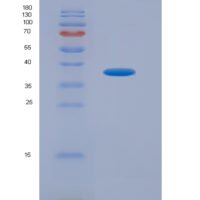
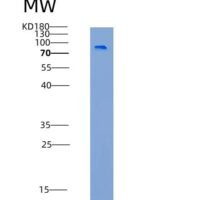
SDS-PAGE: Single band at expected molecular weight confirming purity.

ELISA: Suitable as coating antigen or detection standard.

Western Blot: Compatible with standard Western Blot protocols.

Protein Interaction: Validated for SPR (Surface Plasmon Resonance) and BLI (Bio-Layer Interferometry) studies.

Shipping: Shipped at ambient temperature. Lyophilized protein is stable during transit.

Storage: Store lyophilized protein at -20°C to -80°C. Reconstituted protein should be aliquoted and stored at -80°C. Avoid repeated freeze-thaw cycles.

Shelf Life: 12 months from date of receipt when stored as recommended.

Shipping Time: Orders placed before 2 PM EST ship same day. International orders typically deliver within 5-10 business days.

Protein Biology

Function

Transmembrane protein that plays important roles in connecting the extracellular matrix to the cytoskeleton. Acts as a cell adhesion receptor in both muscle and non-muscle tissues. Receptor for both DMD and UTRN and, through these interactions, scaffolds axin to the cytoskeleton. Also functions in cell adhesion-mediated signaling and implicated in cell polarity (By similarity)

Subcellular Location

Cell membrane (Single-pass type I membrane protein); Cytoplasm, cytoskeleton; Nucleus, nucleoplasm; Cell membrane, sarcolemma; Synapse; Postsynaptic cell membrane

Tissue Specificity

Detected in brain, cardiac muscle and skeletal muscle (at protein level) (PubMed:16709410). Expressed in lung, brain, liver, kidney, diaphragm and stomach (PubMed:1741056)

Subunit

Monomer. Heterodimer of alpha- and beta-dystroglycan subunits which are the central components of the dystrophin-glycoprotein complex. This complex then can form a dystrophin-associated glycoprotein complex (DGC) which is composed of three subcomplexes: a cytoplasmic complex comprised of DMD (or UTRN), DTNA and a number of syntrophins, such as SNTB1, SNTB2, SNTG1 and SNTG2, the transmembrane dystroglycan complex, and the sarcoglycan-sarcospan complex. Interacts (via the N-terminal of alpha-dystroglycan) with LARGE1; the interaction enhances laminin binding (PubMed:15210115). Interacts with SGCD. Interacts with AGR2 and AGR3. Interacts (beta-dystroglycan) with DMD; the interaction is inhibited by phosphorylation on the PPXY motif. Interacts (beta-dystroglycan, via its PPXY motif) with UTRN (via its WWW and ZZ domains); the interaction is inhibited by phosphorylation on the PPXY motif. Interacts (beta-dystroglycan, via its phosphorylated PPXY motif) with the SH2 domain-containing proteins, FYN, CSK, NCK and SHC. Interacts (beta-dystroglycan) with CAV3 (via a central WW-like domain); the interaction disrupts the binding of DMD. beta-dystroglycan directly interacts with ANK3, but not with ANK2; this interaction does not interfere with DMD-binding and is required for retention at costameres (By similarity). Identified in a dystroglycan complex that contains at least PRX, DRP2, UTRN, DMD and DAG1 (By similarity). Interacts with POMGNT1 (By similarity). beta-dystroglycan interacts with CD93 (By similarity). Alpha-dystroglycan interacts with HSPG2; the interaction is required for acetylcholinesterase (AChE) localization at the neuromuscular junctions (NMJ) (By similarity). Alpha-dystroglycan interacts with AGRN; the interaction is required for up-regulation of SOX9 and cartilage formation (By similarity). Alpha-dystroglycan interacts with pikachurin (EGFLAM); the interaction is required for photoreceptor ribbon synapse formation (By similarity)

Gene: DAG1  |  Organism: Oryctolagus cuniculus  |  Synonyms: Dystroglycan; Dystrophin-associated glycoprotein 1
Key Publications

Frequently Asked Questions

How do I order or inquire about this product?

Fill out the Online Inquiry form with your required quantity and specifications. You can also email sales@biocrestsci.com. Our team typically responds within 4 business hours with a quote and availability confirmation.

What is the shipping and delivery time?

Orders placed before 2 PM EST ship the same day. Domestic (US) delivery typically takes 2-3 business days. International orders deliver within 5-10 business days. All products are shipped at ambient temperature with appropriate packaging to ensure stability.

How should I store this recombinant protein?

Lyophilized proteins should be stored at -20°C to -80°C upon receipt. After reconstitution, aliquot and store at -80°C. Avoid repeated freeze-thaw cycles. Shelf life is 12 months from date of receipt when stored as recommended.

What quality controls are performed on your products?

Each product undergoes SDS-PAGE purity analysis (typically >85-95%), endotoxin testing, and bioactivity validation. Products are validated for ELISA, Western Blot, and SPR/BLI applications as specified on this product page. A Certificate of Analysis (CoA) is available upon request.

Shopping Cart
Scroll to Top