Recombinant Escherichia coli DNA-binding protein H-NS (hns)

Recombinant Escherichia coli DNA-binding protein H-NS (hns) — A DNA-binding protein implicated in transcriptional repression (silencing). Purity >85%.

SKU: BCRECP-003012 Category:

Product Specifications

Product SkuBCRECP-003012
Product DescriptionRecombinant Escherichia coli DNA-binding protein H-NS (hns) Protein is expressed from E.coli with N-terminal 6xHis-tagged. It contains 2-137aa. [Accession | P0ACF8].
Uniprot No.P0ACF8
Gene Nameshns
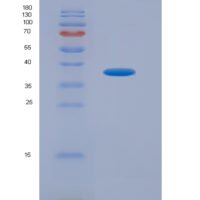
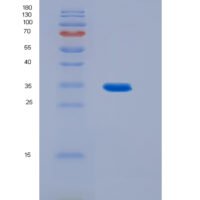
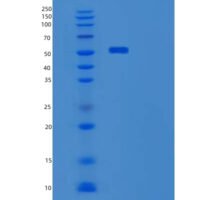
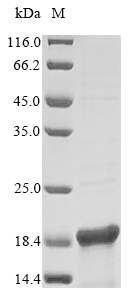
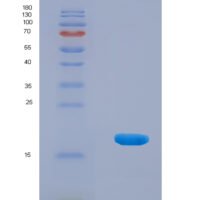
PurityGreater than 85% as determined by SDS-PAGE.
Expression SystemE.coli
Expression Region2-137aa
SpeciesEscherichia coli (strain K12)
Tag InfoN-terminal 6xHis-tagged
Molecular weight19.5kDa
ActivityPlease contact us to obtain bioactivity data.
BufferIf the delivery form is liquid, the default storage buffer is Tris/PBS-based buffer, 5%-50% glycerol. If the delivery form is lyophilized powder, the buffer before lyophilization is Tris/PBS-based buffer, 6% Trehalose.
StorageStore at -20°C/-80°C upon receipt, aliquoting is necessary for mutiple use. Avoid repeated freeze-thaw cycles.
Research AreasOthers

Function

A DNA-binding protein implicated in transcriptional repression (silencing). Also involved in bacterial chromosome organization and compaction. H-NS binds tightly to AT-rich dsDNA and inhibits transcription.

Biological Context

Subcellular Location: Cytoplasm, nucleoid

Product Specifications

Recombinant Escherichia coli DNA-binding protein H-NS (hns) is a recombinant protein from Escherichia coli (strain K12), expressed in E.coli, covering amino acids 2-137aa, with N-terminal 6xHis-tagged tag, molecular weight 19.5kDa, purity Greater than 85% as determined by SDS-PAGE.. Suitable for ELISA and Western Blot applications.

SDS-PAGE: Single band at expected molecular weight confirming purity.

ELISA: Suitable as coating antigen or detection standard.

Western Blot: Compatible with standard Western Blot protocols.

Protein Interaction: Validated for SPR (Surface Plasmon Resonance) and BLI (Bio-Layer Interferometry) studies.

Shipping: Shipped at ambient temperature. Lyophilized protein is stable during transit.

Storage: Store lyophilized protein at -20°C to -80°C. Reconstituted protein should be aliquoted and stored at -80°C. Avoid repeated freeze-thaw cycles.

Shelf Life: 12 months from date of receipt when stored as recommended.

Shipping Time: Orders placed before 2 PM EST ship same day. International orders typically deliver within 5-10 business days.

Protein Biology

Function

A DNA-binding protein implicated in transcriptional repression (silencing) (PubMed:16963779, PubMed:17046956, PubMed:2128918, PubMed:23543115, PubMed:333393, PubMed:8890170, PubMed:8913298, PubMed:9398522). Also involved in bacterial chromosome organization and compaction (PubMed:10982869, PubMed:21903814, PubMed:6379600). H-NS binds tightly to AT-rich dsDNA and inhibits transcription (PubMed:16963779, PubMed:17435766, PubMed:17881364, PubMed:23543115, PubMed:2512122). Binds upstream and downstream of initiating RNA polymerase, trapping it in a loop and preventing transcription (PubMed:11714691). Binds to hundreds of sites, approximately half its binding sites are in non-coding DNA, which only accounts for about 10% of the genome (PubMed:16963779, PubMed:17046956, PubMed:23543115). Many of these loci were horizontally transferred (HTG); this offers the selective advantage of silencing foreign DNA while keeping it in the genome in case of need (PubMed:17046956, PubMed:17881364, PubMed:26789284). Suppresses transcription at many intragenic sites as well as transcription of spurious, non-coding RNAs genome-wide (PubMed:24449106). Repression of HTG by H-NS is thought to allow their DNA to evolve faster than non-H-NS-bound regions, and facilitates integration of HTG into transcriptional regulatory networks (PubMed:26789284). A subset of H-NS/StpA-regulated genes also require Hha (and/or Cnu, ydgT) for repression; Hha and Cnu increase the number of genes DNA bound by H-NS/StpA and may also modulate the oligomerization of the H-NS/StpA-complex (PubMed:23543115). The protein forms 2 clusters in the nucleoid which gather hns-bound loci together, bridging non-contiguous DNA, and causes DNA substantial condensation (PubMed:21903814). Binds DNA better at low temperatures than at 37 degrees Celsius; AT-rich sites nucleate H-NS binding, further DNA-binding is cooperative and this cooperativity decreases with rising temperature (PubMed:17435766, PubMed:17881364). Transcriptional repression can be inhibited by dominant-negative mutants of StpA or itself (PubMed:8755860). May affect transcriptional elongation (PubMed:25638302). Can increase translational efficiency of mRNA with suboptimal Shine-Dalgarno sequences (PubMed:20595230). Plays a role in the thermal control of pili and adhesive curli fimbriae production, by inducing transcription of csgD (PubMed:17010156). Plays a role in flagellar function (PubMed:11031114). Represses the CRISPR-cas promoters, permits only weak transcription of the crRNA precursor; its repression is antagonized by LeuO (PubMed:20132443, PubMed:20659289). Binds preferentially to the upstream region of its own gene recognizing two segments of DNA on both sides of a bend centered around -150 (PubMed:7934818). Overexpression suppresses secY24, a temperature-sensitive mutation (PubMed:1537791). Has also been reported to activate transcription of some genes (PubMed:2128918, PubMed:338303, PubMed:4566454)

Subcellular Location

Cytoplasm, nucleoid

Subunit

Homodimer, also found as tetramers or higher oligomers (PubMed:12460581, PubMed:23601147, PubMed:3135462, PubMed:338303, PubMed:4566454, PubMed:8755860, PubMed:8913298, PubMed:9398522). Oligomerizes into higher-order complexes that form bridges between adjacent DNA helices. The N-terminal region (residues 1-64) can interact with overexpressed StpA (PubMed:8755860). Forms a complex with Cnu (YdgT) (PubMed:21600204). The H-NS dimer forms a heterotrimeric complex with Hha in the absence of DNA; this is mediated by residues 1-46 (PubMed:11790731, PubMed:16650431, PubMed:21600204, PubMed:26085102). Interacts with Hfq (PubMed:2020545)

Gene: hns  |  Organism: Escherichia coli (strain K12)  |  Synonyms: Heat-stable nucleoid-structuring protein; Histone-like protein HLP-II; Protein B1; Protein H1
Key Publications

Frequently Asked Questions

How do I order or inquire about this product?

Fill out the Online Inquiry form with your required quantity and specifications. You can also email sales@biocrestsci.com. Our team typically responds within 4 business hours with a quote and availability confirmation.

What is the shipping and delivery time?

Orders placed before 2 PM EST ship the same day. Domestic (US) delivery typically takes 2-3 business days. International orders deliver within 5-10 business days. All products are shipped at ambient temperature with appropriate packaging to ensure stability.
How should I store this recombinant protein?

Lyophilized proteins should be stored at -20°C to -80°C upon receipt. After reconstitution, aliquot and store at -80°C. Avoid repeated freeze-thaw cycles. Shelf life is 12 months from date of receipt when stored as recommended.

What quality controls are performed on your products?

Each product undergoes SDS-PAGE purity analysis (typically >85-95%), endotoxin testing, and bioactivity validation. Products are validated for ELISA, Western Blot, and SPR/BLI applications as specified on this product page. A Certificate of Analysis (CoA) is available upon request.

Shopping Cart
Scroll to Top