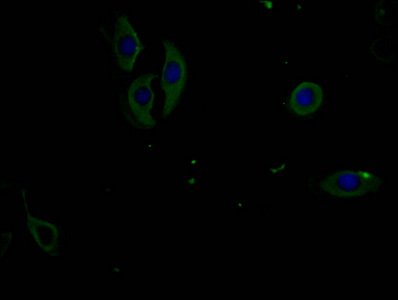
Mouse anti-Human sapiens (Human) EIF2AK3 Monoclonal Antibody

Mouse anti-Human sapiens (Human) EIF2AK3 Monoclonal Antibody — Metabolic-stress sensing protein kinase that phosphorylates the alpha subunit of eukaryotic translation initiation factor 2 (EIF2S1/eIF-2-alpha) in response to various stress, such as unfolded prot…

SKU: BCREC-000154MA Category:

Product Specifications

Uniprot No.Q9NZJ5
Target NamesEIF2AK3
Species ReactivityMouse
ImmunogenRecombinant Human Eukaryotic translation initiation factor 2-alpha kinase 3 protein (115-330AA)
ConjugateNon-conjugated
ClonalityMonoclonal
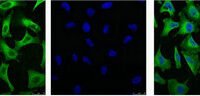
ApplicationsELISA, IF
BufferPBS, 50% glycerol, 0.05% Proclin 300, 0.05%BSA
StorageUpon receipt, store at -20°C or -80°C. Avoid repeated freeze.

Function

Metabolic-stress sensing protein kinase that phosphorylates the alpha subunit of eukaryotic translation initiation factor 2 (EIF2S1/eIF-2-alpha) in response to various stress, such as unfolded protein response (UPR). Key effector of the integrated stress response (ISR) to unfolded proteins: EIF2AK3/PERK specifically recognizes and binds misfolded proteins, leading to its activation and EIF2S1/eIF-2-alpha phosphorylation. EIF2S1/eIF-2-alpha phosphorylation in response to stress converts EIF2S1/eIF-2-alpha in a global protein synthesis inhibitor, leading to a global attenuation of cap-dependent translation, while concomitantly initiating the preferential translation of ISR-specific mRNAs, such as the transcriptional activators ATF4 and QRICH1, and hence allowing ATF4- and QRICH1-mediated reprogramming.

Biological Context

Subcellular Location: Endoplasmic reticulum membrane (Single-pass type I membrane protein)
Tissue Specificity: Ubiquitous. A high level expression is seen in secretory tissues
Disease Association: Wolcott-Rallison syndrome (WRS) : A rare autosomal recessive disorder, characterized by permanent neonatal or early infancy insulin-dependent diabetes and, at a later age, epiphyseal dysplasia, osteoporosis, growth retardation and other multisystem manifestations, such as hepatic and renal dysfunctions, intellectual disability and cardiovascular abnormalities. [The disease is caused by variants affecting the gene represented in this entry]

Product Specifications

Mouse anti-Human sapiens (Human) EIF2AK3 Monoclonal Antibody is a recombinant protein. Suitable for ELISA and Western Blot applications.

SDS-PAGE: Single band at expected molecular weight confirming purity.

ELISA: Suitable as coating antigen or detection standard.

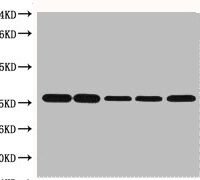
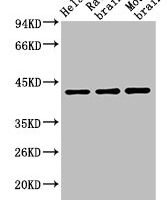
Western Blot: Compatible with standard Western Blot protocols.

Protein Interaction: Validated for SPR (Surface Plasmon Resonance) and BLI (Bio-Layer Interferometry) studies.

Shipping: Shipped at ambient temperature. Lyophilized protein is stable during transit.

Storage: Store lyophilized protein at -20°C to -80°C. Reconstituted protein should be aliquoted and stored at -80°C. Avoid repeated freeze-thaw cycles.

Shelf Life: 12 months from date of receipt when stored as recommended.

Shipping Time: Orders placed before 2 PM EST ship same day. International orders typically deliver within 5-10 business days.

Protein Biology

Function

Metabolic-stress sensing protein kinase that phosphorylates the alpha subunit of eukaryotic translation initiation factor 2 (EIF2S1/eIF-2-alpha) in response to various stress, such as unfolded protein response (UPR) (PubMed:10026192, PubMed:10677345, PubMed:11907036, PubMed:12086964, PubMed:25925385, PubMed:31023583). Key effector of the integrated stress response (ISR) to unfolded proteins: EIF2AK3/PERK specifically recognizes and binds misfolded proteins, leading to its activation and EIF2S1/eIF-2-alpha phosphorylation (PubMed:10677345, PubMed:27917829, PubMed:31023583). EIF2S1/eIF-2-alpha phosphorylation in response to stress converts EIF2S1/eIF-2-alpha in a global protein synthesis inhibitor, leading to a global attenuation of cap-dependent translation, while concomitantly initiating the preferential translation of ISR-specific mRNAs, such as the transcriptional activators ATF4 and QRICH1, and hence allowing ATF4- and QRICH1-mediated reprogramming (PubMed:10026192, PubMed:10677345, PubMed:31023583, PubMed:33384352). The EIF2AK3/PERK-mediated unfolded protein response increases mitochondrial oxidative phosphorylation by promoting ATF4-mediated expression of COX7A2L/SCAF1, thereby increasing formation of respiratory chain supercomplexes (PubMed:31023583). In contrast to most subcellular compartments, mitochondria are protected from the EIF2AK3/PERK-mediated unfolded protein response due to EIF2AK3/PERK inhibition by ATAD3A at mitochondria-endoplasmic reticulum contact sites (PubMed:39116259). In addition to EIF2S1/eIF-2-alpha, also phosphorylates NFE2L2/NRF2 in response to stress, promoting release of NFE2L2/NRF2 from the BCR(KEAP1) complex, leading to nuclear accumulation and activation of NFE2L2/NRF2 (By similarity). Serves as a critical effector of unfolded protein response (UPR)-induced G1 growth arrest due to the loss of cyclin-D1 (CCND1) (By similarity). Involved in control of mitochondrial morphology and function (By similarity)

Subcellular Location

Endoplasmic reticulum membrane (Single-pass type I membrane protein)

Disease Association

Wolcott-Rallison syndrome (WRS) : A rare autosomal recessive disorder, characterized by permanent neonatal or early infancy insulin-dependent diabetes and, at a later age, epiphyseal dysplasia, osteoporosis, growth retardation and other multisystem manifestations, such as hepatic and renal dysfunctions, intellectual disability and cardiovascular abnormalities. [The disease is caused by variants affecting the gene represented in this entry]

Tissue Specificity

Ubiquitous. A high level expression is seen in secretory tissues

Subunit

Forms dimers with HSPA5/BIP in resting cells (PubMed:11907036). Homotetramerizes in response to endoplasmic reticulum (ER) stress, leading to its activation (PubMed:25925385). Interacts with HSP90B1/GRP94 (PubMed:11907036). Interacts with DNAJC3; inhibiting EIF2AK3/PERK activity (By similarity). Interacts with ATAD3A; ATAD3A and EIF2S1/eIF-2-alpha occupy a common binding site within the cytoplasmic loop of EIF2AK3/PERK, leading to prevent EIF2AK3/PERK association with its substrate EIF2S1/eIF-2-alpha (PubMed:39116259). Interacts with MFN2 (By similarity). Interacts with TMEM33 (PubMed:26268696). Interacts with PDIA6 (PubMed:24508390). Interacts with LACC1 (PubMed:31875558)

Gene: EIF2AK3  |  Organism: Homo sapiens  |  Synonyms: PRKR-like endoplasmic reticulum kinase; Pancreatic eIF2-alpha kinase; Protein tyrosine kinase EIF2AK3
Key Publications

Frequently Asked Questions

How do I order or inquire about this product?

Fill out the Online Inquiry form with your required quantity and specifications. You can also email sales@biocrestsci.com. Our team typically responds within 4 business hours with a quote and availability confirmation.

What is the shipping and delivery time?

Orders placed before 2 PM EST ship the same day. Domestic (US) delivery typically takes 2-3 business days. International orders deliver within 5-10 business days. All products are shipped at ambient temperature with appropriate packaging to ensure stability.

How should I store this recombinant protein?

Lyophilized proteins should be stored at -20°C to -80°C upon receipt. After reconstitution, aliquot and store at -80°C. Avoid repeated freeze-thaw cycles. Shelf life is 12 months from date of receipt when stored as recommended.

What quality controls are performed on your products?

Each product undergoes SDS-PAGE purity analysis (typically >85-95%), endotoxin testing, and bioactivity validation. Products are validated for ELISA, Western Blot, and SPR/BLI applications as specified on this product page. A Certificate of Analysis (CoA) is available upon request.

Shopping Cart
Scroll to Top