Mouse anti-Human/Mouse/Rat sapiens (Human) HRAS Monoclonal Antibody

Mouse anti-Human/Mouse/Rat sapiens (Human) HRAS Monoclonal Antibody — Signal transducer in the Ras-MAPK signaling pathway that regulates cell proliferation and survival.

SKU: BCREC-000922MA Category:

Product Specifications

Uniprot No.P01112
Target NamesHRAS
Species ReactivityMouse
ImmunogenRecombinant Human HRAS protein
Immunogen SpeciesHomo sapiens (Human)
ConjugateNon-conjugated
IsotypeMouse IgG1
ClonalityMonoclonal
ApplicationsELISA, WB
BufferPBS, 50% glycerol, 0.05% Proclin 300, 0.05%BSA
StorageUpon receipt, store at -20°C or -80°C. Avoid repeated freeze.

Function

Signal transducer in the Ras-MAPK signaling pathway that regulates cell proliferation and survival. Ras proteins bind GDP/GTP and possess intrinsic GTPase activity. Recognized by LZTR1 that mediates its ubiquitination by a BCR (BTB-CUL3-RBX1) E3 ubiquitin-protein ligase complex.

Biological Context

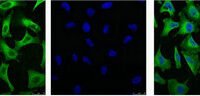
Subcellular Location: Nucleus; Cytoplasm; Cytoplasm, perinuclear region
Tissue Specificity: Widely expressed
Disease Association: Costello syndrome (CSTLO) : A rare condition characterized by prenatally increased growth, postnatal growth deficiency, intellectual disability, distinctive facial appearance, cardiovascular abnormalities (typically pulmonic stenosis, hypertrophic cardiomyopathy and/or atrial tachycardia), tumor predisposition, skin and musculoskeletal abnormalities. [The disease is caused by variants affecting the gene represented in this entry] | Congenital myopathy with excess of muscle spindles (CMEMS) : Variant of Costello syndrome. [The disease is caused by variants affecting the gene represented in this entry] | Thyroid cancer, non-medullary, 2 (NMTC2) : A form of non-medullary thyroid cancer (NMTC), a cancer characterized by tumors originating from the thyroid follicular cells. NMTCs represent approximately 95% of all cases of thyroid cancer and are classified into papillary, follicular, Hurthle cell, and anaplastic neoplasms. [Disease susceptibility is associated with variants affecting the gene represented in this entry] | [Mutations which change positions 12, 13 or 61 activate the potential of HRAS to transform cultured cells and are implicated in a variety of human tumors] | Bladder cancer (BLC) : A malignancy originating in tissues of the urinary bladder. It often presents with multiple tumors appearing at different times and at different sites in the bladder. Most bladder cancers are transitional cell carcinomas that begin in cells that normally make up the inner lining of the bladder. Other types of bladder cancer include squamous cell carcinoma (cancer that begins in thin, flat cells) and adenocarcinoma (cancer that begins in cells that make and release mucus and other fluids). Bladder cancer is a complex disorder with both genetic and environmental influences. [Disease susceptibility is associated with variants affecting the gene represented in this entry] | Schimmelpenning-Feuerstein-Mims syndrome (SFM) : A disease characterized by sebaceous nevi, often on the face, associated with variable ipsilateral abnormalities of the central nervous system, ocular anomalies, and skeletal defects. Many oral manifestations have been reported, not only including hypoplastic and malformed teeth, and mucosal papillomatosis, but also ankyloglossia, hemihyperplastic tongue, intraoral nevus, giant cell granuloma, ameloblastoma, bone cysts, follicular cysts, oligodontia, and odontodysplasia. Sebaceous nevi follow the lines of Blaschko and these can continue as linear intraoral lesions, as in mucosal papillomatosis. [The disease is caused by variants affecting the gene represented in this entry]

Product Specifications

Mouse anti-Human/Mouse/Rat sapiens (Human) HRAS Monoclonal Antibody is a recombinant protein. Suitable for ELISA and Western Blot applications.

SDS-PAGE: Single band at expected molecular weight confirming purity.

ELISA: Suitable as coating antigen or detection standard.

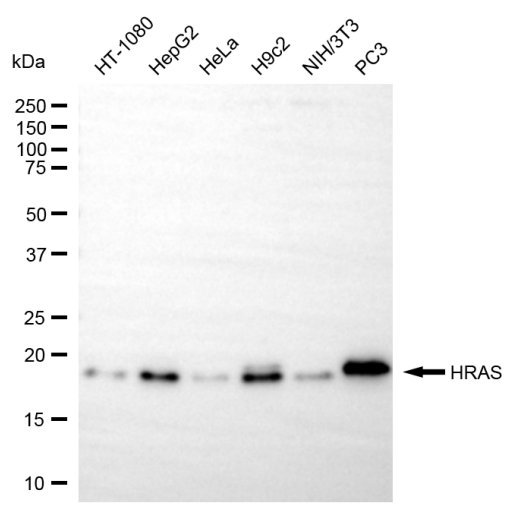
Western Blot: Compatible with standard Western Blot protocols.

Protein Interaction: Validated for SPR (Surface Plasmon Resonance) and BLI (Bio-Layer Interferometry) studies.

Shipping: Shipped at ambient temperature. Lyophilized protein is stable during transit.

Storage: Store lyophilized protein at -20°C to -80°C. Reconstituted protein should be aliquoted and stored at -80°C. Avoid repeated freeze-thaw cycles.

Shelf Life: 12 months from date of receipt when stored as recommended.

Shipping Time: Orders placed before 2 PM EST ship same day. International orders typically deliver within 5-10 business days.

Protein Biology

Function

Signal transducer in the Ras-MAPK signaling pathway that regulates cell proliferation and survival (PubMed:22821884). Ras proteins bind GDP/GTP and possess intrinsic GTPase activity (PubMed:12740440, PubMed:14500341, PubMed:9020151). Recognized by LZTR1 that mediates its ubiquitination by a BCR (BTB-CUL3-RBX1) E3 ubiquitin-protein ligase complex (PubMed:40934300)

Subcellular Location

Nucleus; Cytoplasm; Cytoplasm, perinuclear region

Disease Association

Costello syndrome (CSTLO) : A rare condition characterized by prenatally increased growth, postnatal growth deficiency, intellectual disability, distinctive facial appearance, cardiovascular abnormalities (typically pulmonic stenosis, hypertrophic cardiomyopathy and/or atrial tachycardia), tumor predisposition, skin and musculoskeletal abnormalities. [The disease is caused by variants affecting the gene represented in this entry] | Congenital myopathy with excess of muscle spindles (CMEMS) : Variant of Costello syndrome. [The disease is caused by variants affecting the gene represented in this entry] | Thyroid cancer, non-medullary, 2 (NMTC2) : A form of non-medullary thyroid cancer (NMTC), a cancer characterized by tumors originating from the thyroid follicular cells. NMTCs represent approximately 95% of all cases of thyroid cancer and are classified into papillary, follicular, Hurthle cell, and anaplastic neoplasms. [Disease susceptibility is associated with variants affecting the gene represented in this entry] | [Mutations which change positions 12, 13 or 61 activate the potential of HRAS to transform cultured cells and are implicated in a variety of human tumors] | Bladder cancer (BLC) : A malignancy originating in tissues of the urinary bladder. It often presents with multiple tumors appearing at different times and at different sites in the bladder. Most bladder cancers are transitional cell carcinomas that begin in cells that normally make up the inner lining of the bladder. Other types of bladder cancer include squamous cell carcinoma (cancer that begins in thin, flat cells) and adenocarcinoma (cancer that begins in cells that make and release mucus and other fluids). Bladder cancer is a complex disorder with both genetic and environmental influences. [Disease susceptibility is associated with variants affecting the gene represented in this entry] | Schimmelpenning-Feuerstein-Mims syndrome (SFM) : A disease characterized by sebaceous nevi, often on the face, associated with variable ipsilateral abnormalities of the central nervous system, ocular anomalies, and skeletal defects. Many oral manifestations have been reported, not only including hypoplastic and malformed teeth, and mucosal papillomatosis, but also ankyloglossia, hemihyperplastic tongue, intraoral nevus, giant cell granuloma, ameloblastoma, bone cysts, follicular cysts, oligodontia, and odontodysplasia. Sebaceous nevi follow the lines of Blaschko and these can continue as linear intraoral lesions, as in mucosal papillomatosis. [The disease is caused by variants affecting the gene represented in this entry]

Tissue Specificity

Widely expressed

Subunit

In its GTP-bound form interacts with PLCE1 (PubMed:11022048). Interacts with TBC1D10C (PubMed:17230191). Interacts with RGL3 (By similarity). Interacts with HSPD1 (By similarity). Found in a complex with at least BRAF, HRAS, MAP2K1, MAPK3 and RGS14 (By similarity). Interacts (active GTP-bound form) with RGS14 (via RBD 1 domain) (By similarity). Forms a signaling complex with RASGRP1 and DGKZ (PubMed:11257115). Interacts with RASSF5 (PubMed:18596699). Interacts with PDE6D (PubMed:11980706). Interacts with IKZF3 (PubMed:10369681). Interacts with RACK1 (PubMed:14500341). Interacts with PIK3CG; the interaction is required for membrane recruitment and beta-gamma G protein dimer-dependent activation of the PI3K gamma complex PIK3CG:PIK3R6 (By similarity). Interacts with RAPGEF2 (PubMed:10608844, PubMed:11598133). Interacts (active GTP-bound form) with both SHOC2 and PP1c (all isoforms) to form a tertiary complex; SHOC2 and PP1c preferably bind M-Ras/MRAS, but they also bind K-Ras/KRAS, N-Ras/NRAS and H-Ras/HRAS (PubMed:35768504, PubMed:35831509, PubMed:36175670). Interacts (GTP-bound form) with MAPKAP1/SIN1; inhibiting H-Ras/HRAS activity (PubMed:35522713). Interacts (GDP-bound form) with LZTR1; this interaction mediates HRAS ubiquitination by BCR E3 ligase complex (PubMed:40934300)

Gene: HRAS  |  Organism: Homo sapiens  |  Synonyms: H-Ras-1; Ha-Ras; Transforming protein p21; c-H-ras; p21ras
Key Publications

Frequently Asked Questions

How do I order or inquire about this product?

Fill out the Online Inquiry form with your required quantity and specifications. You can also email sales@biocrestsci.com. Our team typically responds within 4 business hours with a quote and availability confirmation.

What is the shipping and delivery time?

Orders placed before 2 PM EST ship the same day. Domestic (US) delivery typically takes 2-3 business days. International orders deliver within 5-10 business days. All products are shipped at ambient temperature with appropriate packaging to ensure stability.

How should I store this recombinant protein?

Lyophilized proteins should be stored at -20°C to -80°C upon receipt. After reconstitution, aliquot and store at -80°C. Avoid repeated freeze-thaw cycles. Shelf life is 12 months from date of receipt when stored as recommended.

What quality controls are performed on your products?

Each product undergoes SDS-PAGE purity analysis (typically >85-95%), endotoxin testing, and bioactivity validation. Products are validated for ELISA, Western Blot, and SPR/BLI applications as specified on this product page. A Certificate of Analysis (CoA) is available upon request.

Shopping Cart
Scroll to Top