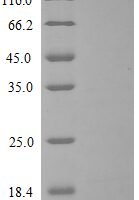
Recombinant Human Myosin regulatory light polypeptide 9 (MYL9) (Active)

Recombinant Human Myosin regulatory light polypeptide 9 (MYL9) (Active) — Myosin regulatory subunit that plays an important role in regulation of both smooth muscle and nonmuscle cell contractile activity via its phosphorylation. Purity >95%.

SKU: BCACP-000013 Category:
Product SKUBCACP-000013
Product DescriptionRecombinant Human Myosin regulatory light polypeptide 9 (MYL9) protein is expressed from Yeast with C-terminal 10xHis-tagged. It contains 2-172aa. [Accession | P24844].
Uniprot No.P24844
Gene NamesMYL9
PurityGreater than 95% as determined by SDS-PAGE.
Expression SystemYeast
Expression Region2-172aa
SpeciesHomo sapiens (Human)
Tag InfoC-terminal 10xHis-tagged
Molecular weight21.7kDa
ActivityMeasured by its binding ability in a functional ELISA. Immobilized Human MYL9 at 2 μg/mL can bind Anti-MYL9 recombinant antibody , the EC50 is 4.628-6.430 ng/mL.
BufferLyophilized from a 0.2 μm filtered 20 mM Tris-HCl, 0.5 M NaCl, 6% Trehalose, pH 8.0
StorageStore at -20°C/-80°C upon receipt, aliquoting is necessary for mutiple use. Avoid repeated freeze-thaw cycles.
Alternative Names20 kDa myosin light chain; LC20; MLC-2C; Myosin RLC; Myosin regulatory light chain 2, smooth muscle isoform; Myosin regulatory light chain 9; Myosin regulatory light chain MRLC1

Function

Myosin regulatory subunit that plays an important role in regulation of both smooth muscle and nonmuscle cell contractile activity via its phosphorylation. Implicated in cytokinesis, receptor capping, and cell locomotion. In myoblasts, may regulate PIEZO1-dependent cortical actomyosin assembly involved in myotube formation.

Biological Context

Subcellular Location: Cytoplasm, cytoskeleton; Cytoplasm, cell cortex
Tissue Specificity: Smooth muscle tissues and in some, but not all, nonmuscle cells
Disease Association: Megacystis-microcolon-intestinal hypoperistalsis syndrome 4 (MMIHS4) : A form of megacystis-microcolon-intestinal hypoperistalsis syndrome, a congenital visceral myopathy primarily affecting females, and characterized by loss of smooth muscle contraction in the bladder and intestine. Affected individuals present at birth with functional obstruction of intestine, microcolon, dilation of bladder, and secondary hydronephrosis. The majority of cases have a fatal outcome due to malnutrition and sepsis, followed by multiorgan failure. MMIHS4 inheritance is autosomal recessive. [The disease may be caused by variants affecting the gene represented in this entry]

Product Specifications

Recombinant Human Myosin regulatory light polypeptide 9 (MYL9) (Active) is a recombinant protein from Homo sapiens (Human), expressed in Yeast, covering amino acids 2-172aa, with C-terminal 10xHis-tagged tag, molecular weight 21.7kDa, purity Greater than 95% as determined by SDS-PAGE.. Suitable for ELISA and Western Blot applications.
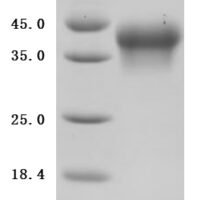
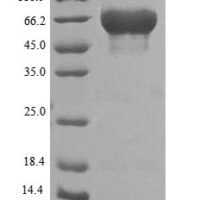
SDS-PAGE: Single band at expected molecular weight confirming purity.

ELISA: Suitable as coating antigen or detection standard.

Western Blot: Compatible with standard Western Blot protocols.

Protein Interaction: Validated for SPR (Surface Plasmon Resonance) and BLI (Bio-Layer Interferometry) studies.

Shipping: Shipped at ambient temperature. Lyophilized protein is stable during transit.

Storage: Store lyophilized protein at -20°C to -80°C. Reconstituted protein should be aliquoted and stored at -80°C. Avoid repeated freeze-thaw cycles.

Shelf Life: 12 months from date of receipt when stored as recommended.

Shipping Time: Orders placed before 2 PM EST ship same day. International orders typically deliver within 5-10 business days.

Protein Biology

Function

Myosin regulatory subunit that plays an important role in regulation of both smooth muscle and nonmuscle cell contractile activity via its phosphorylation. Implicated in cytokinesis, receptor capping, and cell locomotion (PubMed:11942626, PubMed:2526655). In myoblasts, may regulate PIEZO1-dependent cortical actomyosin assembly involved in myotube formation (By similarity)

Subcellular Location

Cytoplasm, cytoskeleton; Cytoplasm, cell cortex

Disease Association

Megacystis-microcolon-intestinal hypoperistalsis syndrome 4 (MMIHS4) : A form of megacystis-microcolon-intestinal hypoperistalsis syndrome, a congenital visceral myopathy primarily affecting females, and characterized by loss of smooth muscle contraction in the bladder and intestine. Affected individuals present at birth with functional obstruction of intestine, microcolon, dilation of bladder, and secondary hydronephrosis. The majority of cases have a fatal outcome due to malnutrition and sepsis, followed by multiorgan failure. MMIHS4 inheritance is autosomal recessive. [The disease may be caused by variants affecting the gene represented in this entry]

Tissue Specificity

Smooth muscle tissues and in some, but not all, nonmuscle cells

Subunit

Myosin is a hexamer of 2 heavy chains and 4 light chains: interacts with myosin heavy chain MYO19 (By similarity). Interacts with LUZP1; the interaction results in inhibition of phosphorylation of MYL9 by DAPK3 (PubMed:38009294)

Gene: MYL9  |  Organism: Homo sapiens  |  Synonyms: 20 kDa myosin light chain; MLC-2C; Myosin RLC; Myosin regulatory light chain 2, smooth muscle isoform; Myosin regulatory light chain 9; Myosin regulatory light chain MRLC1
Key Publications

Frequently Asked Questions

How do I order or inquire about this product?

Fill out the Online Inquiry form with your required quantity and specifications. You can also email sales@biocrestsci.com. Our team typically responds within 4 business hours with a quote and availability confirmation.

What is the shipping and delivery time?

Orders placed before 2 PM EST ship the same day. Domestic (US) delivery typically takes 2-3 business days. International orders deliver within 5-10 business days. All products are shipped at ambient temperature with appropriate packaging to ensure stability.

How should I store this recombinant protein?

Lyophilized proteins should be stored at -20°C to -80°C upon receipt. After reconstitution, aliquot and store at -80°C. Avoid repeated freeze-thaw cycles. Shelf life is 12 months from date of receipt when stored as recommended.

What quality controls are performed on your products?

Each product undergoes SDS-PAGE purity analysis (typically >85-95%), endotoxin testing, and bioactivity validation. Products are validated for ELISA, Western Blot, and SPR/BLI applications as specified on this product page. A Certificate of Analysis (CoA) is available upon request.

Shopping Cart
Scroll to Top